
_svg.png)
Dubai Commercial Presence Setup: The 2026 Strategic Trend Analysis
Updated: Jul 16
By 2026, the era of treating a Dubai trade licence as a mere administrative checkbox has ended; it is now the strategic cornerstone of a sophisticated global wealth plan. You likely recognise that the UAE offers unparalleled growth potential, yet the fear of a complex Dubai commercial presence setup often stalls the most ambitious expansion plans. It’s frustrating to watch banking delays and regulatory friction hold your capital hostage whilst your competitors move at light speed.
We’re here to dismantle those barriers. You’ll discover how to master the 2026 landscape with an infrastructure that secures a 100% foreign-owned entity, functional business banking, and residency in under a month. This strategic analysis deconstructs current trends, providing a definitive blueprint to integrate your UK base with a high-performance UAE presence designed for rapid advancement and total market agility.
Table of Contents
The Evolution of Dubai Commercial Presence Setup: 2026 Strategic Trends
The definition of a Dubai commercial presence setup has transformed from a simple tax-efficiency play into a high-stakes strategic asset. UK entrepreneurs are increasingly positioning Dubai as their secondary operational hub to bypass European trade friction and tap into high-growth emerging markets. In 2026, success isn't defined by having a licence; it's defined by having a functional, mid-shore entity that satisfies global transparency standards whilst maintaining maximum agility. This shift requires a move away from legacy 'offshore' thinking toward a model rooted in substance, banking reliability, and digital integration.
The Impact of the D33 Economic Agenda
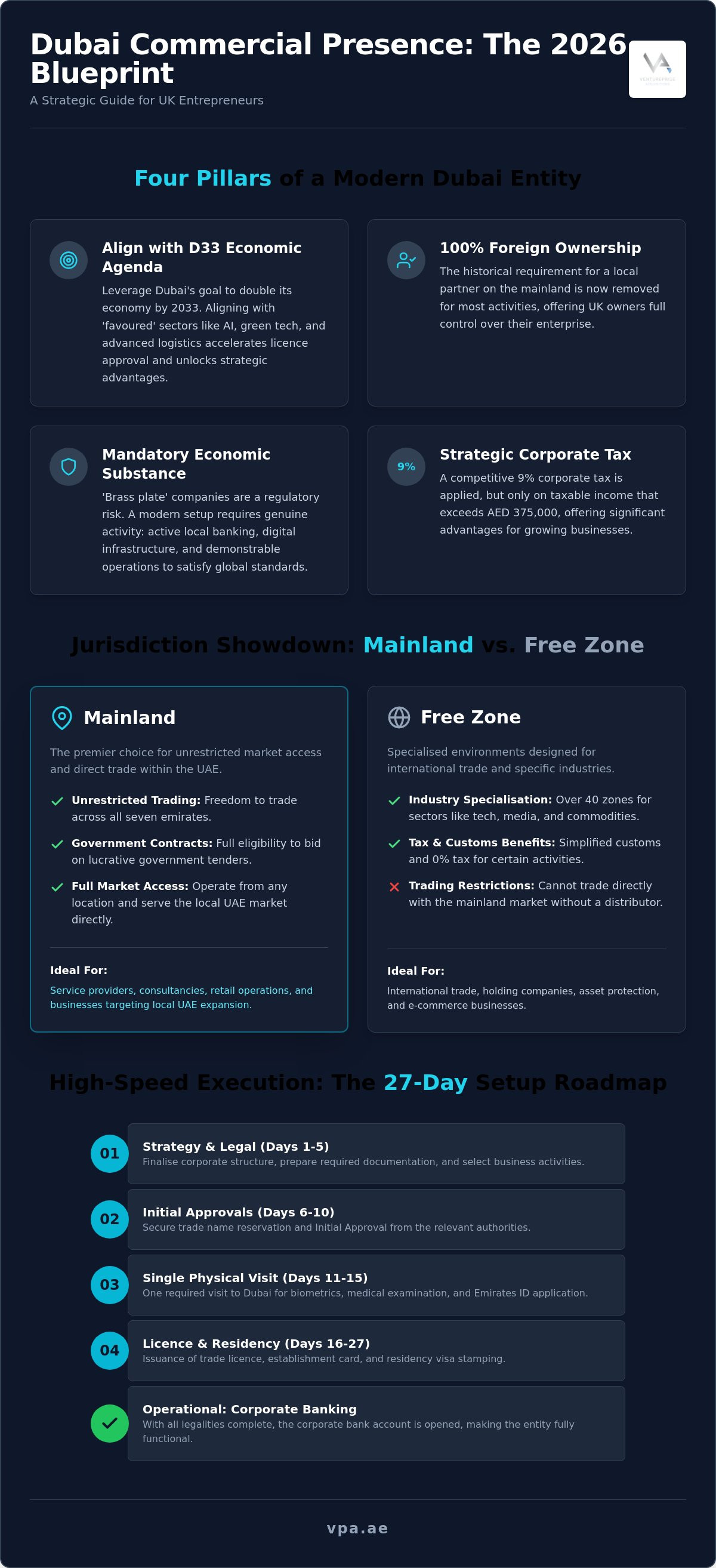
The Dubai Economic Agenda (D33) serves as the primary catalyst for current setup trends, aiming to double the size of Dubai's economy by 2033 through a massive injection of foreign direct investment. The D33 Agenda dictates that foreign direct investment must reach specific targets across 100 transformative projects to double the emirate's GDP by 2033. This government-led growth creates 'favoured' sectors, particularly in AI, green tech, and advanced logistics. Aligning your business with these national goals doesn't just provide a moral compass; it accelerates your licence approval process and places you within an ecosystem designed for rapid scaling. By understanding the nuances of UAE corporate law, you can position your firm within these high-priority categories to unlock strategic advantages that competitors often overlook.
Substance Requirements and Global Transparency
The transition to a 'mid-shore' jurisdiction is a response to the global demand for financial integrity. You can't rely on 'brass plate' companies anymore; they're a significant regulatory risk. Modern Economic Substance Regulations (ESR) require UK-owned entities to demonstrate genuine activity within the UAE to maintain their standing. Building a legitimate Dubai commercial presence setup involves more than just a virtual office. It requires:
Active, local business banking with established institutions to facilitate international trade.
Robust digital infrastructure that integrates seamlessly with UAE government platforms.
Strategic company formation that accounts for the 9% corporate tax threshold on income exceeding AED 375,000.
This commitment to substance ensures your business remains resilient against international tax scrutiny. It secures your long-term operational viability whilst providing the transparency that modern banking institutions demand before opening corporate accounts.
Navigating the Structural Choice: Mainland vs Free Zone for Remote Owners
Choosing the right vehicle for your Dubai commercial presence setup is no longer a binary choice between cost and speed. It's a high-level strategic decision that dictates your market access, tax efficiency, and long-term scalability. In 2026, the mainland advantage has shifted significantly. Most business activities on the mainland now permit 100% foreign ownership, removing the historical requirement for a local partner. By following the official steps to start a business on the mainland, you gain the freedom to trade across all seven emirates and bid for lucrative government contracts without the geographical restrictions inherent to free zones.
Free zones remain highly agile environments, with over 40 specialised jurisdictions catering to specific industries like tech, commodities, or media. However, they're often more restrictive regarding local UAE trade. For entrepreneurs focused on asset protection and wealth structuring rather than daily operations, a Dubai holding company setup often proves superior to an operational branch. This structure allows you to consolidate international assets under a stable UAE umbrella whilst navigating the 9% corporate tax landscape, which applies to taxable income exceeding AED 375,000.
The Remote Owner’s Decision Framework
Accessing the local UAE market is the primary differentiator in your framework. If your revenue is entirely international, a free zone's streamlined customs and zero-tax environment for certain activities might suffice. However, if you're eyeing local expansion or government tenders, mainland is essential. Your UK residency status also influences the "Management and Control" test for tax purposes. You should explore our Dubai company setup solutions to map out a trajectory that aligns with your specific residency and growth goals.
The Hybrid Model: UK Management with UAE Presence
Most UK entrepreneurs don't want to relocate fully, necessitating a hybrid management model. You must organise your board and management structure to satisfy both UK and UAE authorities, ensuring that strategic decisions are documented as occurring within the Emirates. This involves maintaining a legitimate physical presence and potentially appointing local directors. The role of a London based Dubai business advisory is critical here. They act as the bridge that ensures cross-border compliance whilst you manage your empire from the UK. If you're unsure which path fits your 2026 goals, you can speak with our strategic consultants to clarify your options.
Building Your Operational Infrastructure: Banking, HR and IT Consulting
Securing a licence is merely the first step. The true test of a Dubai commercial presence setup lies in the operational infrastructure that supports it. In 2026, the primary hurdle isn't the government; it's the banking sector. Opening a business account has become a minefield of compliance and "Know Your Customer" (KYC) requirements that can stall your momentum for months if handled incorrectly. Beyond finance, you must address data residency laws to ensure your IT infrastructure remains compliant whilst scaling your presence with lean HR strategies that don't require an immediate, massive local headcount.
Securing UAE Business Banking in 2026
To pass KYC faster, UK entrepreneurs must present a "gold standard" documentation pack. This includes clear proof of source of wealth, detailed business plans, and evidence of existing trading history. Traditional banks often require a minimum balance ranging from AED 25,000 to over AED 100,000, maintained as a monthly average. However, the rise of digital-first entities like Wio Bank and Zand Bank has transformed the timeline, often offering zero-balance accounts for qualifying firms. We specialise in aligning your documentation with these evolving standards. See how we handle company formation and banking to bypass these traditional delays.
Strategic Management and Governance
Lean international expansion relies on precision. You can't afford operational bloat. Implementing strategic management consulting in Dubai ensures your entity operates with maximum efficiency from day one. This involves managing remote teams through robust governance frameworks that satisfy both UK and UAE tax authorities. For high-net-worth individuals, this is also the moment to integrate Private Clients Foundations and Trusts. These structures provide an elite layer of asset protection, ensuring your commercial success is shielded by a sophisticated wealth-structuring strategy. If you're ready to build a resilient infrastructure, book a strategic consultation today.
Execution Over Theory: The Direct Path to UAE Residency and Setup
Execution is the only metric that matters when expanding your footprint. Whilst government portals offer a "do it yourself" veneer, they often lack the urgency required by high-value entrepreneurs. A truly elite Dubai commercial presence setup follows a compressed 27-day reality, moving from initial electronic submission to a fully functional residency and operational entity. Success in this ecosystem depends on eliminating the middlemen who thrive on administrative friction. By leveraging direct authority relationships, you bypass the generic "apply and wait" queues and move straight to results.
The Step-by-Step Direct Route
Precision timing is the hallmark of a professional expansion. Your roadmap is divided into clear, actionable phases that respect your time:
Days 1-12: Remote formation. We handle electronic document submission and name approvals whilst you remain in the UK. No travel is required during this initial processing phase.
Days 13-20: Visa generation. Your entry permit is issued, allowing for the finalisation of your travel documents.
The Execution Phase: A focused 4-day on-the-ground sprint in Dubai. This is where your ground game must be flawless, covering medical tests, biometrics for your Emirates ID, and the activation of your corporate banking facilities.
Lifestyle and Relocation Support
Once the foundation is set, your focus must shift to post-setup growth. This involves activating high-level business growth consultancy and wealth management strategies to ensure your UAE entity performs as a robust profit centre. Read more on our business blog about avoiding setup myths and mastering the nuances of the Dubai government ecosystem. We don't just provide a service; we act as your authoritative partner in unlocking the full potential of the Middle East.
Mastering the 2026 Dubai Business Frontier
The 2026 landscape demands more than just a licence; it requires a sophisticated, transparent infrastructure that aligns with the D33 Agenda. You've seen that success hinges on choosing the right jurisdiction, whether that's mainland for total market access or a specialised free zone for industry agility. Navigating the banking minefield and building local substance are no longer optional hurdles but essential steps in securing your global legacy.
We specialise in accelerating this transition. As a UK-rooted firm with a dedicated on-the-ground presence, we dismantle the barriers that slow your progress. Our direct authority relationships allow us to bypass traditional middlemen and deliver a 27-day end-to-end timeline for your Dubai commercial presence setup. You don't have to navigate this alone or settle for administrative delays.
Take the decisive step toward your next phase of growth. Secure your Dubai commercial presence with Ventureprise Acquisitions and transform your international strategy into a high-performance reality. Your expansion starts now.
Frequently Asked Questions
Do I need to live in Dubai to maintain my commercial presence?
No, you aren't required to be a full-time resident to maintain your entity, but you must satisfy Economic Substance Regulations. This requires demonstrating that your core income-generating activities occur within the UAE. Whilst residency is often essential for the primary bank account signatory to ensure operational stability, you can manage the strategic direction of your firm from the UK or elsewhere.
Can I own 100% of my Dubai company as a UK citizen in 2026?
Yes, you can maintain 100% ownership of your entity in 2026. Recent regulatory shifts have removed the requirement for local Emirati partners for the vast majority of commercial activities on the mainland. This ensures that UK entrepreneurs retain total control over their equity and strategic decisions, allowing for a seamless integration into your global portfolio without the need for local intermediaries.
How much does a Dubai commercial presence setup actually cost?
Total costs depend on your specific jurisdiction and activity. Mainland licenses generally range from AED 10,000 for professional services to AED 25,000 for general trading. Free zone fees vary from AED 8,000 in northern emirates to over AED 50,000 in premium Dubai hubs like DMCC. You must also factor in establishment cards, which cost approximately AED 2,000, and individual visa processing at roughly AED 5,000 per person.
What is the difference between a Dubai Free Zone and Mainland setup for a remote owner?
The distinction centres on trade permissions and regulatory scope. Mainland structures allow you to trade across all seven emirates and bid for government tenders, whilst free zones are primarily designed for international trade. For remote owners, a Dubai commercial presence setup in a free zone offers streamlined digital processing, but mainland provides the ultimate flexibility if you intend to tap into the local UAE economy.
How long does it take to get a business bank account in Dubai?
Opening a corporate account usually takes between four and twelve weeks. Whilst digital-first banks have reduced this timeline for simple structures, traditional institutions perform exhaustive checks that require professional documentation. Success in your Dubai commercial presence setup depends on having a resident signatory and a clear audit trail. We bypass these delays by ensuring your documentation meets the high standards required by UAE compliance departments.


Comments