
_svg.png)
Dubai Company Compliance: The 2026 No-Nonsense Guide
- Aug 18
- 8 min read
Your Dubai trade licence isn't just a piece of paper; it's a strategic fortress that, if left unmaintained, can crumble into a liability overnight. You've likely felt the weight of shifting regulations, especially with the 2026 corporate tax landscape creating a new layer of complexity for international founders. It's exhausting to navigate these hurdles whilst dealing with agents who offer vague advice and even less accountability. We understand that the fear of hidden fines or a compromised residency is a distraction you can't afford.
This guide is your definitive roadmap to mastering annual compliance for Dubai company entities in 2026. You'll gain a clear, no-nonsense calendar of mandatory filings and tax obligations designed to keep your entity shielded and operational. We'll dismantle the confusion surrounding the 9% corporate tax threshold and provide a precise strategy for navigating the new AML and UBO mandates. By the end of this article, you'll have the exact keys needed to eliminate regulatory friction and protect your UAE residency with absolute certainty.
Table of Contents
Maintaining Your Commercial Shield: Trade Licences and Residency
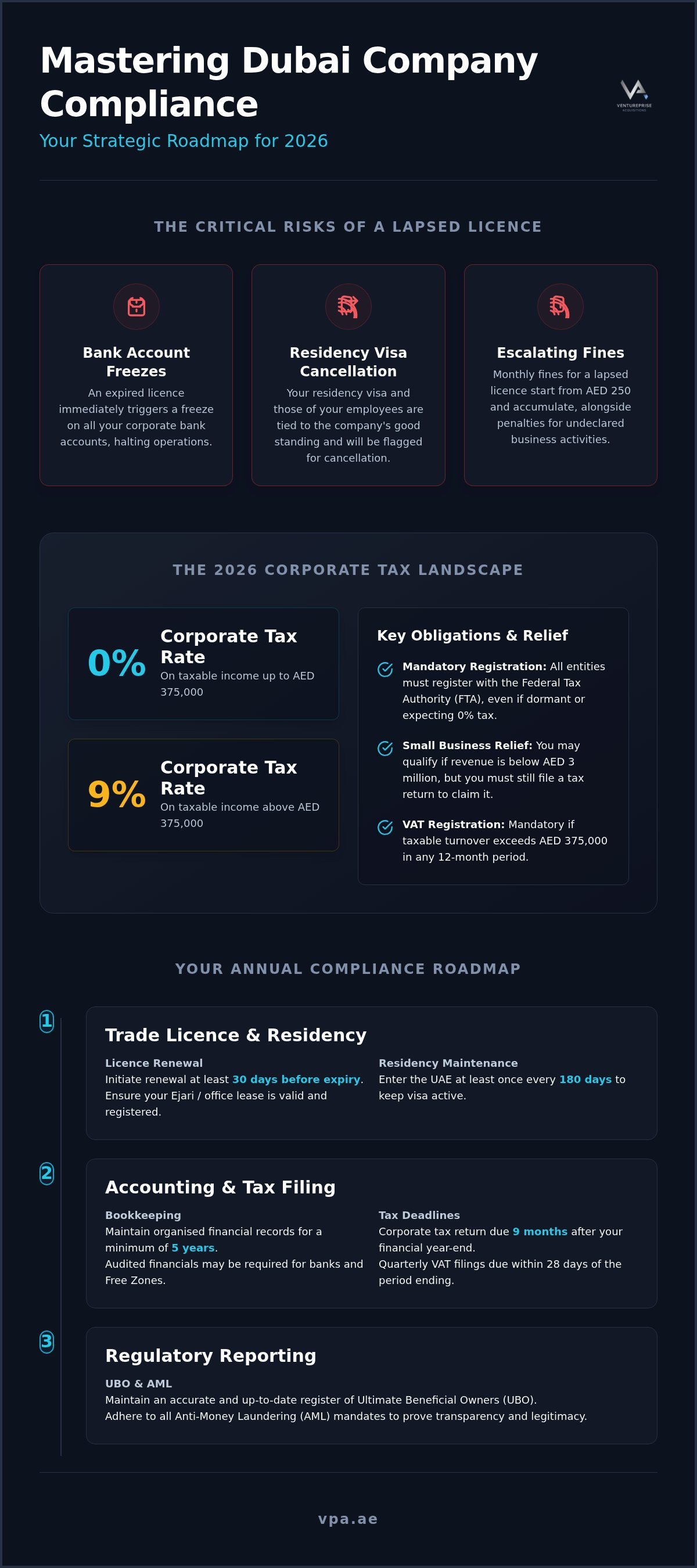
Your trade licence is the bedrock of your presence in the Emirates. Under the UAE Commercial Companies Law, maintaining a valid permit is mandatory for any legal operation. Timing is more critical than the fee itself. A lapsed licence doesn't just incur a monthly fine starting from AED 250; it triggers a cascade of failures. Your corporate bank accounts will be frozen, and your residency visas will be flagged for cancellation. Ensuring seamless annual compliance for Dubai company operations means initiating the renewal at least 30 days before expiry to avoid these operational roadblocks.
Licence Renewal and Activity Audits
Business models evolve, but licences often stagnate. Entrepreneurs frequently face heavy fines for "activity creep" because their operations no longer match their registered categories. Conduct a rigorous audit of your activities before you pay the renewal fee. Additionally, ensure your Ejari or office lease is registered well in advance. The system is now fully integrated; a missing or expired lease will instantly block your licence renewal, leaving your business in a legal vacuum.
Residency Maintenance for Remote Owners
Maintaining UAE residency whilst based in London requires tactical planning. The "180-day rule" dictates you must enter the UAE at least once every six months to keep your visa active. It's a non-negotiable requirement for anyone holding a residency permit. Ventureprise eliminates the friction of these mandatory visits by streamlining the biometrics and medical processes. We've reduced medical tests to eight minutes and biometrics to fifteen, ensuring your compliance trip is a minor pitstop rather than a week-long administrative ordeal. This "Remote Start" capability for renewals means you can initiate the process from the UK, flying in only when physical presence is legally required. Discover how our strategic management solutions handle this ground-level bureaucracy on your behalf.
Navigating the 2026 Tax and Accounting Mandates
Tax neutrality in Dubai is no longer an automatic right; it's a status that must be actively defended through precise reporting. The Federal Tax Authority (FTA) has transitioned to a rigorous enforcement model, making annual compliance for Dubai company owners a matter of detailed documentation rather than just renewal fees. Failure to register for corporate tax, even for dormant or tax-exempt entities, now carries immediate financial penalties.
Corporate Tax Registration and Filing
Registration is mandatory for all entities, regardless of whether you expect to pay tax. For a business with a financial year ending 31 December 2025, your first return and payment are due by 30 September 2026. The 0% rate applies to taxable income up to AED 375,000, whilst anything above attracts a 9% levy. If your revenue is below AED 3 million, you may qualify for Small Business Relief, but you must still file a return to claim it.
Bookkeeping and Audit Requirements
The days of "shoebox accounting" are over. You must maintain organised financial records for at least five years to withstand a potential FTA audit. For those seeking "Qualifying Free Zone Person" status to maintain 0% tax on international income, audited financial statements are often non-negotiable. Banks also require these documents to keep your corporate facilities operational. Don't assume your Free Zone status exempts you from these record-keeping standards.
VAT registration is mandatory once your taxable turnover exceeds AED 375,000 in a 12-month period. Late registration fines are aggressive and retroactive. Quarterly filings must be submitted within 28 days of the period ending. Mastering these mandates is now the most critical component of annual compliance for Dubai company entities. If the prospect of managing these deadlines whilst running your UK operations feels overwhelming, you can consult our strategic management team to automate your tax roadmap.
The Regulatory Minefield: ESR, UBO, and AML Obligations
Transparency is the new global currency. The UAE's strategic alignment with international standards has accelerated a shift towards rigorous non-financial reporting. Maintaining annual compliance for Dubai company entities now requires navigating a complex web of Ultimate Beneficial Ownership (UBO) and Anti-Money Laundering (AML) mandates that extend far beyond simple tax filings. These regulations are designed to ensure your business isn't just a "brass plate" but a legitimate, transparent operation.
Proving Economic Substance in 2026
While Cabinet Decision No. 98 of 2024 simplified the landscape by removing ESR notification requirements for new financial years, the underlying principle of substance remains critical for tax residency. You must still demonstrate that your Core Income Generating Activities (CIGA) are managed within the Emirates to benefit from international double tax treaties. Historical compliance for the 2019 to 2022 period remains auditable. Failure to have met these standards in the past can still trigger six-figure fines today, making a retrospective audit of your records a vital safety measure.
UBO and Transparency Mandates
Transparency isn't optional. You must maintain a Register of Partners and a Register of UBO at your registrar's level. Any change in ownership or control, defined as 25% or more of shares or voting rights, must be reported within 15 days. Failure to update this register isn't just a minor oversight; second-time violations trigger fines of AED 50,000, whilst a third offence can lead to a 12-month licence suspension. High-value traders and specific service providers must also register with the goAML portal under Federal Decree-Law No. 10 of 2025 to report suspicious transactions. This "hidden" calendar of deadlines is where most remote owners falter. If your compliance framework hasn't been updated for these 2026 standards, contact our strategic management specialists to audit-proof your entity before the next regulatory window.
Executing Compliance: A Strategic Roadmap for Remote Owners
Managing annual compliance for Dubai company structures requires more than just ticking boxes on government portals. These digital interfaces are often a labyrinth for international users lacking local presence. A "set and forget" mentality is the fastest route to bank account freezes and cancelled visas. Instead, you need a proactive 12-month calendar anchored to your specific licence issuance date. This ensures every filing, from UBO updates to tax returns, occurs within the legal window.
The Ventureprise Model for Automated Governance
We act as your direct liaison with UAE authorities, bypassing the middleman extortion that often plagues the industry. Our Strategic Management Consulting ensures your corporate structure is optimised for the 2026 fiscal environment. We handle the ground-level bureaucracy whilst you remain focused on your UK operations. This direct government liaison eliminates the noise and ensures that annual compliance for Dubai company entities is handled with surgical precision.
Moving Forward: Beyond Simple Filings
Compliance is the foundation of long-term stability and scaling. Once your entity is bulletproof, you can leverage that status for sophisticated Private Client Wealth Structuring and family foundations. This transition from basic setup to strategic wealth management is where true professional potential is unlocked. It's about moving from a reactive state to a position of strength where your UAE entity serves as a global asset.
Don't wait for a penalty notice to arrive. Take control of your entity's future today. A 15-minute consultation with our on-the-ground team will audit your current status and provide a definitive path forward. We dismantle the barriers between you and a perfectly compliant Dubai presence.
Transform Compliance Into Your Competitive Advantage
Maintaining a bulletproof presence in the Emirates is no longer about reactive filings; it's about strategic foresight. You've seen how the 2026 corporate tax roadmap and rigorous UBO transparency mandates have fundamentally changed the rules of the game. Mastering annual compliance for Dubai company structures is the only way to safeguard your international tax neutrality and residency status. Neglecting these shifts invites operational paralysis through frozen accounts and cancelled visas.
Ventureprise Acquisitions bridges the gap between your UK base and the UAE authorities. With our deep UK roots and local Dubai presence, we act as your direct government liaison to eliminate middlemen and administrative friction. We specialise in remote residency maintenance, ensuring your on-the-ground obligations are met whilst you focus on global growth. Don't leave your entity's survival to chance or unreliable third-party agents. Take the first step towards absolute regulatory certainty today.
Get your 2026 Dubai compliance audit with Ventureprise and secure your professional future.
Frequently Asked Questions
Do I need to be physically present in Dubai to renew my company licence in 2026?
No, you don't need to be in the UAE to renew your trade licence. The process is entirely digital and can be managed whilst you are in the UK. However, you must ensure your registered office lease or flexi-desk agreement is current, as the Ejari system is now fully integrated with the licensing portals. Any lapse in your tenancy will automatically block the renewal of your commercial permit.
What are the penalties for missing an ESR filing for a Free Zone company?
Whilst Cabinet Decision No. 98 of 2024 removed ESR notification requirements for new financial years, historical compliance remains a significant risk. If you failed to file a report for the 2019 to 2022 period, you could face legacy fines starting at AED 50,000. Second-time offences for these historical periods can escalate to AED 400,000, making it vital to audit your past filings to ensure no liabilities remain hidden.
Is corporate tax mandatory for all Dubai companies in 2026?
Corporate tax registration is mandatory for every entity, even if you expect your liability to be zero. You must register with the Federal Tax Authority (FTA) regardless of your revenue levels. Filing an annual return is a non-negotiable part of annual compliance for Dubai company owners. Failing to register before your specific deadline, which is based on your licence issuance month, results in an immediate AED 10,000 penalty.
How often must I enter the UAE to keep my residency visa valid?
You must enter the UAE at least once every 180 days to keep your residency permit active. If you exceed this window, your visa is automatically cancelled, which triggers a cascade of issues including the freezing of your corporate bank accounts. We mitigate this risk for remote owners by coordinating the renewal process and streamlining biometrics, ensuring your mandatory entry is a brief, efficient stop on your global travel schedule.
Can I manage my Dubai company compliance from the UK without a local partner?
Technically you can access government portals from abroad, but managing annual compliance for Dubai company structures without on-the-ground support is high-risk. Local systems like goAML and the UBO register require precise, timely updates that are difficult to coordinate from a distance. A local partner acts as your direct government liaison, removing the administrative burden and ensuring you avoid the escalating fines associated with late filings or misclassified business activities.


Comments