
_svg.png)
Dubai Foundations for Asset Protection: The 2026 Strategic Reference Guide
- 4 days ago
- 8 min read
Updated: 7 hours ago
Your wealth isn't truly secure if it's still legally tied to your personal identity. Whilst many high-net-worth individuals rely on standard holding companies, the most sophisticated global investors are now pivoting to Dubai foundations for asset protection to ensure their legacy remains untouchable. You've likely felt the mounting pressure of shifting UAE regulations or the nagging fear that a single commercial liability could dismantle decades of achievement. It's a valid concern; the risk of asset fragmentation during succession is a reality that many entrepreneurs simply aren't prepared to face.
This guide provides the strategic blueprint you need to ring-fence your capital and secure your family's future using the region’s most robust "orphan" legal structures. You'll discover exactly how these self-owning entities operate and gain a definitive framework for choosing between the DIFC and ADGM jurisdictions. We're moving beyond the basics to give you the confidence that your legacy is legally bulletproof and ready for the challenges of 2026 and beyond.
Table of Contents
What are Dubai Foundations? Defining the "Orphan" Entity for 2026
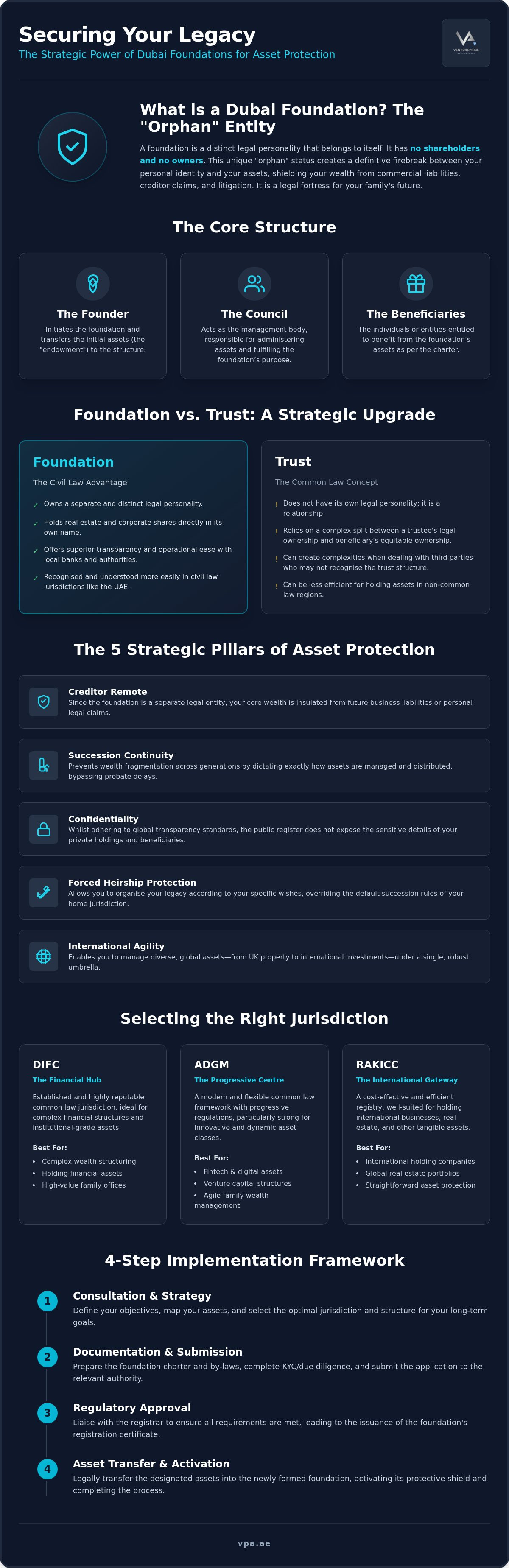
A foundation is a distinct legal personality that, quite literally, belongs to itself. Unlike a traditional company, it has no shareholders and no owners. This unique "orphan" status is what makes Dubai foundations for asset protection a superior choice for high-net-worth individuals. By segregating your personal wealth from your commercial interests, you create a definitive litigation firebreak that shields your core capital from external threats. It isn't just a legal vehicle; it's a fortress for your family's future.
The structure relies on three key components to function effectively. The Founder initiates the foundation and provides the initial assets; the Council acts as the management body responsible for fulfilling the foundation’s purpose; and the Beneficiaries are the individuals or entities entitled to benefit from the assets. For many UK entrepreneurs, this clarity of structure is replacing the traditional trust as the preferred vehicle for private client wealth structuring. It provides the control you need without the personal liability you don't.
Foundation vs. Trust: The Civil Law Advantage
The shift from common law trust concepts to the civil law foundation model isn't just a matter of semantics. It's a strategic upgrade. Whilst a trust relies on the complex split between legal and beneficial ownership, a foundation holds real estate and corporate shares directly in its own name. This makes Dubai foundations for asset protection far more efficient when dealing with local land departments or third-party banks in the Dubai International Financial Centre (DIFC). You gain a level of transparency and operational ease that traditional trusts simply can't match.
The 2026 Regulatory Landscape
The UAE’s legal evolution has outpaced many traditional offshore hubs. By 2026, the regulatory framework in Dubai has become significantly more robust than classic "tax haven" alternatives, offering a sophisticated environment for complex asset holdings. An Orphan Entity is a self-owning legal structure that severs the link between personal ownership and asset control, effectively acting as the primary mechanism for asset protection in 2026. This evolution ensures that your assets remain secure, regardless of how the global legal climate shifts.
The 5 Strategic Pillars of Asset Protection via Foundations
Establishing Dubai foundations for asset protection isn't just a legal formality; it's a strategic move to build an impenetrable wall around your capital. By 2026, the UAE has refined its framework to offer five core pillars that outperform traditional offshore structures. First, your assets become creditor remote. Since the foundation is a separate legal entity, your core wealth is insulated from future business liabilities or aggressive legal claims targeting you personally. Succession continuity ensures that family wealth doesn't fragment across generations. You can dictate exactly how assets are managed and distributed, bypassing the administrative delays of probate.
When ring-fencing global capital, it is critical to perform due diligence on all existing legal risks; for those with Brazilian interests, you can explore Consulta Jurídica Completa CPF e CNPJ to ensure no outstanding claims compromise your new structure.
Confidentiality remains a priority for high-value families. Whilst the UAE adheres to global transparency standards, the public register doesn't expose the sensitive details of your private holdings. Forced heirship protection is perhaps the most vital tool for international families. It allows you to organise your legacy according to your specific wishes, overriding the default rules of your home jurisdiction. Finally, these structures offer unparalleled international agility, allowing you to manage diverse assets under a single, robust umbrella. These benefits of a UAE foundation provide the long-term stability required in an increasingly volatile global market.
Bridging UK and UAE Assets
Many UK entrepreneurs find themselves trapped between two legal systems. You can wrap UK-based assets within a Dubai foundation to gain international agility and protection. This approach is a core part of effective Succession Planning for Dubai Businesses: The 2026 Strategic Checklist. It ensures your global portfolio moves as one cohesive unit, regardless of where individual assets are located, providing a seamless transition for future generations.
Protection from Marital and Family Claims
The "self-owning" nature of Dubai foundations for asset protection cushions against claims from marital gain equalisation. Because the assets don't belong to you personally, they aren't easily considered part of a matrimonial pool during disputes. We ensure the Council is structured to prevent internal familial disagreements from paralysing assets. This keeps your capital productive even during periods of personal turmoil. If you're ready to secure your family's future, speak with our private client team.
Selecting the Right Jurisdiction: DIFC, ADGM, or RAKICC?
Choosing between the three primary UAE jurisdictions is a strategic decision that defines the structural integrity of your wealth. The DIFC remains the gold standard for entrepreneurs requiring deep common law integration and high prestige; it's the ideal choice for holding shares in major corporate entities. Conversely, the ADGM is often the preferred choice for complex investment holdings and family office structures, especially following the 2026 regulatory updates that clarified beneficial ownership requirements. For those seeking to hold international assets without a physical UAE presence, RAKICC offers a cost-effective alternative with registration fees starting at AED 1,500.
Don't fall into the "minefield" of selecting a jurisdiction based on price alone. This short-sighted approach often leads to operational failure, as a mismatch between the jurisdiction's rules and your specific asset types can complicate banking or future transfers. Jurisdiction choice should be dictated by the location of the assets, not the location of the founder. Selecting the wrong centre can result in unnecessary administrative friction that undermines the very security you're trying to build.
Corporate Tax and Foundations in 2026
The UAE’s tax landscape has shifted, making it vital to understand how the 9% corporate tax threshold affects your holdings. Foundations are generally tax-neutral, but commercial activities or real estate income exceeding the AED 375,000 threshold now require careful management. Implementing the right private client wealth structuring Dubai is essential to remain compliant whilst ensuring your capital continues to grow without unnecessary leakage.
Operational Excellence in Governance
The resilience of Dubai foundations for asset protection rests on the Council and the Guardian. The Council acts as the management body, whilst the Guardian provides an essential layer of oversight to ensure the Founder’s original intent is never compromised. This dual-governance model prevents the structural drift that often plagues less regulated jurisdictions. If you're ready to determine which jurisdiction fits your portfolio, consult with our strategic planning team today.
Implementation Strategy: Bypassing the Administrative Minefield
The reality of UAE bureaucracy is that it remains unforgiving to the unprepared. A "DIY" approach to setup often results in rejected applications, significant delays, and missed strategic opportunities. Professional wealth structuring requires more than just a basic understanding of the law; it demands an intimate knowledge of the current 2026 regulatory environment. By leveraging local expertise, you ensure your structure is "on the ground" and fully operational from the moment of registration. Ventureprise Acquisitions removes the professional barriers that often stall international clients, providing a clear path to elite wealth management.
Our proven 4-step execution path moves you from concept to capital protection with surgical precision. We begin with strategic design, move through jurisdictional application, oversee the formal transfer of assets, and conclude with banking activation. This methodical approach ensures that your Dubai foundations for asset protection are not just legal on paper, but functional in practice. We act as your authoritative partner, ensuring that every administrative hurdle is cleared before it can impact your timeline or your legacy.
Drafting the Charter and By-laws
Avoiding generic templates is critical for long-term security. A template might seem convenient, but it often leaves your assets exposed to legal challenge because it fails to account for your specific commercial risks. You must customise the "purpose" of the foundation to align with your long-term expansion goals and family requirements. We ensure every clause is drafted to withstand scrutiny, providing the flexibility you need whilst maintaining an impenetrable legal firebreak.
Banking and Substance Requirements
Opening and operating a bank account in 2026 requires more than a simple certificate of incorporation. You need to demonstrate genuine substance and clear governance to satisfy modern compliance standards. For those considering more complex arrangements, exploring asset protection trusts Dubai can provide a hybrid solution that enhances your overall security. Discover our bespoke wealth structuring solutions to see how we streamline this entire process, allowing you to focus on growth rather than administration.
Securing Your Legacy: The Path to Absolute Wealth Protection
Building a future-proof estate requires more than just capital; it demands a structure that can withstand the legal and commercial pressures of a global economy. We've explored how the "orphan" nature of Dubai foundations for asset protection provides a definitive firebreak, separating your personal identity from your business risks. Whether you opt for the prestige of the DIFC or the investment flexibility of the ADGM, your success depends on choosing a jurisdiction that aligns with your specific asset types whilst supporting your long-term expansion goals.
Don't let administrative complexity or generic templates leave your wealth exposed. With our UK roots and physical presence on the ground in Dubai, we provide the direct, results-driven advisory needed to navigate the 2026 regulatory landscape with certainty. We dismantle the professional barriers that stall progress, ensuring your structure is fully operational and banking-ready from day one. Secure your global legacy with a bespoke Dubai foundation strategy; contact Ventureprise Acquisitions today. Your family's future deserves the security of a structure that truly belongs to itself.
Frequently Asked Questions
Is a Dubai foundation better than a British Virgin Islands (BVI) trust?
A Dubai foundation often outperforms a BVI trust when holding tangible assets like regional real estate or corporate shares directly. Unlike a trust, which relies on the trustee’s legal ownership, a foundation possesses its own distinct legal personality. This makes it significantly easier to navigate banking and property registration within the UAE and broader Middle East, as the structure is recognised as a corporate body rather than a private contract.
Can I move my existing UK company shares into a Dubai foundation?
You can move existing UK company shares into a foundation, though the transfer must be handled with precision to account for UK tax implications like Capital Gains Tax. Using Dubai foundations for asset protection for international holdings creates a robust litigation firebreak. This strategy effectively isolates your UK commercial risks from your core wealth, ensuring that a professional setback in one jurisdiction doesn't dismantle your global legacy.
Do I need to be a UAE resident to set up a foundation for asset protection?
What is the minimum asset value required to make a foundation viable in 2026?
There is no strict legal minimum asset value, and RAKICC foundations can be established with a nominal capital of just USD 100. However, viability is typically a question of cost versus benefit; the structure becomes a strategic necessity when your assets reach a level where personal liability or succession fragmentation poses a genuine risk. For most high-net-worth individuals, the peace of mind provided by Dubai foundations for asset protection far outweighs the annual administrative costs.
How much control does the Founder actually retain over the foundation assets?
Founders retain significant control by reserving specific powers within the foundation’s Charter and By-laws. You can appoint yourself to the Council or act as a Guardian to oversee all management decisions and ensure the foundation’s purpose is fulfilled. This dual-governance model ensures that whilst the assets are legally "orphaned" to provide protection, the strategic direction remains firmly under your influence throughout your lifetime.


Comments