
_svg.png)
Dubai HR Strategy for Startups: The 2026 Strategic Execution Guide
- 2 days ago
- 11 min read
Your Dubai startup doesn't have an HR problem. It has a compliance time bomb. Every month you operate without a bulletproof Dubai HR strategy for startups, you're exposed to regulatory penalties that can cripple your cash flow before you've even hit your first growth milestone. The UAE's labour framework is precise, unforgiving, and built for businesses that take it seriously from day one.
You already know this isn't a market where you can improvise your people operations. The Emiratisation quota system, the Wage Protection System, and the complexities of managing a genuinely multicultural workforce aren't bureaucratic footnotes; they're the architecture your entire scaling strategy rests upon. Get them wrong, and the fines, visa blocks, and reputational damage follow fast.
This guide cuts through the jargon and gives you a practical, 2026-ready framework to build a compliant, scalable HR function without the legal friction that slows most founders down. You'll learn exactly how to structure your contracts, meet your Emiratisation obligations, and attract global talent whilst keeping your operation watertight. Consider this your strategic execution playbook for building a team in Dubai the right way.
Table of Contents
Beyond the Minefield: Why Dubai HR Strategy in 2026 is Different
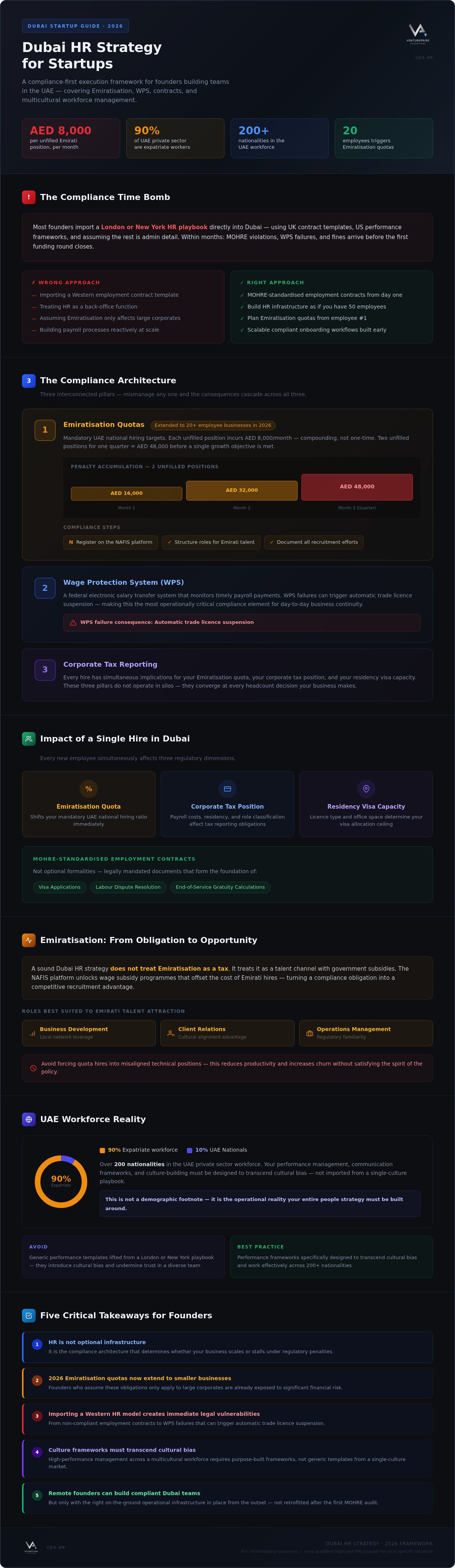
Most founders arrive in Dubai with an HR playbook built for London or New York. They template their employment contracts from a UK model, set up a performance review cycle borrowed from a US accelerator, and assume the rest is administrative detail. Within months, they're facing Ministry of Human Resources and Emiratisation (MOHRE) violations, Wage Protection System failures, and fines that hit before their first funding round closes. This isn't bad luck. It's a predictable consequence of applying the wrong framework to a fundamentally different regulatory environment.
A genuine Dubai HR strategy for startups isn't simply a compliance checklist dressed up in strategic language. It's the intersection of federal labour law, the Emiratisation policy framework, corporate tax obligations introduced in recent years, and the operational realities of managing a workforce drawn from across the globe. In 2026, these elements don't operate in separate silos. They converge. A hire you make today has implications for your Emiratisation quota, your corporate tax position, and your residency visa capacity simultaneously. Founders who treat HR as a back-office function rather than a strategic pillar discover this the hard way.
The Multicultural Complexity of the UAE Workforce
Roughly 90% of the UAE's private sector workforce are expatriates, representing more than 200 nationalities. That's not a demographic footnote; it's the operational reality your people strategy must be built around. MOHRE-standardised employment contracts aren't optional formalities. They're legally mandated documents that protect both parties and form the foundation of every visa application, labour dispute resolution, and end-of-service gratuity calculation your business will ever process.
HR as a Pillar of Operational Excellence
The businesses that scale cleanly in Dubai build their HR infrastructure as if they already have fifty employees, even when they're hiring their third. Scalable contracts, compliant onboarding workflows, and properly structured payroll processes don't become important at headcount ten. They become a liability at headcount three if they're wrong. This is the operational philosophy underpinning Strategic Management Consulting in Dubai: get the architecture right first, then build at pace.
Ventureprise operates from exactly this position. Plain English strategy, on-the-ground Dubai expertise, and a direct bias towards execution over deliberation. Because in this market, the cost of delay is never abstract.
Compliance Architecture: Emiratisation, WPS, and Fines
Compliance isn't a background task you delegate to a part-time administrator. In Dubai, it's a live financial exposure that compounds monthly. The regulatory architecture governing your workforce sits across three interconnected pillars: Emiratisation quotas, the Wage Protection System, and corporate tax reporting. Mismanage any one of them, and the consequences cascade across all three.
Avoiding the Monthly AED 8,000 Penalty
The 2026 Emiratisation framework has extended quota obligations to private sector businesses with as few as twenty employees, and the penalty for each unfilled Emirati position is AED 8,000 per month. That's not a one-time fine. It accumulates. A startup with two unfilled quota positions running non-compliant for a full quarter is looking at AED 48,000 in penalties before a single growth objective has been met.
Getting compliant starts with MOHRE registration and accurate headcount classification. Your practical steps:
Register on the NAFIS platform to track your Emiratisation targets in real time and access wage subsidy programmes that offset the cost of Emirati hires.
Structure roles that genuinely attract Emirati talent: think business development, client relations, and operations management rather than forcing quota hires into misaligned technical positions.
Document every recruitment effort. MOHRE audits assess good-faith compliance, and a paper trail of active hiring attempts carries weight.
A sound Dubai HR strategy for startups doesn't treat Emiratisation as a tax. It treats it as a talent channel with government-subsidised acquisition costs, which, framed correctly, is a competitive advantage most founders overlook.
The Wage Protection System (WPS) Workflow
The UAE Central Bank's Wage Protection System requires salary disbursement through approved financial institutions within a mandated timeframe each month. Non-compliance triggers an automatic block on new work permit applications, and persistent failures can escalate to trade licence suspension. For a startup in hiring mode, that's an existential operational risk.
Build your payroll infrastructure around WPS from the outset. Use a MOHRE-approved agent bank, maintain a dedicated payroll account separate from your operational cash flow, and set your payroll cycle to process no later than the fourteenth of each month to create a compliance buffer. Critically, your end-of-service gratuity liability must be calculated and provisioned from each employee's first working day. Under UAE Labour Law, EOSG accrues at twenty-one days' basic salary per year for the first five years of service. Founders who treat this as a future accounting problem rather than a present cash flow obligation routinely hit a liquidity wall when early employees depart.
There's also the corporate tax dimension that most HR guides ignore entirely. Since the introduction of the 9% Federal Corporate Tax, employee cost structures, including gratuity provisions and salary classifications, now carry direct implications for your taxable profit calculation. HR data and tax reporting can no longer operate as separate functions. Your payroll records are simultaneously your compliance evidence for MOHRE and your cost basis for Federal Tax Authority submissions. Integrating these data streams from day one is not administrative overhead; it's the structural foundation of a clean, audit-ready operation.
Choosing between fixed-term and flexible employment contracts adds another layer. Fixed-term contracts, now the standard under the updated UAE Labour Law, provide predictable EOSG calculations and clearer termination frameworks. Flexible contracts suit project-based or part-time arrangements but require precise drafting to avoid misclassification risk. Get the contract architecture right before you make your first hire, not after your third dispute. If you're building this infrastructure and want a clear-eyed assessment of where your current exposure sits, speak with the Ventureprise team before the next payroll cycle.
Building a High-Performance Culture Amongst Global Talent
Culture is not a ping-pong table and a Friday all-hands. In Dubai, where your team might span twelve nationalities, three time zones of origin, and wildly different professional norms, culture is the operational system that determines whether your people pull in the same direction or quietly disengage whilst collecting their tax-free salary. Most startup guides gesture vaguely at "building a great culture" without confronting the specific friction of managing a 90% expat workforce where individual motivations, communication styles, and performance expectations differ significantly by background. A serious Dubai HR strategy for startups addresses this directly.
The transient nature of Dubai's expat market compounds the challenge. Talented professionals arrive with a two-to-three-year horizon in mind. They're optimising for career acceleration, lifestyle, and financial positioning, not long-term loyalty to a brand they've never heard of. Your employer value proposition must compete against multinationals with established reputations, structured career pathways, and benefits budgets that dwarf yours. The answer isn't to outspend them. It's to out-position them.
Talent Acquisition in a High-Velocity Market
Speed is a genuine competitive advantage in Dubai's hiring environment. Senior candidates often hold multiple offers simultaneously, and the gap between first interview and signed contract is where most startups lose the people they actually want. Compress your hiring process ruthlessly: pre-agreed offer parameters, streamlined interview stages, and a clear visa sponsorship timeline communicated upfront. Residency sponsorship is a tangible differentiator for candidates relocating from markets where work authorisation is uncertain or expensive. Use it explicitly in your recruitment messaging, not as a footnote, but as a headline benefit.
Beyond the tax-free salary, the incentive structures that genuinely attract and retain high-performers in this market include:
Equity participation: Even modest ESOP arrangements signal long-term commitment and align interests in ways a salary increment never can.
Education and development allowances: High-calibre candidates in Dubai are actively investing in their own growth; match that ambition.
Lifestyle infrastructure: School fee contributions, private medical cover, and annual flight allowances carry disproportionate weight for relocating professionals with families.
Accelerated responsibility: Startups can offer senior scope that a corporate role never would at the same career stage; make this explicit.
Performance and Behavioural Alignment
Operational excellence in a Dubai startup context means every team member, regardless of cultural background, understands precisely what "good" looks like in measurable, observable terms. That definition cannot live in a founder's head.
Standardise your KPIs around outputs, not behaviours. Behaviour-based metrics introduce cultural bias immediately; what reads as assertive communication in one cultural context reads as aggression in another. Output-based frameworks, tied to specific deliverables, revenue targets, or project milestones, create a shared performance language that transcends those differences. Pair this with structured check-in rhythms that normalise direct feedback across the team, building psychological safety incrementally rather than assuming it exists. This is where a Dubai HR strategy for startups moves from compliance infrastructure into genuine competitive advantage.
If you're ready to build a people architecture that performs as hard as your commercial strategy, speak with the Ventureprise team about structuring your HR function for scale.
Executing Your Strategy: The Ventureprise Remote-First Approach
Most founders building in Dubai aren't physically in Dubai. They're in London, New York, or Singapore, managing a team they see twice a year and relying on WhatsApp updates to know whether their compliance obligations are being met. That gap between strategic intent and on-the-ground execution is where businesses bleed money, miss deadlines, and accumulate the kind of regulatory exposure that no amount of catch-up fixes cleanly.
This is the operational reality that software platforms simply cannot solve. Automating your HR processes is useful. Having someone physically present at a MOHRE office, managing a biometrics appointment, or liaising directly with a government authority on your behalf is an entirely different category of problem. No dashboard resolves that.
Operational Support for Remote Founders
Ventureprise handles the concierge infrastructure that remote founders can't manage from overseas: medical screenings, Emirates ID biometrics, visa status tracking, and direct government liaison that cuts through the queue rather than joining it. The result is a commercial presence that functions as if you're on the ground, without requiring you to be. For founders structuring their Dubai HR strategy for startups from abroad, this isn't a convenience; it's the operational backbone that makes the entire strategy executable.
Establishing that presence without personal relocation is entirely achievable. The architecture exists. What most founders lack is a partner who knows precisely how to activate it, in plain English, without the deliberate complexity that generic agents use to justify their retainers.
Your Direct Path to Scaling
Ventureprise's position is straightforward: strategy without execution is overhead. The only Dubai HR strategy for startups that actually matters is one that gets implemented, compliantly, at pace, without the founder becoming the bottleneck. That's the operating principle behind every engagement.
If you're ready to close the gap between where your people infrastructure is and where it needs to be, explore Ventureprise's end-to-end company setup and operational solutions. The path forward is direct. The only question is when you start.
Your Next Move Defines Your Scaling Trajectory
The gap between a Dubai startup that scales cleanly and one that stalls under regulatory pressure isn't talent or capital. It's infrastructure. A properly executed Dubai HR strategy for startups integrates your compliance obligations, your people architecture, and your commercial ambitions into a single, coherent system that performs under scrutiny.
Three things determine whether you're ahead of this or behind it: your contracts are structured correctly before your next hire, your Emiratisation and WPS obligations are actively managed rather than reactively patched, and your culture framework is built for a genuinely global workforce, not borrowed from a market that doesn't apply here.
Ventureprise brings on-the-ground Dubai specialists and UK-led strategic management expertise to bear on exactly these challenges. Direct paths to residency, compliance, and operational clarity, without the jargon that slows most founders down.
Don't let the next payroll cycle become the moment you discover your exposure. Connect with the Ventureprise team today and build the people infrastructure your growth actually deserves.
Frequently Asked Questions
Does my Dubai startup need to hire Emiratis in 2026?
Yes, and the threshold is lower than most founders assume. The 2026 Emiratisation framework applies to private sector businesses with twenty or more employees, with mandatory quotas that increase annually. Each unfilled position carries a monthly penalty of AED 8,000 per role, which accumulates regardless of whether you're actively recruiting.
The practical move is to register on the NAFIS platform immediately, even before you hit the headcount threshold. It gives you real-time visibility of your obligations and access to wage subsidy programmes that partially offset the cost of compliant Emirati hires. Starting early turns a regulatory obligation into a subsidised talent channel.
What is the Wage Protection System (WPS) and is it mandatory for startups?
WPS is the UAE Central Bank's mandatory salary disbursement system requiring all private sector employers, including startups, to pay wages through approved financial institutions within a specified monthly window. There are no exemptions based on company size or age. Non-compliance triggers an automatic block on new work permit applications, which for a growing team is an immediate operational crisis.
Set up a dedicated payroll account through a MOHRE-approved bank, keep it separate from your operational cash flow, and process payroll no later than the fourteenth of each month to maintain a compliance buffer. This is non-negotiable infrastructure, not optional process.
Can I manage my Dubai HR strategy whilst living in the UK?
A robust Dubai HR strategy for startups is absolutely manageable from the UK, but only with the right on-the-ground infrastructure in place. Government touchpoints such as biometrics appointments, MOHRE registrations, and visa status updates require a physical presence in Dubai that no software platform or remote dashboard can substitute.
Founders who try to manage these processes remotely through email chains and local freelancers typically accumulate delays and compliance gaps that compound quickly. The viable solution is a trusted operational partner with a genuine Dubai presence who can execute those touchpoints on your behalf, keeping your compliance posture clean without requiring you to relocate.
What are the penalties for HR non-compliance in the UAE?
Penalties scale with the severity and duration of the violation. Emiratisation quota shortfalls attract AED 8,000 per unfilled position per month. WPS failures trigger work permit blocks initially, escalating to trade licence suspension for persistent non-compliance. Incorrectly structured employment contracts or unpaid end-of-service gratuity can result in MOHRE-escalated labour disputes, which carry both financial liability and reputational consequences.
The compounding nature of these penalties is the critical point. A startup running two compliance failures simultaneously for six months isn't looking at two problems; it's looking at a cash flow event that can eclipse an entire funding tranche. Proactive compliance architecture costs a fraction of reactive remediation.
How does the 9% Corporate Tax affect my startup payroll and HR?
The Federal Corporate Tax introduced a direct link between your HR records and your tax reporting that most founders haven't fully absorbed. Employee costs, including salary structures, end-of-service gratuity provisions, and allowances, form part of your deductible cost base for Federal Tax Authority submissions. How you classify and document these costs in your payroll system determines your taxable profit calculation.
This means your HR data and your tax reporting can no longer operate as separate functions managed by different people with different spreadsheets. Payroll records are simultaneously your MOHRE compliance evidence and your FTA cost documentation. Integrating these data streams from your first hire isn't administrative overhead; it's the difference between a clean audit and an expensive correction exercise.


Comments