
_svg.png)
Dubai Mainland vs Free Zone Comparison: The 2026 Strategic Framework
- Aug 7
- 8 min read
Choosing between a mainland or free zone setup used to be a simple question of ownership. In 2026, that assumption is not just outdated; it's a strategic liability. You're likely feeling the pressure of the new 9% corporate tax regulations and the anxiety of being locked into a structure that limits your long-term expansion. It's exhausting to navigate hidden setup costs when all you want is a transparent, high-velocity path to UAE residency and global trade.
This Dubai mainland vs free zone comparison dismantles the persistent myths holding entrepreneurs back. You'll identify the exact corporate framework that aligns with your 2026 growth strategy whilst ensuring you remain fully compliant with tax obligations. We provide a blunt assessment of trade rights, a blueprint for remote management from the UK, and the tactical steps to secure your residency in as little as six days. This is about removing barriers and positioning your business as an elite force in a competitive global market.
Table of Contents
Decoding the 2026 Dubai Business Landscape
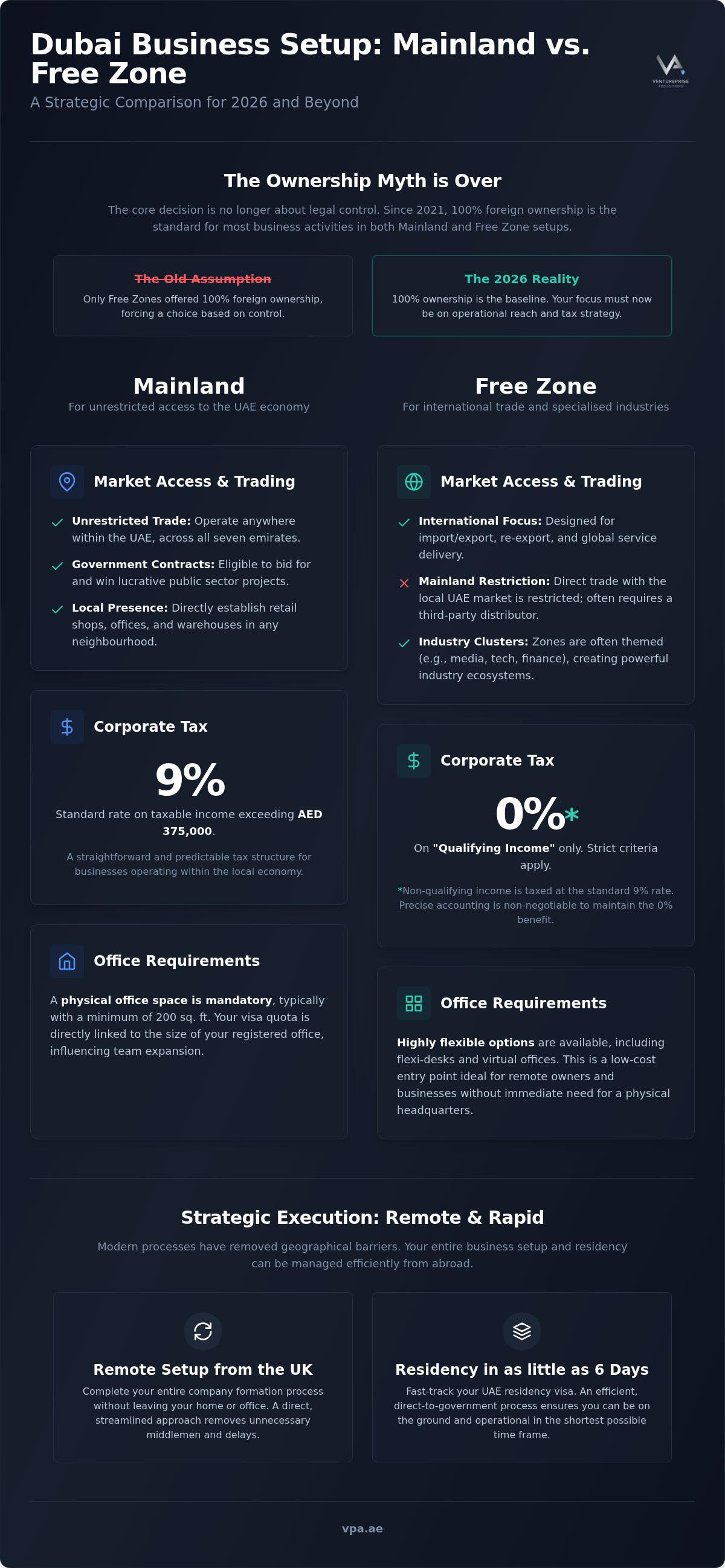
The local partner requirement is dead. For years, the standard Dubai mainland vs free zone comparison rested on the assumption that only free zones offered 100% foreign ownership. That era ended in 2021, and by 2026, full ownership is the baseline for both structures. The Department of Economy and Tourism (DET) governs the mainland, whilst various authorities manage the comprehensive list of Dubai's free zones. Today, the choice isn't about legal control; it's about operational reach. A modern Dubai Mainland entity is a borderless commercial vehicle designed to penetrate every corner of the UAE market without restriction.
The Remote Owner Reality
You don't need to be on the ground to build your empire. Modern digital systems allow you to initiate company formation from the UK without stepping foot in the UAE. Your physical location amongst global markets doesn't dictate your structure. Whether you're in London or Manchester, you can command a Dubai entity that serves clients locally or globally. We've removed the geographical friction that once slowed down ambitious founders. This remote-first approach means your growth strategy remains untethered to your passport or your postcode.
The 2026 Regulatory Environment
The UAE has aggressively streamlined what used to be a bureaucratic minefield. Government processing is now faster and more transparent than ever. To maintain this speed, direct relationships with authorities are vital. Middlemen and third-party agents often add layers of confusion and cost that you simply don't need. A blunt, direct approach to setup ensures you move from planning to profit in days, not months. This shift in the Dubai mainland vs free zone comparison favours those who value agility over tradition. By cutting out the noise, you gain an immediate competitive advantage in a high-velocity market.
Operational Constraints: Where Can You Actually Trade?
Your commercial boundaries are defined by your licence type. In any Dubai mainland vs free zone comparison, the most critical factor is where your revenue originates. Mainland entities possess the unrestricted power to trade in any neighbourhood and bid for lucrative government contracts. This borderless flexibility is essential for businesses that need a physical presence on the high street or direct access to the local UAE market across all seven emirates.
Free Zones operate under a different logic. They are designed as hubs for international trade and service exports. If your business targets local UAE consumers, staying strictly within a Free Zone can become a trap; it often requires a third-party distributor to move goods into the mainland. However, for global entrepreneurs, both structures are equally potent commercial vehicles. For those seeking maximum agility, a hybrid model, utilising a Free Zone entity with a Mainland branch, offers the best of both worlds.
Physical Office Requirements
Mainland licences typically require a physical office space of at least 200 sq. ft. This requirement isn't just a regulatory hurdle; it directly dictates your visa quota and your ability to scale your on-the-ground team. Conversely, Free Zones offer flexi-desks and virtual offices. These are low-cost entry points perfect for remote owners who manage operations from the UK and don't require a dedicated physical headquarters immediately.
Client and Customer Targeting
Choose your structure based on your favourite client profile. If you are a consultant or IT specialist serving B2B global markets, a Free Zone is often the most efficient path. If your strategy involves retail, F&B, or local distribution, the mainland is the only logical choice. Logistics management is far simpler when you aren't navigating the customs barriers that technically exist between Free Zones and the local market. If you are unsure which path suits your 2026 targets, speak with our strategists to map out your operational footprint and ensure your Dubai mainland vs free zone comparison leads to the right decision.
The Financial Impact: Corporate Tax and Visa Quotas
The fiscal landscape in the UAE has matured significantly. In any Dubai mainland vs free zone comparison, you must now account for the 9% corporate tax rate applied to taxable income exceeding AED 375,000. Whilst mainland entities face this standard rate, Free Zone companies only enjoy a 0% rate on "Qualifying Income." If your Free Zone revenue doesn't meet specific regulatory criteria, you'll be taxed at the same 9% rate as a mainland firm. VAT registration remains a separate but equally vital obligation; it's mandatory once your taxable turnover hits the AED 375,000 threshold, regardless of which zone you inhabit. Tax optimisation is a matter of structure, not just location.
Visa Quotas and Residency Speed
Your ability to scale depends on your visa capacity. For mainland companies, your office footprint dictates your quota; typically, you need roughly 80 to 100 sq. ft. per visa. If you intend to hire a large team, your physical space must reflect that ambition. We've refined the process to eliminate delays, securing residency for our clients in as little as six days whilst competitors often take six weeks. Explore our company formation and residency setup for UK expats to see how we accelerate your entry into the market.
Banking and Wealth Security
Opening a corporate bank account is the final hurdle for many startups. Mainland companies often find this process smoother because banks perceive them as having a more permanent local footprint. This stability is crucial when integrating your business with private client wealth services to ensure long-term asset protection. A robust corporate structure isn't just about trading; it's about securing the wealth you generate. Contact our strategic advisors to finalise your financial setup and protect your global assets.
Strategic Execution: Choosing Your Growth Model
Executing your expansion requires a decisive shift from a UK-centric mindset to a Dubai-optimised one. In this final Dubai mainland vs free zone comparison, your choice must reflect your specific growth model rather than just your current budget. The "Service-Based" framework is often the favourite for consultants and IT professionals because it prioritises digital efficiency and global reach. Conversely, the "Scale-Up" framework makes Mainland the only viable choice for retail, F&B, and local services that require physical proximity to the UAE consumer and unrestricted market access.
Don't fall for the "cheap license" trap. Many entrepreneurs choose the lowest initial cost only to find themselves buried in operational friction six months later. High-value outcomes require a setup that supports your long-term ambitions, not just your immediate entry. A structure that feels affordable today might block your banking access or limit your visa quotas tomorrow. We treat your setup as a strategic management decision, ensuring your corporate vehicle is built for speed and scale.
Step-by-Step Decision Matrix
Assess your primary revenue source: Is your income derived from local UAE trade or international service exports?
Determine your team size: How many visas and what volume of physical space will you require by the end of 2026?
Evaluate your market: Do you need to bid for government contracts or operate in specific local neighbourhoods?
For those managing the transition from Britain, our Starting a Company in Dubai from London guide provides essential remote transition tips to bridge the gap between markets.
The Ventureprise Advantage
We act as an elite guide for visionary strategists. By maintaining direct liaisons with authorities, we eliminate the middlemen and underhand tactics that often stall progress. Our bespoke advisory treats your setup as a high-stakes expansion rather than a mere paperwork exercise. We remove the professional barriers that hold others back, allowing you to focus entirely on your commercial objectives. Contact our experts to execute your Dubai expansion with precision and absolute certainty.
Command Your Commercial Future in Dubai
Navigating the Dubai mainland vs free zone comparison is no longer a matter of checking boxes; it's about engineering a vehicle for rapid advancement. You've seen that the 2026 landscape demands a dual focus on operational reach and tax efficiency. Whether you require the borderless market access of a mainland entity or the specialised, tax-optimised environment of a free zone, your choice must align with your long-term wealth strategy and hiring needs. The era of hidden costs and middleman delays is over for those who act with precision.
We provide a high-velocity path to the UAE market, securing your residency in as little as six days through direct government liaisons. Our UK-standard professional advisory ensures your setup is handled with the intellectual rigour your expansion deserves. Stop navigating the bureaucracy alone and start building your legacy in the world's most dynamic business hub. Secure your Dubai commercial presence with Ventureprise Acquisitions and remove the barriers to your global growth today. Your vision for 2026 starts with a single, strategic move.
Frequently Asked Questions
Do I need a local Emirati partner for a Dubai mainland company in 2026?
No, you don't need a local Emirati partner for the vast majority of mainland business activities in 2026. The UAE has fully implemented 100% foreign ownership laws, allowing you to retain absolute legal and operational control of your commercial vehicle. Whilst a Local Service Agent is required for certain professional licences, they act as a liaison with government departments and hold no equity or management rights in your firm.
Can a Dubai Free Zone company trade with mainland UAE businesses?
Free Zone companies can provide services to mainland entities, but they cannot trade goods directly with the local market without a local distributor or agent. You are technically restricted from operating on the mainland high street or bidding for certain government contracts. If your primary growth model relies on direct UAE market penetration, the Dubai mainland vs free zone comparison clearly favours a mainland licence for unrestricted commercial reach.
What is the corporate tax difference between mainland and free zone in 2026?
Both structures are subject to a 9% corporate tax on profits exceeding AED 375,000, but Free Zone entities can access a 0% rate on "Qualifying Income." This exemption is contingent on meeting strict regulatory requirements set by the Federal Tax Authority. Mainland entities pay the standard 9% rate on all taxable income above the threshold, which makes strategic financial planning essential to protect your profit margins regardless of your location.
How many visas can I get with a free zone license vs mainland?
Mainland visa quotas scale based on your physical office square footage, whilst Free Zone quotas are fixed by your specific licence package. For mainland setups, you typically secure one visa for every 80 to 100 sq. ft. of leased space. Free Zones offer more rigid packages, often limiting you to a set number of visas, such as two or three, unless you commit to a larger physical office or a more expensive licence tier.
Can I manage my Dubai mainland company whilst living in the UK?
You can manage your Dubai mainland company entirely from the UK without any requirement for physical residency. The UAE's digital government portals allow you to handle administrative tasks, renewals, and filings remotely. This setup provides the strategic advantage of a high-growth Middle Eastern presence whilst allowing you to maintain your current lifestyle in Britain. We specialise in facilitating this remote transition, ensuring your corporate structure remains compliant and high-performing from abroad.


Comments