
_svg.png)
Dubai Mainland vs Free Zone Comparison: The 2026 Strategic Guide for UK Entrepreneurs
- Jul 8
- 9 min read
Updated: Jul 15
The single most expensive mistake a UK entrepreneur can make in 2026 isn't choosing the wrong office. It's choosing the wrong legal jurisdiction based on outdated advice. You've likely felt the weight of the regulatory minefield whilst researching your expansion, fearing that a local partnership is mandatory or that your profits will be swallowed by complex new rules. This Dubai mainland vs free zone comparison strips away the noise to focus on what actually drives your bottom line: strategic market access and long-term tax efficiency.
We understand the anxiety surrounding the 2026 corporate tax implications and the absolute necessity for 100% foreign ownership. You need a setup that allows for rapid execution, not a drawn-out process filled with traditional agency fluff. This guide delivers a clear, blunt framework to help you decide which structure supports your high-performance goals. We'll explore the operational realities of both jurisdictions, ensuring your move to Dubai is built on a foundation that eliminates professional barriers and accelerates your global growth.
Table of Contents
Decoding the Fundamental Divide: Operational Reach vs. Territorial Boundaries
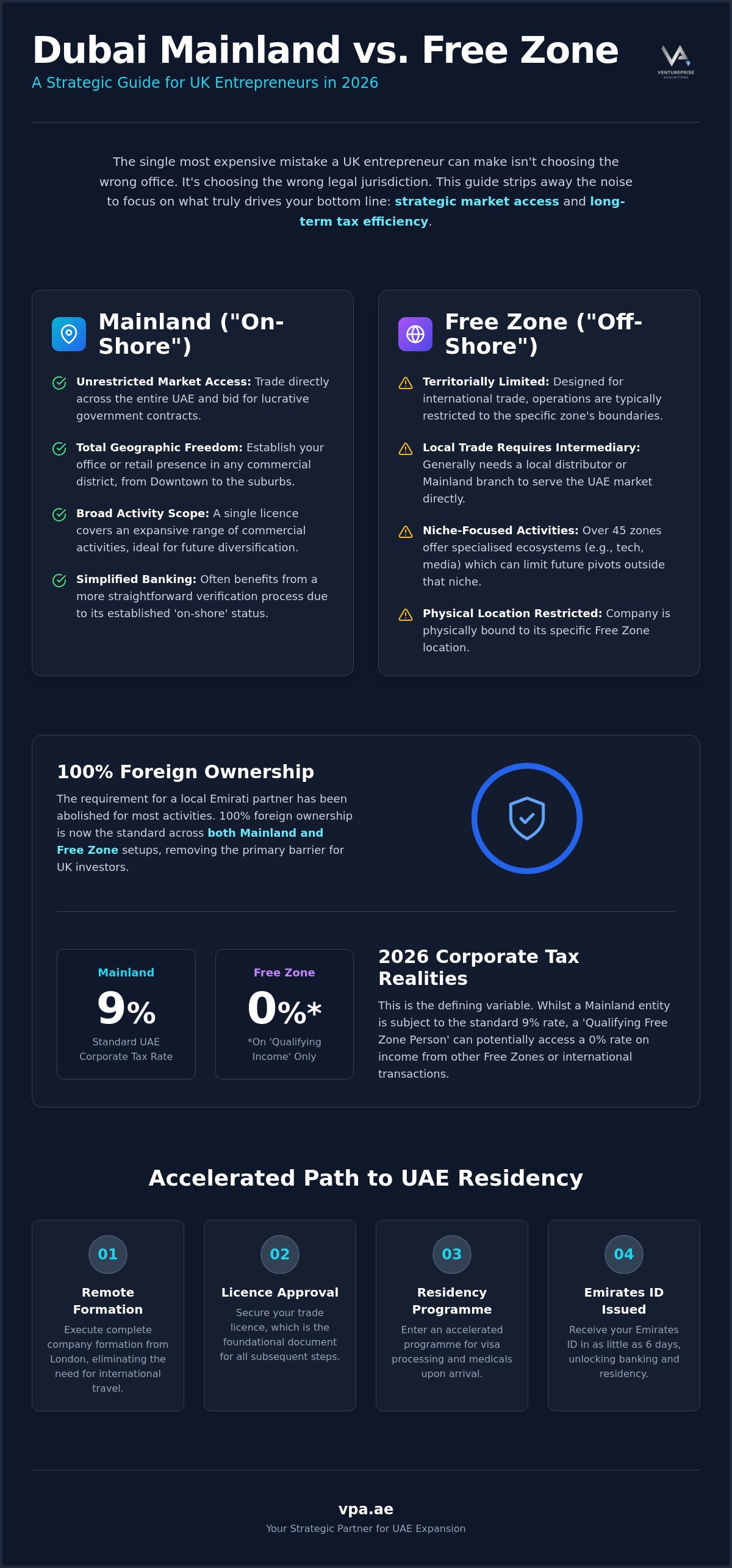
Choosing your jurisdiction isn't a mere administrative box-ticking exercise. It's the most critical strategic decision you'll make for your UAE expansion. The Dubai mainland vs free zone comparison often starts with a misunderstanding of boundaries. A Mainland entity is an 'on-shore' company regulated by the DED. It grants you the absolute right to trade across the entire UAE and bid for lucrative government contracts. Conversely, a Free Zone is a specialised 'off-shore' hub designed primarily for international trade; to understand how specialised firms facilitate these cross-border connections, you can learn more about Global Exclusive Trading (GET). Whilst highly efficient, these zones operate within specific territorial limits.
By 2026, the landscape has shifted. The old barriers are dissolving, yet the strategic choice remains stark. Whilst there are over 45 UAE Free Zones, each offering bespoke ecosystems for tech, media, or finance, your choice of location dictates your future ability to scale. If you intend to capture the local UAE market directly, a Mainland setup is non-negotiable. Free Zone companies generally require a local distributor or a Mainland branch to trade on-shore, adding layers of complexity you might want to avoid. This Dubai mainland vs free zone comparison serves as your strategic compass for identifying where your commercial presence belongs.
Geography and Market Access
Mainland companies enjoy total geographic freedom. You can set up shop in any commercial district, from Downtown to the suburbs, without restriction. Free Zone entities are physically bound to their specific zone. If your strategy involves a retail presence or physical interaction with local UAE consumers, Mainland is the only foundation that makes sense. For entrepreneurs in the food and beverage industry, you can learn more about sourcing professional-grade culinary machinery from specialists like Cyberspace Kitchen & Bakery Equipment. Don't let a "flexi-desk" price point lure you into a structure that prevents you from signing contracts with the biggest players in the region.
Activity Flexibility and Scope
Broadening your commercial reach requires a Mainland licence, which offers an expansive range of commercial and industrial activities under a single roof. This flexibility is vital for entrepreneurs who plan to diversify. Many Free Zones are niche-focused; whilst they offer high-value clusters, they can limit your pivot potential later. Selecting the right company formation path ensures you don't outgrow your licence before your second year of operations.
The 2026 Regulatory Landscape: Ownership, Tax, and Banking Realities
The regulatory framework in 2026 has effectively dismantled the most significant barrier to entry for British investors. For years, the requirement for a local Emirati partner was the primary deterrent for those considering a Mainland setup. That era is over. In any modern Dubai mainland vs free zone comparison, the reality is that 100% foreign ownership is now the standard for the vast majority of commercial and professional activities across the entire UAE.
Whilst the legal path is clearer, the administrative execution remains complex. Banking setup has emerged as the genuine minefield for new entrants. Whilst a licence can be issued in days, activating a corporate account requires navigating rigorous KYC protocols. Your chosen structure directly dictates this speed; Mainland entities often benefit from a more straightforward verification process due to their established 'on-shore' status within the national banking system.
100% Foreign Ownership: No Longer a Free Zone Exclusive
The landmark amendments to the Commercial Companies Law in 2021 permanently changed the game. UK entrepreneurs no longer have to sacrifice control for market access. This shift makes the Mainland a formidable proposition for those who want full equity whilst operating in the heart of the city. For many, starting a company in Dubai from London is the most efficient route to securing this control without the need for immediate relocation. When researching the best path for Exporting to the United Arab Emirates, you'll find that Mainland structures provide the most robust platform for long-term growth.
Tax Efficiency and 2026 Compliance
Corporate Tax is the defining variable of this decade. 'Qualifying Free Zone Persons' can still access a 0% rate on income derived from transactions with other Free Zone entities or international clients. However, the standard 9% rate applies to all taxable profits exceeding AED 375,000 for Mainland companies and non-qualifying Free Zone income. You must decide if the unrestricted market access of a Mainland licence justifies the 9% tax obligation. For a deeper dive into these technical thresholds, consult our guide on Dubai company structure for tax efficiency. If you're unsure which path aligns with your specific revenue targets, you can speak with a strategist to map out your 2026 compliance roadmap.
VAT registration is equally critical. Both Mainland and Free Zone companies must register once taxable supplies and imports exceed the AED 375,000 threshold. This universal requirement ensures that regardless of your Dubai mainland vs free zone comparison results, your accounting and bookkeeping must be airtight from day one.
The Remote Founder’s Decision Matrix: Selecting Your Structure from London
Establishing your presence from London doesn't mean compromising on strategic depth. Ventureprise Acquisitions organises your entire formation whilst you remain in the UK, removing the logistical friction typical of traditional agencies. This "Zero-Travel" setup is designed for high-performance founders who value speed over ceremony. Your Dubai mainland vs free zone comparison must hinge on where your revenue originates and how you intend to scale your human capital.
To cut through the noise, apply these three criteria to your business model:
Revenue Source: Are you targeting international markets or bidding for UAE government tenders?
Operational Model: Will you maintain a lean, remote-led team or hire a significant local workforce?
Physical Infrastructure: Does your brand require a prestigious physical centre of operations or a streamlined virtual presence?
When Mainland is the Only Logical Choice
If your business model involves physical retail, local distribution, or high-level government consulting, Mainland is the only logical choice. Certain regulated professions and "on-the-ground" service delivery mandate an on-shore presence. It provides the unrestricted access needed to sign contracts with local entities and government bodies. Explore our bespoke company setup solutions to secure your Mainland foundation today.
The Free Zone Advantage for Global Traders
Digital nomads and international consultants often favour the streamlined Free Zone environment. It is the ideal ecosystem for those whose client base is purely global. Beyond immediate trade, the benefits of holding company structures within Free Zones for asset protection are immense. Review our Dubai holding company setup guide to understand how this structure shields your wealth whilst you operate remotely. In any Dubai mainland vs free zone comparison, the Free Zone wins for those seeking a secluded yet highly efficient ecosystem.
Ready to finalise your structure? Schedule your strategic planning session to execute your expansion with precision.
Executing Your Expansion: Why the Licence is Only the Beginning
Obtaining a trade licence is merely the entry fee for the UAE market. Most agencies leave you at the finish line with a piece of paper, but we recognise that an entity without infrastructure is a liability. Whilst your initial Dubai mainland vs free zone comparison provides the legal framework, true success requires operational muscle. We transition you from a remote founder to a fully functional regional leader in record time, ensuring your expansion is built on a high-performance foundation.
VPA’s accelerated programme turns the residency process into a streamlined formality. We manage the HR and IT requirements that actually make a company function, providing the strategic management needed to move beyond a shell entity. Our promise is simple: we dismantle the administrative barriers so you can focus exclusively on high-value growth and market penetration. We don't just set up companies; we build operational legacies.
Residency and Concierge Services
The 6-day residency reality is achieved through meticulous coordination. We facilitate an 8-minute medical and a 15-minute biometrics process, removing the typical delays associated with government bureaucracy. This move from a remote London setup to a physical commercial presence is a critical phase of your journey. For a full analysis of how physical entities are evolving this year, refer to our Dubai commercial presence setup pillar.
Protecting Your Assets for the Long Term
Securing a licence without a wealth structure is a tactical error for high-net-worth individuals. Your Dubai mainland vs free zone comparison should lead directly into a conversation about asset protection. We align your corporate structure with Foundations and Trusts to shield your Dubai-based assets against international liabilities. This ensures that your success in the UAE is protected for the next generation. View our private client wealth solutions to see how we integrate asset security into your corporate foundation.
Securing Your Competitive Advantage in the UAE
Your expansion into the Middle East is a catalyst for global transformation. As this Dubai mainland vs free zone comparison has demonstrated, your choice of jurisdiction is the single most important lever for your 2026 growth strategy. You now have the framework to decide between the unrestricted market access of a Mainland entity and the specialised efficiency of a Free Zone hub. Success in this region requires more than a licence; it demands a sophisticated alignment of tax compliance, wealth protection, and operational infrastructure.
Ventureprise Acquisitions exists to remove the professional barriers that stall traditional expansions. We leverage direct government liaisons to eliminate middleman delays, securing your residency in as little as six days. Our UK-led advisory provides the strategic rigor you expect, backed by a dominant physical presence in Dubai to manage every operational detail. Don't leave your international legacy to chance or outdated advice.
Book your strategic consultation with Ventureprise Acquisitions today and execute your expansion with absolute certainty. Your high-performance foundation starts here.
Frequently Asked Questions
Can I own 100% of a Dubai Mainland company as a UK citizen in 2026?
Yes, 100% foreign ownership is now the standard for the majority of commercial and professional activities following the 2021 legislative amendments. UK citizens can exert full control over their Mainland businesses without the historical requirement for a local Emirati partner holding a 51% stake. This shift has fundamentally changed the Dubai mainland vs free zone comparison, making Mainland a primary choice for entrepreneurs who refuse to compromise on equity.
Do I need to live in Dubai full-time if I set up a Free Zone company?
Full-time physical presence in Dubai isn't mandatory for business owners. To maintain the validity of your residency visa, you're generally required to enter the UAE at least once every 180 days. This setup is ideal for remote founders who wish to leverage the UAE's tax-efficient environment whilst spending the majority of their time in the UK or travelling globally to manage their international interests.
Which is cheaper: Dubai Mainland or Free Zone company formation?
Free Zone setups are often perceived as the more budget-friendly option because they offer flexible co-working spaces and lower initial overheads. However, the true cost depends on your scaling strategy. A comprehensive Dubai mainland vs free zone comparison must account for the fact that Mainland companies eliminate the need for third-party distributors or additional branch licences when trading directly across the local UAE market, potentially saving you significant operational fees.
Can a Free Zone company trade with Mainland companies in the UAE?
Free Zone entities can trade with Mainland companies, but they must adhere to specific regulatory boundaries to do so. Direct trade usually requires the appointment of a local distributor or the establishment of a Mainland branch. If your primary revenue stream is derived from on-shore UAE clients, the administrative ease of a Mainland licence often outweighs the secluded efficiency offered by a Free Zone hub.
How long does it take to get a Dubai business licence and residency visa?
Licence issuance is remarkably swift, typically taking between 3 and 14 days depending on the activity. Once the licence is active, the residency process begins. Whilst traditional agencies might take weeks, our accelerated programme facilitates the transition from approval to Emirates ID in as little as six days. This ensures your high-performance foundation is established with the speed required for modern business expansion.


Comments