
_svg.png)
Dubai Market Entry Strategy: A Strategic Roadmap for UK Entrepreneurs in 2026
Most UK entrepreneurs treat the Emirates like a regulatory minefield, yet the $7 billion in non-oil trade recorded in early 2026 proves the real risk is staying on the sidelines. You likely feel the weight of uncertainty regarding hidden middlemen, spiralling costs, or the structural choice between Mainland and Free Zone jurisdictions. These barriers often paralyse ambitious founders who require a secure, scalable base for global expansion rather than a bureaucratic headache. You deserve a transition that is as ambitious as your business goals.
It’s time to replace hesitation with a high-performance dubai market entry strategy designed for absolute speed and total corporate control. Speed is your greatest asset. This roadmap provides a direct, results-oriented framework to navigate the establishment process, allowing you to secure 100% foreign ownership and functional banking without the typical delays. We will detail the exact methodology to move from a remote start to a physical Emirates ID in just 27 days, ensuring your transition is both rapid and legally watertight.
Table of Contents
Navigating the Dubai Market Entry Minefield: Myths vs Reality
A successful dubai market entry strategy in 2026 is no longer about finding a middleman to shift boxes. It's about establishing a robust corporate entity that serves as your global headquarters. Many UK founders still fear the "Local Partner" requirement, but this is largely a relic of the past. Recent regulatory overhauls mean 100% foreign ownership is now the standard baseline for most commercial activities. You retain total control of your equity, your vision, and your profits without the interference of a local sponsor. This proactive approach ensures you aren't just reacting to the market; you're owning it.
Stability is the hallmark of the region. Whilst global markets fluctuate, Dubai's diversified economy provides a predictable, pro-business environment for international capital. This stability allows for long-term strategic planning that many other jurisdictions cannot match. Another common misconception is that you must physically relocate to own a business here. You can manage your Dubai entity from London or Manchester whilst enjoying the benefits of a tax-efficient international structure. It's a bridge to global trade, not a requirement for permanent residency.
The Problem with the Traditional "Agent" Model
Relying on unregulated third-party agents is a high-stakes gamble that often leads to hidden fees or underhand tactics bordering on extortion. These middlemen thrive on complexity and opacity; they often promise rapid results whilst obscuring the true regulatory requirements. The modern landscape favours direct government liaison and transparent formation models. Understanding the dangers of the unregulated Dubai formation market is essential before committing capital. Elite entrepreneurs bypass these gatekeepers by choosing direct, strategic pathways that remove professional barriers rather than creating them. By focusing on direct liaison, you eliminate the risk of hidden costs that plague the unprepared.
Selecting Your Corporate Vehicle: Mainland vs Free Zone Strategy
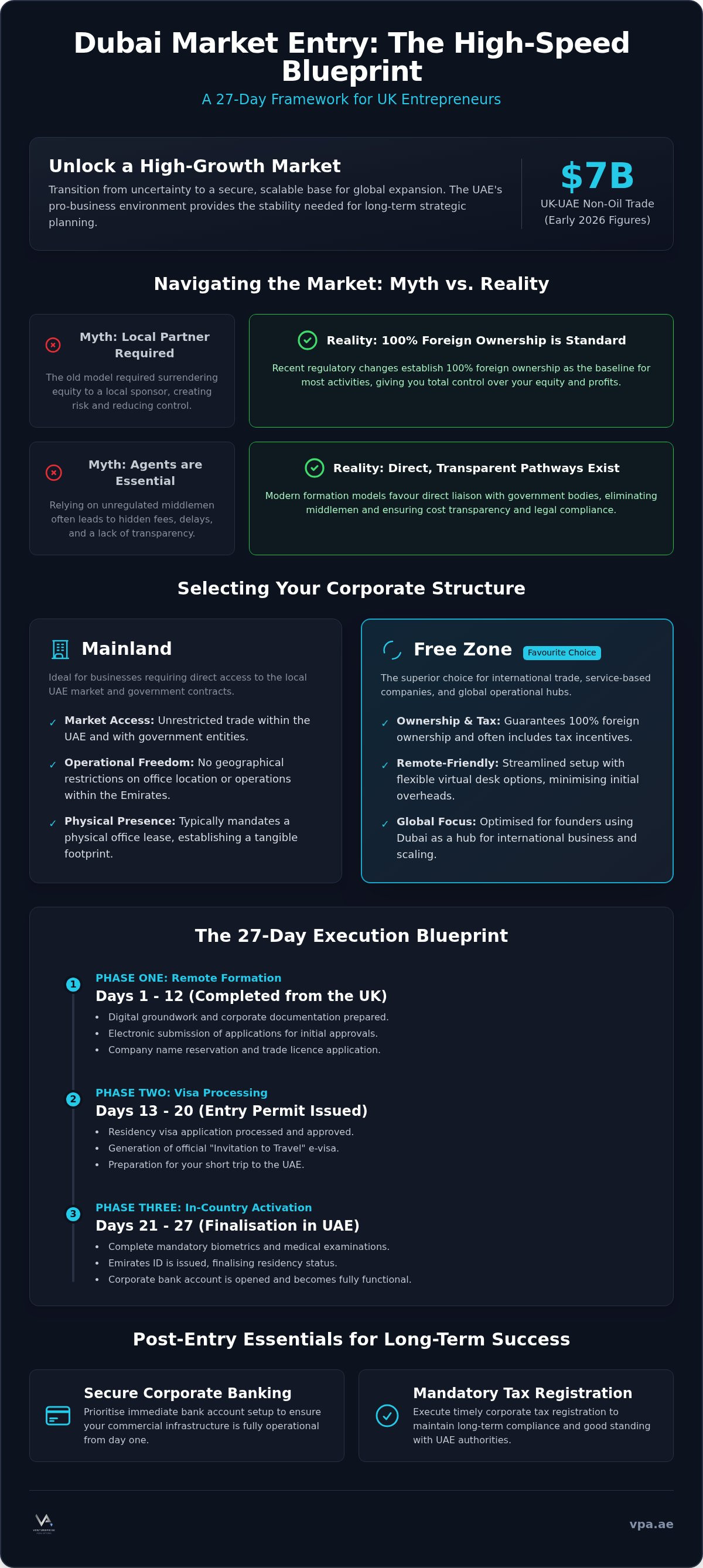
Your dubai market entry strategy hinges on the structural foundation you choose today. For most UK entrepreneurs, the choice between Mainland and Free Zone represents the difference between a localised operation and a global, tax-efficient hub. Free Zones remain the favourite for service-based founders seeking to optimise their international footprint. They offer 100% foreign ownership and streamlined setup processes that bypass the need for physical local presence in the early stages. This allows you to scale rapidly without the immediate overhead of traditional commercial leases.
Mainland entities offer distinct advantages when your business model requires direct trade with UAE government bodies or local retail markets. Whilst Free Zones are often seen as the default for expats, a Mainland licence removes the geographic restrictions on where you can operate within the Emirates. For those who want the best of both worlds, establishing a "Branch" office allows a Free Zone company to tap into mainland opportunities without sacrificing its primary status. Consulting a Practical Market Entry Guide confirms that your choice must reflect your long-term commercial intent rather than just initial setup costs.
Criteria for Choosing Your Entry Vehicle
Success requires an honest assessment of your operational needs. Are you targeting the UAE domestic market or using Dubai as a global hub? Free Zones are generally the superior choice for the latter. You must also consider your physical requirements; Mainland licences typically mandate a physical office lease, whereas many Free Zones provide flexible virtual desk options. Reviewing Dubai Mainland vs Free Zone: The Remote Owner’s Perspective will help you determine which structure supports a lean, agile expansion. If you're still weighing the options, you can reach out for a strategic assessment to ensure your vehicle is fit for purpose.
The 27-Day Execution Blueprint: A How-To for UK Entrepreneurs
Speed defines a modern dubai market entry strategy. Whilst competitors suggest months of travel and exploratory visits, our 27-day blueprint prioritises momentum and precision. Phase One (Days 1 to 12) focuses on electronic formation and digital submission. You remain in the UK whilst the digital groundwork is laid. Phase Two (Days 13 to 20) moves into visa processing and the generation of your "Invitation to Travel". This rapid cycle is supported by the UAE Investment Policy Framework, which has streamlined legal reforms to attract high-value founders who demand efficiency over bureaucracy.
Remote Start: Establishing Your Foundation from London
Electronic signatures have revolutionised the initial 12 days of setup. You don't need to leave your desk in London to initiate a corporate entity or sign articles of association. This digital-first approach is the cornerstone of a modern dubai market entry strategy, removing the friction of physical document couriers and outdated embassy attestations. For a deeper dive into the logistics of starting from abroad, you can explore the strategic insights on our company formation blog.
The Concierge Experience: Navigating Government Appointments
Phase Three (Days 20 to 27) is the "Dubai Sprint". This is where your physical presence meets elite efficiency. We coordinate concierge-led medical exams that take just 8 minutes and biometrics registrations completed in 15 minutes. Direct authority relationships eliminate the need for middlemen, ensuring your Emirates ID is delivered on day 27. You'll receive full formation paperwork and residency stamps, providing everything needed for immediate banking activation. Ready to start your clock? Secure your 27-day residency roadmap today.
Post-Entry Strategy: Operational Excellence and Asset Security
Establishing the entity is merely the beginning; operational excellence is what secures your long-term market position. Your dubai market entry strategy must now pivot toward infrastructure activation. This includes mandatory registration for corporate tax, which in 2026 applies a 9% rate on taxable income exceeding AED 375,000. Whilst the rate remains highly competitive, the administrative burden of compliance requires a precise, professional approach. You'll also need to implement lean HR and IT frameworks that allow your entity to scale globally whilst maintaining a minimal physical footprint in the early stages.
Banking and Tax: The Final Pillars of Market Entry
Opening personal and business bank accounts is often the most frustrating phase for UK expats. It's a regulatory minefield that can stall your momentum if handled incorrectly due to strict KYC and AML protocols. Accessing Ventureprise Solutions provides the strategic management consulting needed to clear these institutional hurdles. We focus on getting your financial infrastructure functional so you can begin trading without delay.
Managing your residency status requires equal attention. The 180-day rule provides the flexibility you need; it requires you to enter the UAE at least once every six months to keep your residency active. This allows you to manage your expansion without a full-time relocation, providing the perfect bridge between your UK interests and your new Dubai headquarters.
Wealth Structuring for High-Net-Worth Individuals
As your international footprint expands, the focus shifts to asset security. Elite founders use foundations and bespoke trusts to bridge their UK and UAE holdings, creating a protective shield around their global wealth. These structures are essential for long-term asset protection and succession planning. For a detailed breakdown of these high-level vehicles, consult our Private Client Wealth Structuring in Dubai: The 2026 Strategic Buying Guide. Protecting your legacy is just as vital as building it.
Dominate the Emirates Market with Precision
A successful dubai market entry strategy in 2026 demands more than just registration; it requires a direct path to operational control and residency. You've seen how 100% foreign ownership and the 27-day execution blueprint remove the traditional barriers to entry. By prioritising a remote-start formation and securing your commercial infrastructure with robust banking and tax registration, you position your business for immediate global scalability. The transition from the UK to the UAE doesn't have to be a bureaucratic struggle when you have an elite partner managing the logistics.
Ventureprise Acquisitions combines deep UK roots with a physical on-the-ground presence in Dubai to ensure your transition is seamless. We offer a zero-travel remote start that delivers your residency and Emirates ID in exactly 27 days. Don't let uncertainty delay your progress. Get your Dubai market entry strategy started today with Ventureprise Acquisitions and unlock the full potential of your international enterprise. Your future in the Emirates starts now.
Frequently Asked Questions
Do I need to live in Dubai to maintain my market entry strategy?
No, you don't need to relocate to the Emirates full-time to sustain your presence. Your residency remains active as long as you enter the country at least once every 180 days. This flexibility is a core component of a modern dubai market entry strategy, allowing you to manage global operations whilst maintaining your primary base in the UK. You can effectively run your entity remotely after the initial concierge-led setup is complete.
What are the minimum financial requirements to start a company in Dubai in 2026?
There are no mandatory requirements to show personal or business bank statements to initiate a company formation. Unlike many other international jurisdictions, you aren't required to purchase property or demonstrate a specific minimum annual turnover to qualify for a licence. This lower financial barrier allows for rapid corporate establishment without tying up significant capital in deposits. You simply need to cover the standard registration and trade licence fees associated with your jurisdiction.
Can a Free Zone company trade with mainland UAE businesses?
Yes, Free Zone companies can trade with mainland UAE businesses, though specific structural requirements apply. Whilst Free Zones are designed for international trade, you can access the domestic market by establishing a mainland branch or working through a local distributor. This dual-layered approach is a sophisticated dubai market entry strategy for entrepreneurs who want to preserve their tax-efficient status whilst tapping into lucrative domestic contracts or local retail opportunities across the Emirates.
How much does a Dubai trade licence cost for a UK entrepreneur?
Trade licence costs vary depending on your specific business activity and chosen jurisdiction. For mainland entities, trade licence fees generally start from AED 12,000, whilst Free Zone options can range from AED 5,000 to AED 50,000. General business registration fees often fall between AED 9,000 and AED 10,000. It's essential to select a licence that aligns with your operational needs to avoid paying for unnecessary permissions or redundant commercial activities.
Is 100% foreign ownership available for all business types?
100% foreign ownership is now available for the vast majority of commercial and industrial activities across both Free Zones and the Mainland. Whilst a few strategic sectors still require local participation, most UK entrepreneurs will find they can retain full equity without a local partner. This shift has removed the primary barrier to entry, allowing founders to maintain absolute control over their intellectual property, corporate governance, and annual profits from day one.


Comments