
_svg.png)
Dubai Professional Licence Requirements: Debunking the Myths for UK Entrepreneurs in 2026
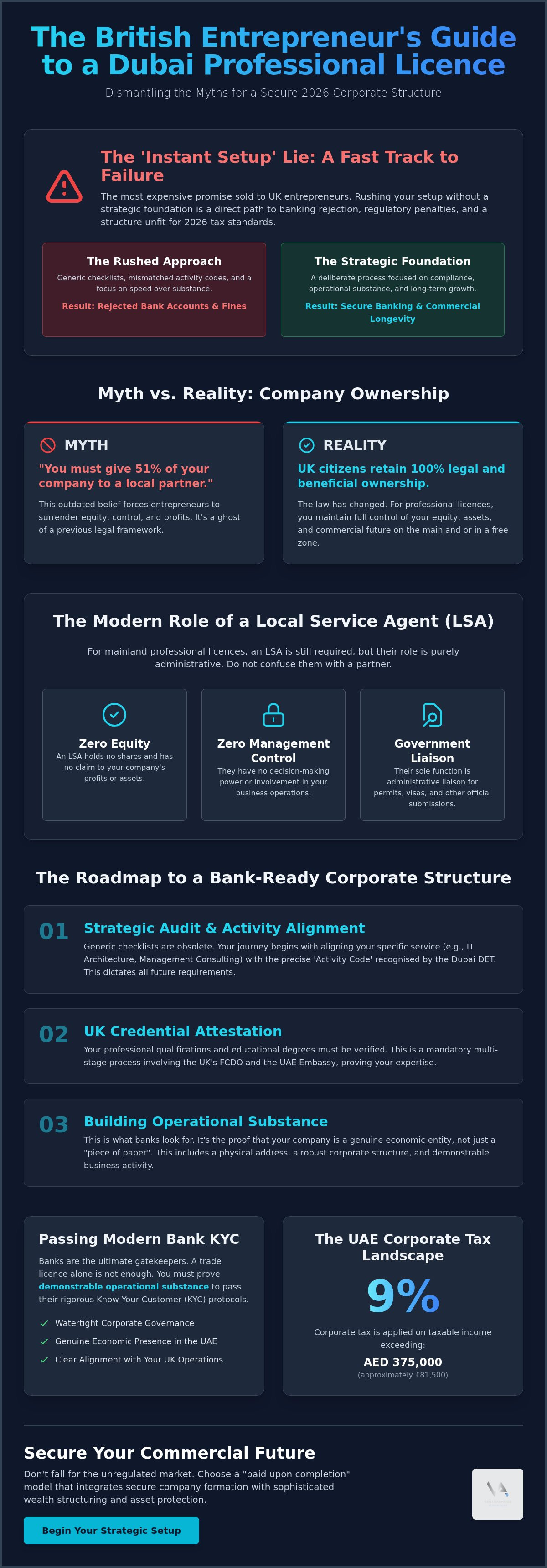
The promise of an "instant" business setup in the UAE is the most expensive lie currently being sold to British entrepreneurs. Whilst the digital transformation of the Dubai Department of Economy and Tourism has streamlined the process, rushing through Dubai professional license requirements without a strategic foundation is a fast track to banking rejection and regulatory penalties. You aren't just buying a piece of paper. You're architecting a global commercial presence that must withstand the scrutiny of 2026 tax standards.
It's frustrating to face a market saturated with unregulated agents who obscure the true costs of Local Service Agents or the reality of the 9% corporate tax threshold. You want a structure that protects your UK operations whilst securing your residency and corporate bank account. This guide dismantles the prevailing myths surrounding professional licences to provide a clear, myth-free roadmap for 2026. We explore the transition to 100% ownership, the exact costs involved, and how to build the operational substance required to pass modern bank KYC checks with absolute certainty.
Key Takeaways
Reclaim full control by dismantling the myth of local partners; UK citizens now enjoy 100% ownership whilst utilising Local Service Agents for purely administrative support.
Navigate the nuances of Dubai professional licence requirements by aligning your setup with specific activity codes rather than relying on generic, outdated checklists.
Prepare for the rigour of corporate banking by building demonstrable operational substance that satisfies modern KYC protocols and secures your residency.
Avoid the "instant setup" trap by prioritising strategic infrastructure over speed, ensuring your corporate framework supports long-term growth rather than just a trade licence.
Secure your commercial future by adopting a "paid upon completion" model that integrates company formation with sophisticated wealth structuring and asset protection.
Table of Contents
Beyond the Checklist: Dismantling the Myth of Generic Dubai Professional Licence Requirements
Ownership and Control: Debunking the Local Partner Misconception
The 'Instant Setup' Trap: Why Speed Without Strategy is a Liability
Operational Substance: Requirements for Banking and Long-Term Residency
Navigating the Unregulated Market: Securing Your Commercial Future
Beyond the Checklist: Dismantling the Myth of Generic Dubai Professional Licence Requirements
Generic checklists are the hallmark of amateur consultancy. In 2026, the Dubai professional license requirements have evolved into a sophisticated regulatory framework that demands more than just a passport copy and a prayer. A professional licence is no longer a mere administrative permit; it's a strategic asset designed for service-based expertise ranging from bespoke management consulting to advanced IT architecture. If you're a UK entrepreneur looking to scale, you must understand that the requirements for your entity are dictated entirely by your specific activity code. There is no "standard" list that applies to everyone, and assuming there is will likely result in costly delays.
Success in the current market requires you to align your initial documentation with UAE corporate law and the latest 2026 tax regulations. With a 9% corporate tax now applicable to taxable income exceeding £81,500 (AED 375,000), your corporate governance must be watertight from the outset. Your UK residency status also plays a pivotal role in how you organise your setup. Whether you're relocating or managing the entity from your UK base, your structure must demonstrate genuine economic substance to satisfy both local regulators and international banking protocols. You can explore more about these foundational steps through our dedicated guide on company formation strategies.
The Evolution of Regulatory Standards in 2026
The Department of Economy and Tourism (DET) has successfully digitised the application process, enabling high-velocity approvals for prepared founders. This speed is a trap for the uninformed. Your "Activity Code" now determines your professional liability and your eligibility for specific tax exemptions. Off-the-shelf packages sold by unregulated agents often use mismatched codes to bypass immediate hurdles, but these shortcuts inevitably lead to regulatory friction during your first mandatory audit. You don't just need a licence; you need a structure that reflects the actual behaviour of your business.
The Strategic Audit: What You Actually Need Before Applying
Your preparation must begin with the attestation of UK educational credentials. This involves a multi-stage verification process through the Foreign, Commonwealth & Development Office (FCDO) and the UAE Embassy in the UK. Depending on your sector, you might also require third-party approvals from bodies like the KHDA for educational services or the DHA for health-related consulting. A Strategic Audit is the comprehensive pre-application validation of your professional credentials, activity alignment, and corporate governance structure that serves as the prerequisite for a secure 2026 expansion. Don't let a missing attestation or a vague activity description stall your momentum when you're at the finish line.
Ownership and Control: Debunking the Local Partner Misconception
The most persistent ghost of the UAE business landscape is the belief that you must surrender 51% of your company to a local sponsor. This is categorically false for service-based entrepreneurs. UK citizens can maintain 100% legal and beneficial ownership of their entities. This applies regardless of whether you choose a mainland structure or a free zone. The legal framework has shifted. You own the equity. You own the control. You own the future of your firm.
Protecting your intellectual property starts with a robust Memorandum of Association (MOA). Whilst 100% ownership is the law, your MOA must explicitly define your management rights and profit distribution. It's the primary document that safeguards your assets against future disputes. Relying on a template is a risk you don't need to take. Your corporate governance should be as sophisticated as the services you provide.
The Local Service Agent (LSA) in 2026
For mainland entities, Dubai professional license requirements still include the appointment of a Local Service Agent. Don't confuse this with a partner. An LSA has zero equity and zero management control. Their role is strictly administrative. They act as your liaison with government departments for labour permits and visa processing. They're an enabler, not an owner.
Smart founders avoid percentage-based agreements. A fixed-fee LSA is the only professional way to operate. It ensures your overheads remain predictable. Your contract must include a clear "no-interference" clause. This legally bars the agent from any involvement in your business operations or strategic decisions. It's a clean, corporate arrangement that keeps your autonomy intact whilst satisfying local regulations.
Strategic Jurisdiction Selection
Choosing between a Free Zone and the Mainland is a decision of strategic intent, not just cost. Free Zones offer sector-specific incentives and are excellent for firms focused on international trade. However, the mainland advantage is significant. It allows you to trade directly with the UAE government and the local market without restrictions. This flexibility is often the deciding factor for consultancies aiming for high-value government contracts.
As highlighted in this Forbes guide to setting up a Dubai business, success depends on matching your structure to your long-term goals. You can compare bespoke zone selections for UK firms via Ventureprise Solutions to see which jurisdiction aligns with your specific activity. Whether you need the prestige of a DIFC address or the flexibility of a DET mainland licence, the choice must be data-driven. If you're unsure which ownership structure best protects your UK interests, you can request a strategic review with our consultants.
The 'Instant Setup' Trap: Why Speed Without Strategy is a Liability
The allure of "instant" results is the primary weapon of the unregulated consultant. Whilst the digital portals of the Dubai authorities are remarkably efficient, the technical issuance of a document is not the same as launching a functional business. A trade licence is merely the first step of a complex infrastructure that must include corporate banking, tax registration, and visa security. Rushing this stage without a strategic roadmap often leads to a "dead" entity, one that possesses a licence but remains unable to move capital or hire staff because the fundamental Dubai professional license requirements were treated as a tick-box exercise rather than a strategic foundation.
You must be wary of the "cowboy" culture that thrives on the periphery of the UAE market. These agents vanish the moment your initial payment clears, leaving you to navigate the complexities of Dubai professional license requirements alone. The cheapest options on the market are frequently the most expensive in the long run. We regularly see UK founders forced to pay thousands of pounds in restructuring fees within their first year because their initial setup was incompatible with 2026 banking protocols or corporate tax laws. A 6-day residency path that prioritises banking support is infinitely more valuable than a 24-hour licence that lacks institutional support.
Recognising the Signs of Setup Extortion
Identifying predatory practices is essential for protecting your capital. Hidden "renewal fees" and heavily inflated "PRO service" mark-ups are common tactics used by agents to claw back margins on "low-cost" setups. You should never pay 100% of your fees upfront in an unregulated market; a staged payment plan linked to milestones is the only way to ensure accountability. For a deeper analysis of the pitfalls to avoid, see our guide on Setting Up A Company In Dubai: 6 Myths That Will Hold You Back.
The Value of Direct Authority Relationships
Eliminating middlemen is the most effective way to reduce the risk of document delays and administrative errors. Direct relationships with government authorities provide a level of transparency that third-party agents simply cannot match. For high-net-worth individuals, the strategic advantage of direct government liaisons ensures that sensitive applications are handled with the necessary discretion and precision. Speed must be a byproduct of process efficiency, not a dangerous shortcut of regulatory compliance.
Operational Substance: Requirements for Banking and Long-Term Residency
Obtaining a trade licence is a administrative victory; opening a corporate bank account is a strategic one. In the current regulatory climate, corporate banking has become the "final boss" of Dubai professional license requirements. Industry data suggests that nearly 40% of new entities face rejection or significant delays during the account opening phase. This isn't due to a lack of paperwork, but a lack of demonstrable operational substance. Banks in 2026 are no longer satisfied with a PDF document; they require proof that your professional business has a genuine, physical presence in the region.
The Economic Substance Regulations (ESR) demand that your entity performs its core income-generating activities within the UAE. For UK entrepreneurs, this means your corporate structure must be more than a "brass plate" on a wall. You must be prepared to link your UK-sourced wealth to your new UAE accounts through rigorous Source of Wealth (SOW) and Source of Funds (SOF) documentation. Failure to align your UK financial history with your UAE corporate goals is the most common reason for banking friction. Professionalism in your setup is the only way to navigate these high-level KYC protocols.
Corporate Banking in 2026: The Substance Test
UAE banks now prioritise AML (Anti-Money Laundering) compliance above all else. They look for a logical connection between your professional activity, your office space, and your expected turnover. Whilst a "flexi-desk" might satisfy the minimum Dubai professional license requirements for the authorities, many Tier-1 banks now insist on a physical office lease or a dedicated workspace before approving a full-service corporate account. Our approach to Strategic Management Consulting ensures that your corporate architecture is built to pass this scrutiny from day one, rather than leaving you stranded with a licence you cannot use.
Residency as a Strategic Asset
There is a persistent myth that securing a 10-year Golden Visa requires a multi-million pound property investment. This is no longer the case for elite professionals. Many service-based entrepreneurs qualify for long-term residency based on their professional expertise and salary brackets alone. This 10-year security allows you to build a life in Dubai whilst maintaining your UK interests. It's also vital to understand the 180-day rule; whilst standard residency visas often require a visit every six months to remain valid, Golden Visas offer much greater flexibility for those who need to travel frequently between London and Dubai. Your residency isn't just a permit; it's a tool for personal wealth structuring and long-term asset protection. If you are ready to secure your banking approval and residency status, our team can architect the necessary substance requirements.
Navigating the Unregulated Market: Securing Your Commercial Future
The UAE's consultancy market is notoriously fragmented, often leaving UK founders vulnerable to agents who prioritise their own commissions over your corporate longevity. We operate on a fundamentally different premise. The Ventureprise Model is built on the principle of "Paid Only Upon Completion". This isn't just a service guarantee; it's a strategic alignment that ensures we're as invested in the successful issuance of your residency and bank accounts as you are. By removing the upfront financial risk, you can focus on the high-level decision-making required to scale your expertise in a new jurisdiction with total peace of mind.
Understanding the technicalities of Dubai professional license requirements is the foundation, but the Ventureprise Model ensures that the execution of these requirements serves your broader commercial objectives. Most entrepreneurs fail because they buy a product, a licence, rather than a strategy. Your expansion into the Middle East should be a catalyst for growth, not a source of administrative friction. Moving from the research phase to execution requires a partner who understands that your time is your most valuable asset and that a "done-for-you" approach is the only way to maintain your momentum in the UK whilst building your presence abroad.
Wealth Structuring and Asset Security
Your Dubai entity shouldn't exist in a vacuum. To truly secure your commercial future, your business must be integrated into a robust foundation or trust framework. This level of Strategic Planning prevents your regional expansion from becoming a liability to your existing UK interests. You can explore these advanced security measures in our resource on Wealth Structuring for UK Entrepreneurs in Dubai. By architecting this at the start, you protect your intellectual property and ensure that your global assets are shielded from local jurisdictional shifts, providing a layer of security that generic agents simply cannot offer.
Your Direct Path to Dubai Expansion
Generic "licence-only" packages are designed for volume, not value. To succeed in 2026, you require a bespoke expansion roadmap that accounts for your specific professional activity, your banking requirements, and your long-term residency goals. This transition from the research phase to execution must be handled with surgical precision to avoid the "instant setup" traps discussed earlier. Meeting Dubai professional license requirements is just the beginning of a much larger wealth-generation journey. If you're ready to move beyond the noise and establish a secure, strategically sound presence, it's time to initiate a confidential discussion. You can secure your Dubai commercial presence with Ventureprise Acquisitions and begin your 2026 expansion with absolute certainty.
Architect Your Global Legacy in Dubai
Transitioning your professional expertise to the Middle East is a move that requires more than administrative filing; it demands a visionary approach to corporate architecture. We have dismantled the outdated myths of local ownership and exposed the "instant setup" fallacies that often lead to banking rejection. You now possess the roadmap to navigate Dubai professional license requirements whilst maintaining 100% control of your entity and securing your long-term residency.
By prioritising operational substance over speed, you ensure your business is built to withstand the scrutiny of 2026 tax standards and global KYC protocols. As specialists in UK-to-UAE wealth migration, we provide the elite guidance necessary to bridge the gap between London and Dubai. Our direct government liaisons and payment protection guarantees offer a level of security that unregulated agents simply cannot replicate.
Don't leave your commercial future to chance. Begin your strategic Dubai expansion with a confidential consultation today. Your international advancement is no longer a distant goal; it is a calculated, secure next step into the world's most ambitious business hub.
Frequently Asked Questions
What are the minimum capital requirements for a professional licence in 2026?
There is typically no minimum paid-up capital requirement for a professional licence in 2026. Unlike commercial entities that may require specific capital injections to be reflected on the licence, professional service firms are valued for their expertise rather than their initial balance sheets. You must, however, demonstrate sufficient liquidity during the banking application phase to cover your operational overheads and satisfy modern KYC protocols.
Can I own 100% of my Dubai company as a UK citizen?
UK citizens can maintain 100% legal and beneficial ownership of their professional entities in Dubai. The previous mandate for a local partner holding 51% equity was abolished for the vast majority of professional activities. Instead, you will appoint a Local Service Agent (LSA) who manages government liaisons for a fixed annual fee without holding any shares or management rights in your firm.
Do I need to be physically present in Dubai to complete the licence requirements?
You don't need to be physically present in Dubai to initiate the Dubai professional license requirements. The Department of Economy and Tourism (DET) and most free zones have digitised their application portals, allowing for remote company formation from the UK. However, you must travel to the UAE for approximately five to seven working days to complete your medical fitness test and biometrics for your residency visa.
How long does the residency application process actually take for UK entrepreneurs?
The end-to-end residency process typically takes between 15 and 25 working days for UK entrepreneurs. Once your entry permit is issued, the physical formalities in Dubai, such as the medical check and Emirates ID biometrics, are usually concluded within a single week. High-velocity processing is the standard for founders who have correctly organised their attested educational credentials before arrival.
What is the difference between a professional licence and a commercial licence?
A professional licence is issued to individuals or entities providing service-based expertise, whilst a commercial licence is required for trading goods or manufacturing. Professional licences allow for 100% foreign ownership on the mainland through an LSA arrangement. Choosing the correct category is vital for your 2026 tax positioning, as your activity code dictates your eligibility for specific exemptions and your overall liability framework.
Are there corporate tax requirements for non-resident owners in Dubai?
UAE corporate tax applies to all business profits generated within the country, regardless of the owner's residency status. As of 2026, a 0% rate applies to taxable income up to £81,500 (AED 375,000), with a 9% rate applied to profits exceeding that threshold. Non-resident owners must ensure their entity is registered for tax to avoid a £2,175 (AED 10,000) penalty for late registration.
How much does a Dubai professional licence cost for a consulting firm?
The total first-year cost for a mainland professional licence setup typically ranges from £5,400 to £13,000. This estimate covers the DET licence fee, a fixed Local Service Agent fee, and the costs associated with one investor visa. These figures fluctuate based on your choice of office space and whether your specific consulting activity requires additional third-party government approvals from bodies like the KHDA.
What happens if my corporate bank account application is rejected?
If your corporate bank account application is rejected, you must immediately audit your corporate structure for deficiencies in "Economic Substance". Rejections are rarely random; they usually stem from a lack of physical presence or unclear Source of Wealth documentation regarding your UK interests. You'll likely need to enhance your operational footprint or refine your corporate governance before re-applying to a different Tier-1 or digital-first banking institution.


Comments