
_svg.png)
Using Dubai as a Hub for Global Expansion: A 2026 Guide
The fastest route to global growth may be the wrong Dubai setup. Using Dubai as a hub for global expansion can bring your business closer to customers, partners and international trade, but the right structure depends on what you plan to do from that base.
If you’re weighing a Dubai presence, start by defining your business activity and intended customers. Free Zone and mainland structures affect how you access the UAE market, and corporate tax rules mean a low-tax assumption shouldn’t drive the decision. You don’t need to travel to begin: initial company formation and visa-processing steps can start remotely.
This guide sets out a practical way to assess whether Dubai fits your growth plans, compare structures and map the steps from planning through formation and residency. The aim is to make a sound expansion decision, not to treat company registration as the goal in itself.
Table of Contents
Using Dubai as a global expansion hub: what strategic value can it offer?
A Dubai expansion hub is an operating base for specific commercial activity, such as coordinating trade, developing business relationships or serving customers in selected markets. It’s more than a registered address: the value depends on what your business will actually do from that base. Using Dubai as a hub for global expansion makes sense when those functions support a clear growth objective.
Dubai’s role in trade and the broader UAE economy may make it relevant to businesses assessing international operations. The Economy of the United Arab Emirates provides wider context. But a location’s profile doesn’t prove that your business will find buyers or partners there. Test the commercial case against your own offer and target customers.
What makes a hub strategically useful to an expanding business?
A base can help a company coordinate cross-border activity, build relationships with partners and organise commercial work closer to intended markets. Identify the functions that would genuinely benefit from being in Dubai. For example, if your plan depends on managing regional partnerships or coordinating international trade, define who will handle that work and how it connects to revenue. If the same work can be managed effectively from your current base, a new entity may add complexity without advancing the plan.
Advantages are only valuable when they match the growth plan
Test each proposed advantage against your customers and operating needs. Where are prospective buyers? Do partners expect regular local engagement? Will trade or business coordination work better from Dubai, or can your existing team manage it? These questions turn a general expansion ambition into a practical case for a presence.
A strategic location does not itself secure market access, prove product demand or generate revenue. Before forming a company, validate demand with prospective customers and define how you’ll develop relationships and deliver commercially. The stronger decision is not simply to enter Dubai, but to decide what role it will play in your business.
Free Zone or mainland: match your Dubai structure to your trading model
Choose a structure based on the work your company will do and the customers it intends to serve. A Free Zone entity may suit a business focused on international trade or activities permitted by its licence. A mainland company may be more appropriate when the plan depends on operating directly in the UAE mainland market. Using Dubai as a hub for global expansion means aligning the entity with your trading model, not selecting a structure for a headline benefit.
When a Free Zone structure may fit the expansion plan
Consider a Free Zone if your planned activity fits the relevant licence and your customers or operations align with that zone’s framework. Many activities, particularly in Free Zones, allow 100% foreign ownership, but not every activity is permitted under every licence. A Free Zone company can conduct international trade, while trading with the mainland UAE may require a branch setup.
When mainland access belongs in the decision
If your strategy relies on serving mainland customers directly, delivering services there or pursuing work that requires a mainland presence, include that need in the structure decision from the outset. A branch or separate mainland setup can affect how you organise and operate the business. Map your intended activity and customer locations before settling on an entity. For a wider view of Dubai company setup options, consider which structure supports the operating presence you need.
Tax treatment depends on the company’s circumstances. The standard UAE corporate tax rate is 9% on taxable profits exceeding AED 375,000. A Free Zone company may qualify for 0% on qualifying income if it meets the relevant conditions. That treatment isn’t automatic, so don’t choose a structure on the assumption that all Free Zone income is tax-free.
Compare the options against your licensed activity, target customers, route to market and operating requirements. That turns the Free Zone and mainland question into a practical decision about how your business will trade.
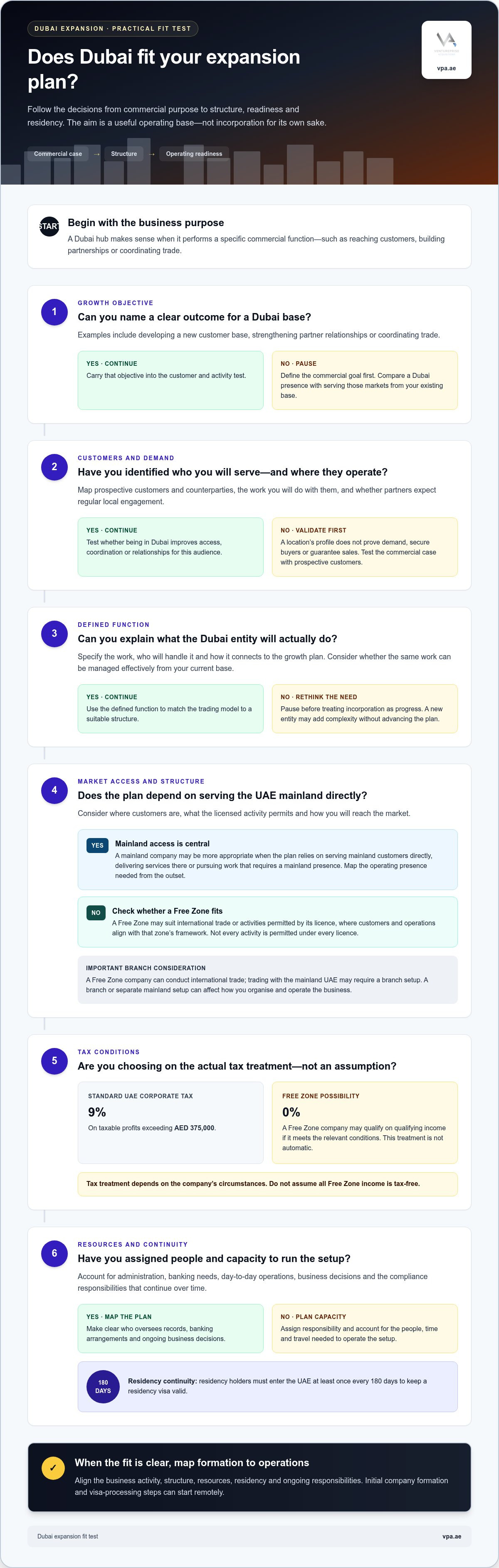
A practical framework for deciding whether Dubai fits your expansion
Use this fit test before committing to a presence. The aim is to establish whether Dubai will perform a specific commercial function, not simply signal international ambition. Compare your answers with the option of serving those markets from your existing base.
Test the commercial case before choosing a structure
Growth objective: Define the outcome you want, such as developing a new customer base, strengthening partner relationships or coordinating trade.
Customer activity: Identify target customers and counterparties, where they operate and what work your business will do with them. A location can support access, but it can’t prove demand or guarantee sales.
Defined function: Specify what the Dubai entity will do. If you can’t explain its role in your operating plan, pause before treating incorporation as progress.
Structure and resources: Match the entity to your activity, then assign responsibility for administration, banking needs and day-to-day operations. Account for the people and capacity required to run the setup.
Compliance and continuity: Map the relevant obligations and how you’ll meet them over time. Residency holders must enter the UAE at least once every 180 days to keep a residency visa valid.
Check operational readiness and ongoing responsibilities
Be specific about who will oversee records, banking arrangements and business decisions, and how often travel will be needed. If key tasks depend on one founder, plan how they’ll be managed when that person is elsewhere. A Dubai hub is a stronger proposition when commercial purpose, ownership and operational capacity line up.
Compare your answers with the alternative of serving those markets from your current base. If the case for Dubai is clear, a strategic planning discussion can help you weigh the options and set priorities.
Turn the Dubai hub decision into a clear formation and growth plan
Once the commercial case is clear, turn it into an operating sequence. Confirm the business activity first, then select a structure that supports your trading model. Next, plan formation, residency and the practical work of running the business. Using Dubai as a hub for global expansion requires these decisions to work together; incorporation alone doesn’t deliver growth.
Coordinate formation with the wider operating model
Set the foundations: Define the activity, intended customers and entity structure, then align the formation process with your expansion priorities.
Plan residency and the visit: Initial company formation and visa processing can begin remotely, so you don’t need to travel for the early steps. The process includes company formation during days 1-12, visa processing during days 13-20, and a visit stage during days 20-27. These are process milestones, not guaranteed outcomes or timings.
Prepare to operate: Assign responsibility for administration and ongoing business decisions. Ventureprise Acquisitions provides banking setup assistance, strategic planning and business growth consultancy. Banking assistance does not guarantee a bank account, and consultancy does not guarantee commercial results.
This joined-up approach keeps the entity connected to its purpose. Ventureprise Acquisitions supports company formation and residency setup, alongside planning for the wider operating model. Explore business growth solutions as part of that plan.
Choose a next step that reduces uncertainty
Ventureprise Acquisitions is based in Dubai and provides plain-English guidance for entrepreneurs planning an expansion. Its company formation and residency support can help you work through the setup process, while strategic planning and business growth consultancy connect those decisions to your wider objectives. Start with the activity, structure and responsibilities you’ve identified, then build the next steps around them.
Use the planning questions in this guide to clarify your priorities and decide what your Dubai entity needs to do.
Turn your expansion decision into forward momentum
A Dubai presence should earn its place in your growth strategy. Define what success would look like and how you’ll judge whether the new base is delivering value. This gives your expansion a clear direction, rather than making company formation the goal in itself.
Ventureprise Acquisitions combines UK roots with a Dubai-based presence and plain-English guidance. Initial company formation and visa-processing stages can begin remotely, so you can start planning before travelling. Support spans formation, residency processing and business growth consultancy, connecting setup decisions to your business’s wider aims.
Ready to turn your expansion priorities into a practical plan? Discuss your Dubai expansion plan with Ventureprise Acquisitions.
Frequently Asked Questions
Do I need to live in Dubai full-time to own a Dubai business?
No. Owning a Dubai business doesn’t mean you must live there full-time. If you hold a residency visa, you must enter the UAE at least once every 180 days to keep it valid. An owner managing the company remotely should plan UAE visits around this requirement.
Do I need to show bank statements or buy property to start a Dubai business?
No. You don’t need to show personal or business bank statements or buy property to start a business in Dubai. Starting a company and applying for banking services are separate steps, so plan for any bank account needs as part of your operating arrangements.
Is there a minimum annual turnover requirement for a Dubai company?
No. There’s no minimum annual turnover threshold for a Dubai company. You still need to carry out activities permitted by your licence and meet other applicable obligations. Plan your business activity around the licence, even if you expect sales to build gradually.
Does setting up a Dubai company mean the business pays no corporate tax?
No. Setting up a company doesn’t create a universal corporate tax exemption. Tax treatment depends on the company’s circumstances, and Free Zone relief applies only where the relevant conditions are met. For a business using Dubai as a hub for global expansion, treat tax registration and the treatment of income as separate planning questions, and refer to current UAE official guidance before relying on a tax position.



Comments