

Corporate Compliance Requirements for Dubai Businesses: Your Key Duties
Compliance is not a single filing; it is a set of connected duties. For UK clients expanding internationally or managing overseas entities, the corporate compliance requirements for Dubai businesses include maintaining accurate records, preparing annual financial statements, and meeting applicable audit, VAT, corporate tax, and governance obligations. UAE VAT is charged at the standard rate of 5%, while the Federal Tax Authority states that corporate tax applies to financial years beginning on or after 1 June 2023.
Here at Ventureprise Acquisitions, we help businesses nationwide navigate these cross-border obligations seamlessly. It is understandable to focus first on setting up a company and securing its licence. However, corporate compliance requirements for Dubai businesses also mean understanding which obligations apply to your structure and activity, then keeping records and deadlines aligned as the business operates. This article covers financial reporting and audit duties, VAT and tax rules, and governance responsibilities, so you can plan for compliance from the outset.
Table of Contents
Financial reporting, IFRS and statutory audits
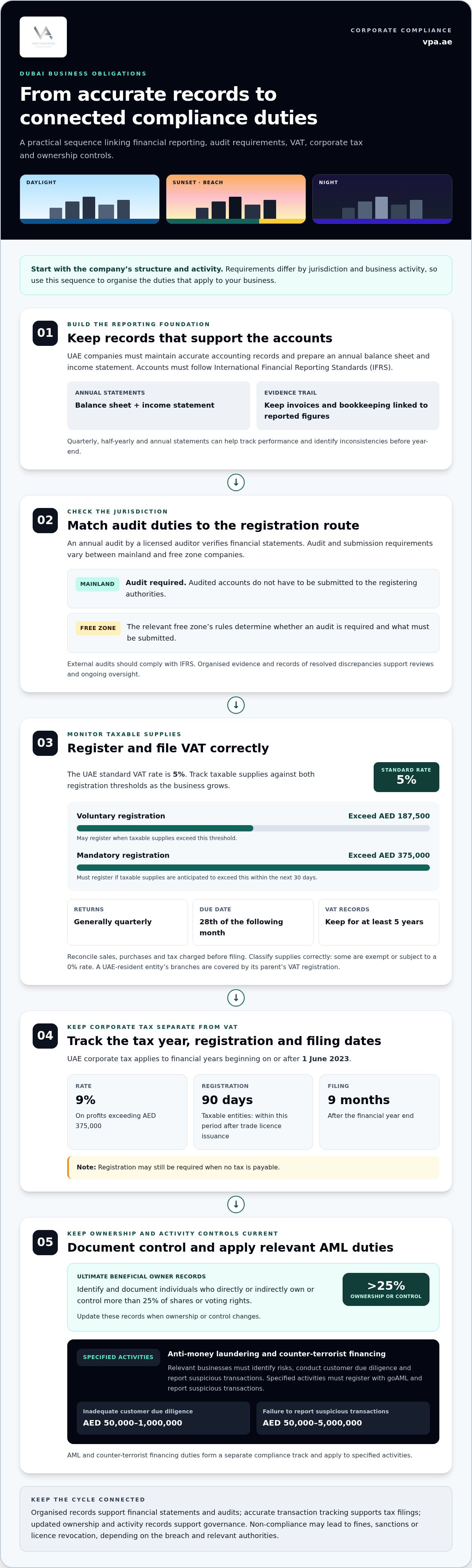
UAE companies must keep accurate accounting records and prepare an annual balance sheet and income statement. Their accounts must follow International Financial Reporting Standards (IFRS) under Ministerial Decision No. 114 of 2023. An annual audit by a licensed auditor verifies the financial statements.
Mainland and free zone audits
A financial audit examines a company’s accounts, but requirements depend on its registration jurisdiction. Mainland UAE companies must have their financial records audited, although they do not have to submit audited accounts to their registering authorities.
For a free zone company, the relevant free zone’s regulations determine whether an audit is required and what must be submitted. This distinction matters when planning reporting deadlines: mainland and free zone authorities may set different requirements. Check the rules for the company’s specific jurisdiction and align its records and accounts accordingly.
Statutory audits and compliance penalties
A statutory audit is an independent review of financial accounts for accuracy and compliance with legal and regulatory requirements. UAE external audits should comply with IFRS, giving auditors a consistent basis for reviewing a company’s reported figures.
Keep supporting records that connect transactions to the figures in the annual balance sheet and income statement. For example, organised invoices and bookkeeping records help explain how reported income and expenses were calculated. Accounting teams may also prepare quarterly, half-yearly and annual financial statements to track performance and identify inconsistencies before year-end.
A compliance audit is a separate review of whether business processes and records follow applicable regulations and guidelines. Regular internal audits can identify gaps early, such as missing documents or inconsistent figures, so the business can address them before they escalate.
Non-compliance may expose a UAE business to fines, sanctions or licence revocation. Consequences depend on the breach and the relevant authorities. Keep audit evidence organised, record how discrepancies are resolved, and submit documents when required by the applicable authority or free zone. This creates a clear trail for external reviews and ongoing compliance oversight.
VAT registration and returns
The UAE introduced Value Added Tax (VAT) on 1 January 2018, with a standard rate of 5%. A business may voluntarily register when its taxable supplies exceed AED 187,500. It must register if it anticipates taxable supplies exceeding AED 375,000 within the next 30 days. Monitor transactions against both thresholds as operations grow, rather than relying only on past turnover.
UAE businesses generally file VAT returns quarterly, with returns and payments normally due on the 28th of the following month. Keep VAT records for at least five years and reconcile sales, purchases and tax charged before each filing. Some activities are exempt or subject to a 0% rate, so classify supplies correctly. A UAE-resident entity’s branches are covered by its parent’s VAT registration and don’t register separately.
Ownership records sit alongside tax registration in the national compliance framework. According to the UAE Ministry of Economy, businesses must identify and document individuals who directly or indirectly own or control more than 25% of a company’s shares or voting rights for Ultimate Beneficial Owner records. Update those records when ownership or control changes. This helps an investor’s ownership position remain distinguishable from the individuals who ultimately control the company.
Corporate tax is a separate obligation from VAT. According to the Federal Tax Authority, UAE corporate tax applies to financial years beginning on or after 1 June 2023. The rate is 9% on profits exceeding AED 375,000. Taxable entities must register within 90 days of trade licence issuance, and corporate tax filings are due within nine months of the financial year end. Registration may still be required when no tax is payable. Consultants should distinguish these filing duties from anti-money laundering and counter-terrorism obligations, which apply to specified activities and form a separate compliance track.
WHAT ARE THE MAIN COMPLIANCE REQUIREMENTS FOR MY UAE & DUBAI COMPANY?
Core duties cover ownership records, licensing, workforce rules and controls against financial crime. The obligations that apply depend on your company’s activity, structure and jurisdiction.
Anti-money laundering and counter-terrorist financing
Anti-money laundering and counter-terrorist financing rules require relevant businesses to identify risks, conduct customer due diligence and report suspicious transactions. According to the UAE Ministry of Economy, businesses must identify and document individuals who directly or indirectly own or control more than 25% of a company’s shares or voting rights for Ultimate Beneficial Owner records.
Specified activities must register with goAML and report suspicious transactions. Inadequate customer due diligence may incur penalties of AED 50,000-1,000,000; failure to report suspicious transactions may incur AED 50,000-5,000,000. These controls help establish an audit trail against money laundering and terrorist financing.
Requirements for designated non-financial businesses
Designated Non-Financial Businesses and Professions (DNFBPs) operate in specified sectors and have anti-money laundering obligations. Examples include real estate brokerage, dealing in precious metals and stones, independent accounting, and corporate services. Businesses conducting these activities must register with goAML and report suspicious transactions.
Privacy rules also depend on where a business operates. The UAE has the DIFC Data Protection Law and ADGM Data Protection Regulations. Identify the applicable framework before collecting or using personal data, particularly across a foreign company’s operations.
Trade licence renewal requirements
Dubai trade licence renewal means keeping the licence valid and meeting the issuing authority’s conditions for the company’s activity. Requirements and fees depend on the jurisdiction and business circumstances; operating without a valid licence may incur a fine of AED 5,000.
To establish a compliant business, determine its activity and jurisdiction, secure required licences and sector approvals, then organise ownership and compliance records. Establishment costs depend on factors such as activity, premises and visa needs; the price depends on the case and is provided after a quote request.
Employment and workforce requirements
Employment compliance covers valid work permits, salary processes and applicable Emiratisation targets. Mainland entities employing staff must register with the Ministry of Human Resources and Emiratisation before applying for work permits. Pay salaries through the Wage Protection System where it applies.
Before sponsoring employee visas, companies must obtain an immigration establishment card. Employing someone without a valid work permit may incur AED 100,000-1,000,000 per worker. Failure to meet Emiratisation targets may incur AED 96,000 per year for each missing Emirati. Align workforce planning with these requirements before recruiting.
Tax compliance and corporate governance support
Corporate tax and governance work best as one control system: accurate records, assigned responsibility and documented decisions. According to the Federal Tax Authority, UAE corporate tax applies to financial years beginning on or after June 1, 2023. That date anchors the tax review to each entity’s financial year, not simply its formation date.
Corporate tax applies to UAE-incorporated entities, entities effectively managed or controlled there, and foreign juridical persons with a UAE permanent establishment. The standard rate is 9% on taxable profits exceeding AED 375,000; certain free zone companies may qualify for 0% on qualifying income, subject to conditions. Ministerial Decision No. (229) of 2025 clarified qualifying free zone income and introduced the de minimis rule. Document the income basis and supporting transactions separately.
For relevant-activity licence holders under the Economic Substance Regulations described, submit an economic substance notification within 6 months of financial year-end. A company required to report must submit its economic substance report within 12 months of year-end. These requirements make contemporaneous records important: board decisions, staff functions and expenditure should support the company’s account of its activities.
Governance also connects anti-money laundering controls, data protection and health and safety to operational decisions. Cabinet Resolution No. (134) of 2025 identifies the UAE’s executive regulations for anti-money laundering and countering the financing of terrorism and proliferation financing. Map each obligation to a responsible role, retain due diligence evidence, and review procedures when activities or ownership change. DIFC and ADGM data protection regimes also matter where relevant.
International groups should compare UAE federal rules with global compliance standards, then document how group policies apply locally. Regular internal audits can test whether written policies match transactions and practice, while employee training clarifies who should escalate concerns. This approach strengthens oversight and helps reveal compliance gaps before they disrupt operations. During formation planning, align governance responsibilities with the chosen structure and business activities.
Ventureprise Acquisitions: Setting Up A Company In Dubai: 6 Myths That Will Hold You Back
Ventureprise Acquisitions supports company formation and strategic planning for businesses entering the Dubai market. If you’re assessing a new venture, entering the market or reconsidering your business structure, connect your intended activity and growth objectives with a suitable formation plan.
Its guide, Setting Up A Company In Dubai: 6 Myths That Will Hold You Back, offers a useful starting point for challenging assumptions before committing to a structure. Strategic planning can also help you consider how business objectives connect with private client foundations and trusts or private client wealth structuring where relevant to your plans.
For a focused discussion about your Dubai business plans, contact Ventureprise Acquisitions.
Make compliance part of your next growth decision
Use the corporate compliance requirements for Dubai businesses as a planning framework, not a task list to revisit only when deadlines approach. Your next strategic move is to connect your company’s structure, intended activities and governance responsibilities so operational decisions support the business you’re building.
Ventureprise Acquisitions can help shape that direction through Company Formation and Strategic Planning. Its guide, Setting Up A Company In Dubai: 6 Myths That Will Hold You Back, can also help you reassess assumptions before making formation decisions. The aim is to make compliance considerations part of the company’s growth model, rather than a separate administrative burden.
If you’re ready to explore how your Dubai business plans fit together, contact Ventureprise Acquisitions to start a conversation. A clear plan gives you a stronger foundation for moving forward with focus and confidence.
Frequently Asked Questions
What corporate compliance requirements apply to businesses in Dubai mainland?
Dubai mainland businesses need a valid licence for their activities, any required sector approvals, tax registrations, accurate financial records and applicable workforce controls. The corporate compliance requirements for Dubai businesses also include maintaining ownership information and updating it when control changes. For example, a company adding a regulated activity should secure the relevant approval before starting it, rather than relying solely on its existing trade licence.
How do Dubai free zone compliance requirements differ from mainland rules?
Free zone requirements are set by the company’s particular jurisdiction, so audit duties and filing procedures can differ between zones. A free zone company should map its obligations to its own authority’s rules, licence conditions and business activities. For instance, a company operating in DMCC must account for DMCCA Company Regulations 2024. Free zone status alone doesn’t determine every tax outcome or remove federal obligations.
What are the UAE corporate tax registration, filing and payment deadlines for Dubai businesses?
Taxable entities generally need to register for corporate tax within 90 days of trade licence issuance, and file their return within nine months of the financial year end. According to the Federal Tax Authority, corporate tax applies to financial years beginning on or after June 1, 2023. Build a tax calendar around the entity’s year end, set aside funds for any liability and schedule payment alongside return preparation.
What are the UAE VAT registration thresholds, filing deadlines and rates for Dubai companies?
The standard UAE VAT rate is 5%. Registration is mandatory if a business anticipates taxable supplies exceeding AED 375,000 within the next 30 days; voluntary registration may be available above AED 187,500. Returns are generally quarterly, with payment normally due on the 28th of the following month. For example, forecast taxable supplies as well as completed sales, and account for exempt or zero-rated activities separately.
What annual accounts, audit and financial reporting requirements apply to Dubai businesses?
UAE companies must keep accurate accounting records and prepare an annual balance sheet and income statement in line with IFRS. Annual audits by licensed auditors are required under the stated general rule, but the registration jurisdiction affects the process. Mainland companies must have their financial records audited, though they do not have to submit audited accounts to their registering authority. Check the relevant free zone’s filing conditions separately.
What are the UAE economic substance and ultimate beneficial owner reporting requirements?
For relevant-activity licence holders under the Economic Substance Regulations described, an economic substance notification is due within 6 months of financial year end; a company required to report must submit its report within 12 months. UBO records identify individuals with ultimate ownership or control. According to the UAE Ministry of Economy, document individuals who directly or indirectly own or control more than 25% of shares or voting rights, and update records when control changes.



Comments