

How to Protect Assets in the UAE With Foundations and SPVs
Asset protection is built before a dispute, not improvised during one. The practical answer to how to protect assets in the UAE is to organise ownership through an appropriate foundation, free-zone holding company or SPV, then support that structure with clear governance, succession planning and reliable records. This approach can help separate personal and business assets and prepare you to explain ownership and transactions during an audit or claim.
It’s understandable to focus first on which structure to use, but the framework around it matters just as much. This guide explains how foundations, holding companies and SPVs can fit into an asset-protection plan, what privacy and succession planning involve, and why compliance and documentation matter when scrutiny arises. Assess the options as part of a coordinated strategy, rather than treating one entity as a shield.
Table of Contents
1. Foundation governance, privacy and succession planning
Trusts and foundations can organise succession, but they work differently. In a trust, assets sit under a trustee’s custody; a foundation holds assets in its own name and follows its charter and governance rules. UAE Federal Trust Law is Decree-Law No. 31 of 2023, described as recognising trusts across all seven emirates. A practical starting point for how to protect assets in the UAE is to define the assets, intended beneficiaries and decision-making arrangements before choosing a jurisdiction.
For a transfer to a spouse, children or a family holding company, distinguish a lifetime transfer from inheritance after death. UAE rules do not automatically transfer a deceased person’s share of jointly owned property to a surviving spouse. For non-Muslims without a registered will, the described default gives the spouse 50% of the estate and divides the remaining 50% equally among the children. Under the civil inheritance rules described for non-Muslims, the deceased may opt for their home-country law.
Federal Decree-Law No. 41 of 2022 introduced a civil personal status code for non-Muslim expatriates in the UAE, as of February 2023. A DIFC will can cover assets across the UAE, including for expatriates living outside Dubai. For families planning how to protect assets in the UAE, a properly structured will, trust or foundation can set out how real estate, accounts and business interests pass. Governance documents can also establish who makes decisions and when.
For personal and business asset protection, consider a foundation, trust, holding company or SPV based on ownership and purpose. These entities can separate assets and clarify succession, but they need coherent records and governance. Compare the rules in each jurisdiction and coordinate cross-border estate planning with legal advice covering the relevant countries.
Include guardianship planning if you have minor children. Record who should care for them and how funds held for their benefit should be managed, then align those instructions with the will and foundation documents. Review trustee, director and manager arrangements, and update documents when family circumstances, assets or intended beneficiaries change.
2. Free-zone companies as holding companies and SPVs
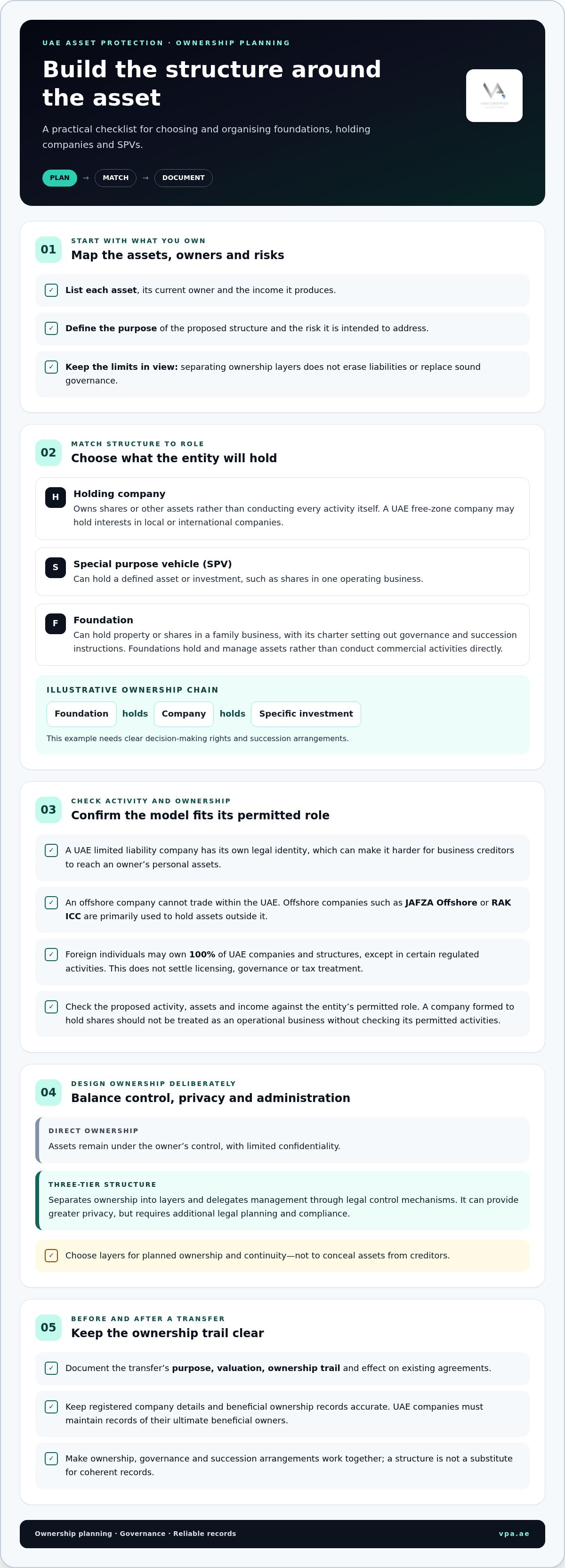
A holding company owns shares or other assets rather than conducting every activity itself. A special purpose vehicle (SPV) can hold a defined asset or investment, such as shares in one operating business. This separates ownership layers, but does not erase liabilities or replace sound governance. Start by listing each asset, its current owner and income, and the risk you want the structure to address.
A UAE free-zone company may serve as a holding company, owning interests in local or international companies. A UAE limited liability company also has its own legal identity, which can make it harder for business creditors to reach an owner’s personal assets. The right model depends on the intended activity: an offshore company cannot trade within the UAE, and offshore companies such as JAFZA Offshore or RAK ICC are primarily used to hold assets outside it.
Foreign individuals may own 100% of UAE companies and structures, except in certain regulated activities. That ownership possibility doesn’t settle licensing, governance or tax treatment. Map the proposed activity, assets and income first; then select an entity whose permitted role fits. A company formed to hold shares should not be treated as an operational business without checking its permitted activities.
Direct ownership places assets under the owner’s control, with limited confidentiality. A three-tier structure separates ownership into layers and delegates management through legal control mechanisms. It can provide greater privacy, but requires additional legal planning and compliance. For example, a foundation could hold a company, which in turn holds a specific investment. That chain needs clear decision-making rights and succession arrangements.
Before transferring assets, document the purpose, valuation, ownership trail and effect on existing agreements. Keep registered company details and beneficial ownership records accurate; UAE companies must maintain records of their ultimate beneficial owners. These structures suit planned ownership and continuity, not concealing assets from creditors. For a structure aligned with your business plans, consider discussing company formation.
3. Why the UAE Is a Preferred Jurisdiction for Asset Protection?
A foundation can hold property or shares in a family business, separating legal ownership from day-to-day management. For example, a DIFC Foundation could hold shares in a family company, while its charter sets out governance arrangements and succession instructions. This gives the family a defined framework for managing wealth across generations and international structures. Foundations are ownership and management instruments, not vehicles for conducting commercial activities directly.
The DIFC Foundation regime was introduced under DIFC Law No.3 of 2018. DIFC and ADGM foundations can hold international property, shares, intellectual property and investment portfolios. A Memorandum of Understanding between the DIFC and Dubai Land Department allows entities such as DIFC Foundations to purchase real estate registered with the department. This creates an option for structuring Dubai property through a foundation, alongside other family assets.
DIFC trusts and private foundations can help separate personal wealth from business assets and establish clear management responsibilities. DIFC and ADGM operate under English common law, offering familiar legal frameworks for international investors. These structures can support governance, ownership planning and intergenerational transfers. Their purpose is to hold and manage assets, rather than operate a trading business.
Setup and ongoing fees for UAE trusts, foundations and holding companies depend on the jurisdiction, structure, assets and administration required. The cost is determined for each case and provided after a quote request. Factors include establishment, governance and ongoing administration.
Compare each structure by asking what it will own, who will control it and how beneficiaries will access the assets. A family with Dubai property and overseas investment portfolios, for instance, needs to consider the relevant jurisdictions and transfer arrangements for each asset. This assessment helps identify a structure suited to the family’s wealth, governance priorities and long-term plans, rather than choosing an entity by name alone.
4. Asset protection during audits and legal claims
Asset protection is tested when an auditor, creditor or court asks who owns an asset and why it moved. Build the evidence trail before a dispute: keep asset registers, contracts, invoices, bank statements and board decisions together. For each transfer, record its date, parties, purpose and supporting valuation. Consistent records help you explain transactions instead of reconstructing them under pressure.
Keep a current schedule of assets, debts, income and expenses alongside signed financial agreements and contracts. Match each entry to its supporting document, then reconcile company accounts against the records. For example, a shareholder loan should have an agreement and entries showing the amount advanced and any repayment. Clear documentation makes corporate disputes easier to assess and supports a coherent account of ownership.
UAE companies must maintain records of their ultimate beneficial owners. Banking privacy does not mean anonymity: beneficial ownership records and AML/KYC requirements form part of compliance, alongside economic substance and corporate governance obligations. These duties do not remove the value of a lawful structure; they mean its ownership, purpose and transactions must be properly documented and transparent to relevant institutions.
Transferring assets to defeat creditors is illegal. A trust, foundation or holding company cannot turn a dishonest transfer into legitimate protection. Keep evidence that planned transfers had a genuine purpose, followed governance procedures and were recorded accurately. If a claim emerges, retain relevant correspondence and agreements, avoid altering records, and build a clear chronology of decisions and transactions.
Prepare one audit file for each entity, with current ownership records, accounts, contracts, approvals and compliance documents. Review it regularly, especially after a change in ownership, financing or business activity. Requirements can involve different emirates and jurisdictions, so label records by entity and location. For focused support with private client wealth structuring, organise the ownership documents and transaction history that underpin your strategy.
Ventureprise Acquisitions: Setting Up A Company In Dubai: 6 Myths That Will Hold You Back
Ventureprise Acquisitions can help turn your asset-protection priorities into a coordinated plan. If you're weighing a UAE company structure alongside family wealth and succession needs, Company Formation and Strategic Planning offer a practical starting point.
For private wealth planning, Ventureprise Acquisitions offers foundations and trusts advisory to help you consider how these structures may fit your ownership and governance objectives. Bring together your asset overview, business plans and succession priorities, then assess how these pieces should work together.
Explore Setting Up A Company In Dubai: 6 Myths That Will Hold You Back for a company-formation perspective, or contact Ventureprise Acquisitions to discuss your plans.
Turn your asset plan into a clear next step
A practical approach to how to protect assets in the UAE begins with decisions you can implement and maintain. Before making structural changes, define what you want your arrangements to achieve: continuity for a family business, clearer succession or a more organised ownership framework. Those priorities give your planning direction and make the next decisions more purposeful.
Ventureprise Acquisitions offers Company Formation and Strategic Planning for entrepreneurs assessing their UAE setup. Its resource, Setting Up A Company In Dubai: 6 Myths That Will Hold You Back, can help frame questions about establishing a presence. Bring your priorities and existing ownership information together to start a focused discussion about the right path for your business and family.
Take the next step at a pace that suits your plans. Contact Ventureprise Acquisitions to discuss your objectives and move towards a more considered structure.
Frequently Asked Questions
Why is the UAE a preferred jurisdiction for asset protection?
The UAE offers several legal frameworks for holding and managing wealth, including structures in the DIFC and ADGM. A practical answer to how to protect assets in the UAE starts with matching each asset to an appropriate structure and jurisdiction. For an international portfolio, map where assets are registered, how they are owned and which arrangements support continuity for beneficiaries.
How can you secure your international assets in the UAE?
Begin with an asset map covering each holding’s location, registered owner, related agreements and intended beneficiary. Then identify the institution’s succession process for accounts and investments, and keep the relevant ownership documents accessible. If assets span several countries, coordinate the plan across those jurisdictions so that a transfer or inheritance process in one place doesn’t conflict with arrangements elsewhere.
Why set up a DIFC Foundation?
A DIFC Foundation can provide a formal framework for holding and managing family wealth. For example, a family may use one to hold shares in a business, with governing documents explaining how decisions are made if the founder can no longer act. This can support continuity between generations. The foundation holds and manages assets; it does not conduct commercial activity directly.
How do UAE free-zone and mainland company structures affect asset protection?
A company’s separate legal identity can distinguish business assets and obligations from an owner’s personal holdings. The practical effect depends on the company’s activities, governance and financial records. A free-zone structure may suit permitted international or other licensed activity, while an offshore entity cannot trade within the UAE. Choose the model according to where the business operates and what the entity is intended to do.
Can UAE residents set up trusts or foundations to protect assets, and what are the requirements?
UAE residents can establish trusts or foundations as part of a wealth-planning strategy. To plan how to protect assets in the UAE, define the purpose, assets, beneficiaries and decision-making arrangements first. The governing documents should explain how the structure is administered and how assets may be transferred. Any company in the ownership chain also needs accurate records of its beneficial ownership.
How do UAE inheritance and succession laws affect asset protection for expatriates and Muslims?
Inheritance outcomes depend on the applicable rules, the person’s circumstances and any valid succession arrangements. For non-Muslims without a registered will, the described default gives a spouse 50% of the estate, with the remainder divided equally among the children; the civil rules described also allow an option for home-country law. Expatriates should align estate documents with assets held in each relevant jurisdiction.



Comments