

Corporate Tax Compliance for Dubai Companies: 2026 Guide
What if your company’s tax position depends less on where it is licensed and more on how its income is classified? Exempt status does not automatically secure a 0% rate, and assuming otherwise can leave important obligations unchecked. Getting corporate tax compliance for Dubai companies right starts with understanding how the national rules apply to your business.
It is reasonable to have questions: does your company need to register if it expects no tax bill, what records must it keep, and how does your operational structure affect its filing? Ventureprise Acquisitions helps clarify that the answers depend on your company’s structure, activities, income and financial year. Under the standard regime, taxable income up to AED 375,000 is taxed at 0%, with income above that threshold taxed at 9%. Qualifying exempt income is subject to separate conditions.
This 2026 guide explains the core obligations, highlights assumptions to check against current rules and helps you organise your next steps. You will learn what information to gather for registration, record-keeping and returns, so you can assess your position and plan your company administration clearly.
Key Takeaways
Start corporate tax compliance for Dubai companies by identifying the entity’s taxable-person status and financial period.
Assess free-zone tax treatment by looking beyond the licence to the conditions that may apply to qualifying income.
Use a clear workflow to organise registration checks, ongoing record-keeping and return preparation.
Gather the company’s details and records, then list any outstanding questions before deciding on next steps.
Table of Contents
Corporate tax compliance for Dubai companies: what the rules cover
UAE corporate tax applies to taxable business profits under UAE rules. The regime is governed by Federal Decree-Law No. 47 of 2022 and applies to relevant financial years starting on or after 1 June 2023. For most taxable persons, the rate is 0% on taxable income up to AED 375,000 and 9% on the portion above that threshold.
The UAE corporate tax regime applies to taxable business income within its scope. The company’s legal status, activities and circumstances determine how its obligations are assessed. Corporate tax is separate from VAT, which concerns taxable supplies and imports, and from an individual’s personal tax position. Treating these as one compliance task can lead to missed registrations or incorrect reporting. The Taxation in the United Arab Emirates provides general background. Use UAE government and Federal Tax Authority guidance to verify current requirements for your business.
Which companies should assess their corporate tax position?
Start by identifying the legal entity, where it was established, what it does and whether it has business activity or a presence in the UAE. UAE-incorporated companies, including free-zone entities, should assess their position. Foreign entities operating through a UAE permanent establishment may also fall within the rules. Individuals conducting business are assessed under separate criteria. Do not assume a company is outside the regime simply because it has no immediate tax bill.
Formation location alone does not establish an automatic exemption. Free-zone status may affect the treatment of qualifying income, but it does not remove the need to determine whether the entity is within the regime and which conditions apply. This is why corporate tax compliance for Dubai companies should begin with classification, not a guess based on the licence or business address.
Before setting compliance tasks, record the entity’s legal form, activities, ownership and financial year. Then consult current Federal Tax Authority guidance and relevant UAE government information on registration and taxable-person status. This assessment gives the company a sound basis for planning its next steps.
Free-zone status and corporate tax: what Dubai companies must not assume
A free-zone licence does not automatically mean a company pays no corporate tax. The key distinction is between where the entity is established and how its income is classified. A Qualifying Free Zone Person (QFZP) may access a 0% rate on qualifying income, but only while meeting the applicable conditions. Income outside that category is generally taxed at 9%, and QFZPs do not receive the AED 375,000 zero-rate threshold on non-qualifying income.
Free-zone incorporation alone does not settle a company’s corporate tax treatment. Eligibility and the nature of its income must be assessed against current UAE rules.
What should a company check before relying on a free-zone tax position?
Separate the entity’s legal setup from the treatment of each income stream. Review business activities, customer and transaction details, and the records that support how income is classified. A QFZP must meet conditions that include adequate economic substance, qualifying income, transfer pricing compliance and audited financial statements. Non-qualifying revenue must also remain within the de minimis limit: no more than 5% of total revenue or AED 5 million, whichever is lower.
Failure to meet a condition can remove QFZP status for the current tax period and the following four periods. Use the Federal Tax Authority Corporate Tax Guidance to check current criteria and official guidance. Careful classification is central to corporate tax compliance for Dubai companies. Keep the evidence behind your position clear, and organise accounting records so income and transactions can be reviewed consistently.
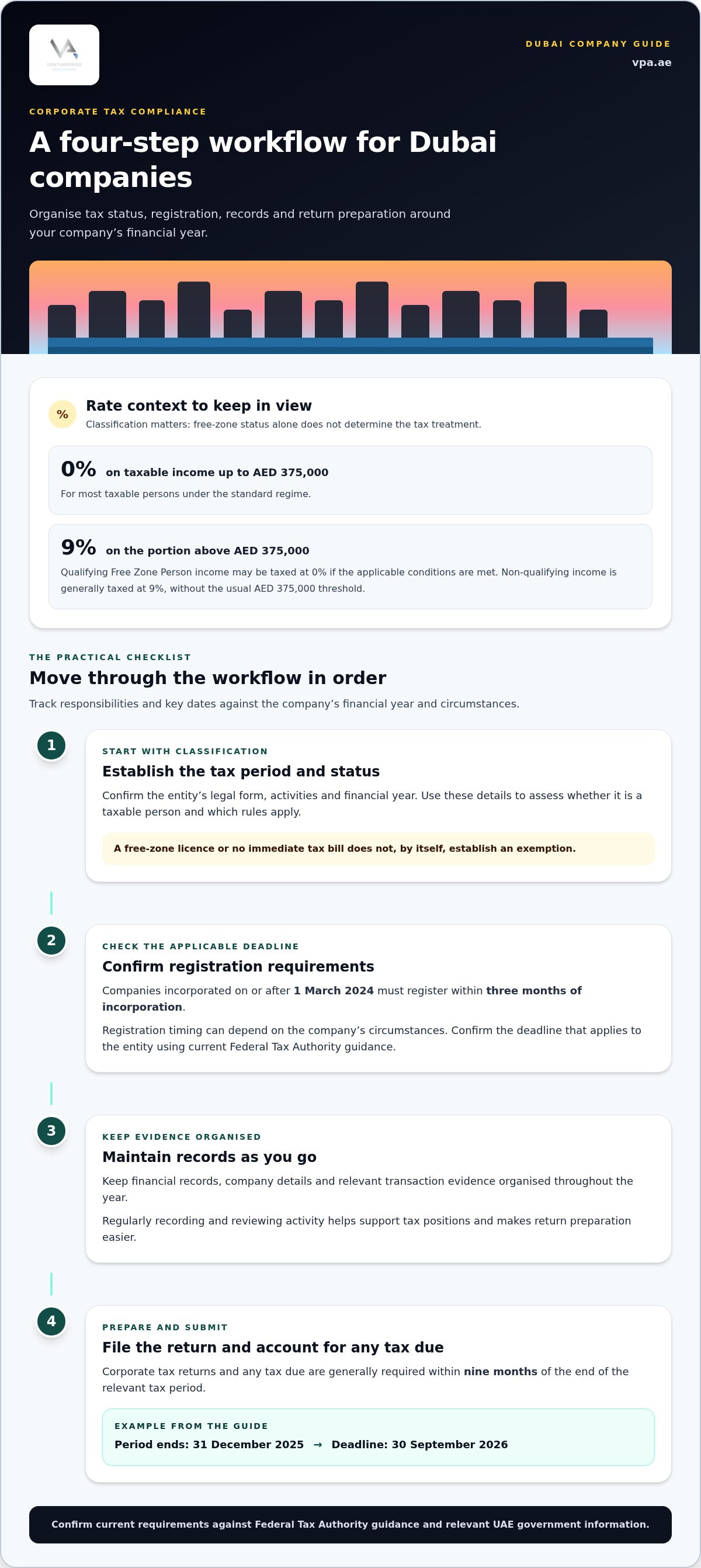
A practical corporate tax compliance checklist for Dubai companies
Turn the rules into a repeatable process. Corporate tax compliance for Dubai companies is easier to manage when responsibility for each step is clear and key dates are tracked against the company’s financial year and circumstances.
Establish the tax period and status. Confirm the entity’s legal form, activities and financial year. Use these details to assess whether it is a taxable person and which rules apply.
Check registration. Companies incorporated on or after 1 March 2024 must register within three months of incorporation. Confirm the deadline that applies to your entity using current Federal Tax Authority guidance, as registration timing can depend on the company’s circumstances.
Maintain records as you go. Keep financial records, company details and relevant transaction evidence organised throughout the year. Regularly recording and reviewing activity makes it easier to support tax positions and prepare a return.
Prepare and submit the return. Corporate tax returns and any tax due are generally required within nine months of the end of the relevant tax period. For example, a period ending on 31 December 2025 has a deadline of 30 September 2026. Confirm the deadline for your own period.
Which records and dates belong on the compliance calendar?
Build a calendar around the company’s financial year, registration deadline, return filing and payment dates. Organise formation details alongside financial records and transaction evidence, so the company’s structure and activity can be understood in context. The Company Formation information explains the company’s support for establishing a business and residency through strategic guidance. Record-keeping duties and retention rules depend on applicable requirements, so verify current details through official UAE guidance rather than relying on a general checklist.
Make the calendar a working tool, not just a year-end reminder. Assign responsibility for updating records and flagging changes in activities or transactions that could affect the company’s tax position. Keep deadlines visible and update the calendar whenever the company’s financial period or circumstances change.
How to organise the next steps for corporate tax compliance
Move from uncertainty to a clear handover. Bring together the information needed to understand the company’s position, identify open questions and assign each next step to the right person.
Identify the entity. Record its legal name, structure, formation details, activities and financial year. Include any changes that could affect how the business operates.
Gather the working records. Organise available financial information and relevant transaction evidence so the company’s activities and income can be reviewed in context.
List unresolved questions. Note any uncertainty about taxable-person status, income classification, free-zone conditions, cross-border activity or upcoming deadlines. Separate established facts from issues requiring a specialist view.
Agree responsibilities. Decide who will maintain records, monitor dates and coordinate any required filing or registration.
This handover makes corporate tax compliance for Dubai companies more manageable because it turns a broad obligation into defined decisions and actions. Keep questions about tax classification, deadlines and reporting together with the records needed to assess them. For wider business priorities, Ventureprise Acquisitions offers Strategic Planning: “Craft strategies that align with your business goals.”
When should a company seek specialist tax guidance?
Seek qualified tax advice if the company’s classification, eligibility for a particular treatment or cross-border position remains uncertain. These questions can depend on detailed facts, so set them out clearly and use current rules to guide the assessment. Registration, filing and tax interpretation are distinct steps, and it is useful to identify which question needs to be resolved before acting.
Tax administration should also sit within the company’s wider operating plan. Where business structure and growth planning intersect, strategic business support can help frame those wider priorities. Prepare your entity details, records and outstanding questions, then contact Ventureprise Acquisitions to discuss Company Formation and your next steps.
Make your next compliance decision with clarity
Strong administration starts before a deadline appears. Assign an owner for tax-related records, keep key company information accessible and make unresolved questions visible. That way, decisions can be addressed deliberately rather than under pressure, and corporate tax compliance for Dubai companies has a practical place within the wider business plan.
Ventureprise Acquisitions offers Company Formation: “Establish your business and residency in Dubai via our ‘strategic’ guidance.” Its Strategic Planning service helps “Craft strategies that align with your business goals.” Keep the company’s tax classification, filing obligations and supporting records clearly organised as part of its administration.
Take the next step with a clear picture of your entity, current records and any points that still need resolution. Discuss your Company Formation and next steps.
Frequently Asked Questions
Is every Dubai free-zone company exempt from corporate tax?
No. A free-zone licence alone does not establish exemption, and preferential treatment does not automatically apply to every income stream. For corporate tax compliance for Dubai companies, distinguish the entity’s registration location from the tax treatment of its activities and income. For example, a business may need to assess different revenue streams separately. Use current Federal Tax Authority guidance or qualified tax advice to evaluate the company’s specific position.
When does a Dubai company need to register for corporate tax?
Registration deadlines depend on the company’s category and circumstances, and registration is separate from calculating whether tax is ultimately payable. Under current UAE rules, companies incorporated on or after 1 March 2024 must register within three months of incorporation. Other entities may follow different requirements, so check the Federal Tax Authority’s latest instructions for the company’s legal form and relevant dates rather than copying another business’s schedule.
What records should a company keep for corporate tax compliance?
Keep financial and business records organised so transactions, income and the company’s tax position can be understood and supported. For example, establish a regular process to reconcile accounting entries with relevant invoices and transaction evidence, and note the business purpose of unusual items. The precise records and retention rules depend on applicable requirements and circumstances, so verify current guidance and seek qualified advice if a transaction or classification is unclear.
Do Dubai companies need to file a corporate tax return if no tax is payable?
Possibly. A nil tax bill does not, by itself, show that the company has no filing obligation. First establish the entity’s status and which requirements apply to the relevant tax period, then verify the return rules with the Federal Tax Authority. Do not treat a zero payment, low profits or free-zone registration as proof that no return is due. Keep evidence of the assessment and any relief position relied upon.
Can a company formation specialist handle corporate tax compliance?
A company formation specialist can support the establishment of a business, while corporate tax compliance involves separate questions about classification, records, registration and filing. Ventureprise Acquisitions offers Company Formation through strategic guidance for establishing a business and residency. For complex questions about income classification or eligibility, use qualified tax advice and assess the company’s position against current requirements.



Comments