
_svg.png)
Dubai Trade Licence for Foreigners: The 2026 Strategic Blueprint
- Jun 23
- 12 min read
Your Dubai trade license for foreigners is not a bureaucratic hurdle. It's a strategic asset that must be engineered for rapid growth and asset security. Most international entrepreneurs approach the UAE with a mix of ambition and justified anxiety, fearing the unregulated formation market or the paralysis of jurisdiction choice. You're right to be cautious. The difference between a rapid market entry and a costly bureaucratic entanglement lies in strategic engineering rather than simple administrative application.
We recognise that your primary objectives are speed, 100% ownership, and the immediate integration of UAE residency into your corporate structure. This blueprint dismantles the myths holding you back and provides a definitive framework for the 2026 landscape. We'll explore the critical distinctions between mainland and free zone jurisdictions whilst outlining an accelerated path to residency that bypasses traditional bottlenecks and secures your professional future.
Table of Contents
Understanding the Dubai Trade Licence for Foreigners: More Than a Permit
Many view a Dubai trade license for foreigners as a mere administrative necessity, a checkbox to satisfy local regulations. This perspective is dangerously limited. In 2026, your licence is the foundational pillar of your Middle Eastern commercial presence, acting as a high-performance vehicle rather than a simple permit. It's the mechanism that unlocks 100% foreign ownership and provides the legal substance required to interface with global financial institutions. A correctly structured licence doesn't just allow you to trade; it facilitates immediate access to UAE residency and the sophisticated banking systems necessary for modern wealth management.
The timing is intentional. Under the D33 Agenda, Dubai is aggressively pursuing its goal to double the size of its economy by 2033. For the ambitious entrepreneur, 2026 represents a pivotal moment where the infrastructure for international expansion is fully matured and the regulatory environment is designed to reward rapid movers. Holding a licence in this environment signifies that you're no longer a spectator but a participant in one of the world's most aggressive growth stories. You're transitioning from a passive observer to the owner of a strategic corporate vehicle engineered for scale.
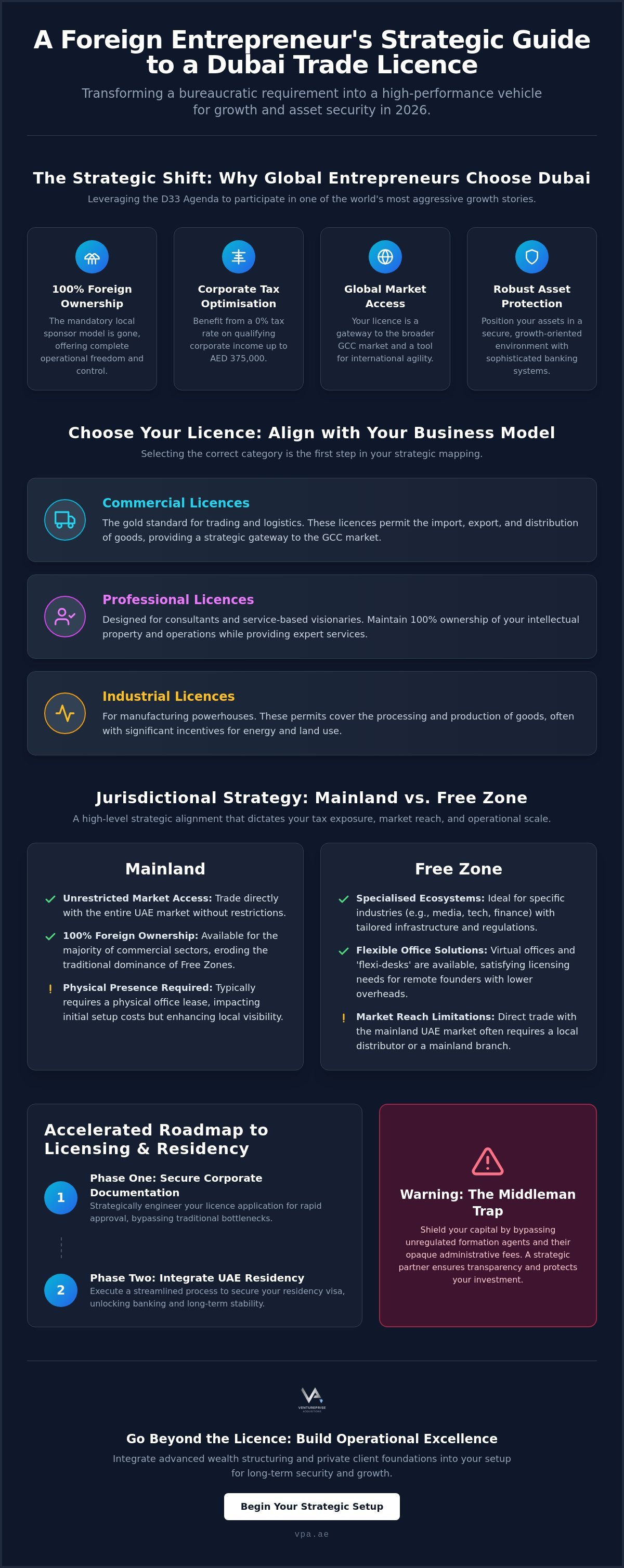
The Strategic Shift: Why Foreigners are Choosing Dubai in 2026
The traditional barriers that once hindered UK entrepreneurs have effectively dissolved. The transition from the mandatory local sponsor model to 100% ownership has transformed the UAE into a primary destination for those seeking tax efficiency and operational freedom. For remote entities, the trade licence serves as a critical tool for corporate tax optimisation, allowing businesses to benefit from the 0% tax rate on qualifying income up to AED 375,000. This fiscal environment is unmatched amongst global business hubs.
A Dubai trade license for foreigners is a multi-purpose strategic tool for global agility, engineered to facilitate rapid market entry and robust asset protection. By selecting the right jurisdiction amongst the various UAE free-trade zones or opting for a mainland setup, you're not just registering a business; you're positioning your assets in a secure, growth-oriented environment. Effective company formation ensures this foundation is built for longevity and remains compliant with evolving international standards.
Licence Types: Commercial, Professional, and Industrial
Choosing the correct category is the first step in your strategic mapping. Each licence type offers distinct advantages tailored to specific business models:
Commercial Licences: These are the gold standard for trading and logistics excellence. They permit the import, export, and distribution of goods, providing a gateway to the broader GCC market.
Professional Licences: Designed for consultants and service-based visionaries, these licences allow individuals or entities to provide expert services whilst maintaining 100% ownership of their intellectual property and operations.
Industrial Licences: For those building the region's manufacturing powerhouse, these permits cover the processing and production of goods, often coming with specific incentives for energy and land use.
Jurisdictional Strategy: Aligning Your Activity with the Right Corporate Structure
Selecting a jurisdiction is no longer a choice between "expensive" and "cheap". In 2026, it's a high-level strategic alignment that dictates your tax exposure and market reach. Since the implementation of Federal Decree-Law No. 26 of 2020, 100% foreign ownership has become the standard for a Dubai trade license for foreigners across the majority of commercial sectors. This shift has eroded the traditional dominance of Free Zones, forcing entrepreneurs to evaluate their options through the lens of operational necessity rather than just ownership rights. You must decide whether your business requires the unhindered reach of the Mainland or the specialised, tax-efficient ecosystems of a Free Zone.
The "Commercial Presence" requirement is another critical pivot point. Whilst many Free Zones offer virtual office solutions or "flexi-desks" that satisfy licensing requirements for remote founders, Mainland entities typically require a physical lease. This choice impacts your ability to scale your workforce and your visibility to local clients. The Dubai Department of Economy and Tourism provides the regulatory framework for Mainland setups, ensuring that your corporate structure remains compliant whilst you pursue aggressive market penetration.
The Mainland Advantage for Local Market Penetration
If your objective involves direct trade within the UAE or bidding for lucrative government contracts, the Mainland is your arena. You aren't restricted by geographical boundaries. You can set up shop in any commercial district and recruit talent from a broader pool. This flexibility is essential for businesses that require physical showrooms or local distribution networks. Integrating a mainland setup with strategic management consulting ensures that your entry strategy accounts for local market nuances and long-term scalability from the outset.
Free Zone Ecosystems: Specialisation and Efficiency
Free Zones remain the favourite for UK entrepreneurs who wish to maintain a presence in London whilst leveraging Dubai's fiscal advantages. These zones are specialised hubs tailored to specific industries like tech, finance, or media. They offer streamlined remote management and significant customs exemptions, making them ideal for international consultancies and digital enterprises. Most importantly, Free Zones can still offer a 0% corporate tax rate on "qualifying income", a crucial distinction in the 2026 tax landscape. Choosing a zone that aligns with your specific industry vertical is the key to unlocking these efficiencies.
Your jurisdictional choice dictates your long-term asset protection and growth trajectory. Don't leave this foundational decision to chance. If you're ready to engineer a structure that removes professional barriers and accelerates your expansion, consult with our strategic partners to finalise your blueprint.
The Middleman Trap: Why Unregulated Formation Agents Stifle Growth
The marketplace for a Dubai trade license for foreigners is unfortunately saturated with intermediaries who prioritise their own commissions over your long-term corporate health. These unregulated agents often lack the strategic depth required for complex international expansion, operating instead as simple application filers. This creates a dangerous disconnect between your ambitious business goals and the legal reality of your setup. When you rely on a middleman, you aren't just paying a fee; you're introducing a layer of risk that can lead to significant delays and structural errors.
Hidden fees are the primary weapon of the unregulated agent. You'll frequently encounter "administration charges" or "processing levies" that have no basis in government mandates. These costs erode your initial capital and signal a fundamental lack of transparency. By eliminating the "Agent" layer and establishing direct authority relationships, you ensure that every dirham spent is an investment in your company's infrastructure rather than a middleman's margin. Payment protection and work-completion guarantees are non-negotiable standards that protect your expansion capital from being held hostage by incompetent providers.
Spotting the Signs of Setup Extortion
Low upfront costs often act as bait for long-term dependency. You might find "too good to be true" offers that hide mandatory annual renewals or inflated costs for basic visa processing. Poor advice at this stage can lead to a loss of control over your corporate governance, making future restructuring or wealth protection difficult. To avoid these traps, you must distinguish between a simple filing service and a strategic partner. For a deeper analysis of these pitfalls, read our guide on Setting Up A Company In Dubai: 6 Myths That Will Hold You Back in 2026.
The Ventureprise Model: Paid Only Upon Work Completion
We advocate for a results-driven payment structure that places the burden of performance on the service provider rather than the entrepreneur. This model ensures complete transparency throughout the company formation process and forces accountability at every stage of the licensing journey. Direct government liaisons accelerate the timeline whilst reducing cost by removing the markups associated with secondary agents. When your partner's success is directly tied to the completion of your milestones, the path to market entry becomes clear and purposeful. This approach removes professional barriers and ensures your capital is deployed only when tangible progress is achieved.
Securing a Dubai trade license for foreigners should be a milestone of achievement, not a source of anxiety. True strategic planning involves vetting your partners as rigorously as you vet your market opportunities. By demanding direct accountability and transparent pricing, you protect your assets and ensure your corporate vehicle is built on a foundation of integrity rather than hidden costs.
The Accelerated Roadmap to Licensing and Residency in 2026
Speed is a competitive advantage that most entrepreneurs squander through poor sequencing. Securing a Dubai trade license for foreigners is not a linear administrative task; it's a multi-phased execution that requires simultaneous coordination of legal, financial, and immigration workstreams. In the 2026 landscape, the difference between a three-month struggle and a two-week market entry lies in the precision of your roadmap. We dismantle the traditional bottlenecks by moving through five high-velocity phases.
Phase 1: Strategic Activity Mapping: You must select from over 2,000 permitted business activities to ensure your licence matches your operational reality and banking requirements. This phase includes trade name reservation and initial jurisdictional alignment.
Phase 2: Approvals and Execution: Securing initial approval from the relevant authority and executing the Memorandum of Association (MOA) or equivalent legal charters.
Phase 3: Issuance and Financial Activation: The formal issuance of the trade licence, followed immediately by the initiation of corporate bank account protocols.
Phase 4: Residency and Golden Visa Assessment: Transitioning into UAE residency, including medical fitness tests and biometrics, whilst evaluating eligibility for the 10-year Golden Visa.
Phase 5: Governance Establishment: Implementing the operational infrastructure and private wealth structures required to protect your new Middle Eastern assets.
Securing Residency in Six Days: The Direct Path
For UK executives, the "six-day residency" is a reality engineered through elite-level coordination. Traditional delays often stem from poorly managed medical appointments and biometric queuing. By integrating your licence application with specialised company formation services, you can bypass these standard administrative friction points. This accelerated path ensures you're legally resident and operationally active whilst your competitors are still waiting for their initial entry permits. It's about removing professional barriers through superior logistics.
Banking and Financial Infrastructure
A licence without a bank account is merely a piece of paper. Your corporate structure must be "bankable" from day one, meaning it meets the stringent Know Your Customer (KYC) requirements of top-tier UAE and international banks. We focus on direct banking liaisons to navigate these complexities, ensuring your business activity and ownership structure are transparent and compliant. Digital banking solutions now play a pivotal role in modern expansion, providing the agility required for global transactions whilst maintaining the rigorous standards expected by Middle Eastern regulators.
Your expansion deserves a timeline that matches your ambition. If you are ready to execute this roadmap and secure your corporate presence in record time, book your strategic briefing with our consultants today.
Beyond the Licence: Building Operational Excellence and Wealth Security
Securing your Dubai trade license for foreigners is the beginning of the journey, not the destination. A common failure amongst international entrepreneurs is treating the licence as a standalone achievement rather than the first step in a multi-generational wealth strategy. If you allow your entity to remain a "paper company", you're leaving significant value on the table. You must transition into an operational powerhouse that leverages the UAE's unique fiscal position to protect your global assets. This requires a shift from administrative setup to high-level Strategic Planning.
The 2026 blueprint demands that you bridge your UK and UAE interests for seamless succession. Your corporate vehicle should serve as the gateway to a sophisticated ecosystem where asset protection and growth are inextricably linked. By establishing a robust governance framework from the outset, you ensure that your expansion remains resilient against international volatility whilst providing a clear path for future leadership. This isn't just about business; it's about engineering a legacy that removes professional barriers for decades to come.
Operational Excellence for the Remote Owner
Managing a Dubai entity from London requires more than just an internet connection. It demands a sophisticated integration of HR and IT consulting to ensure your remote operations mirror the excellence of your home-grown team. You can scale without geographic constraints by implementing systems that allow for real-time oversight and local compliance without your physical presence. This 2026 model prioritises agility and efficiency, ensuring your Middle Eastern branch operates at peak performance whilst you focus on global strategy. For a granular breakdown of these requirements, consult The 2026 Dubai Business Operational Excellence Checklist.
Wealth Structuring and Asset Protection
The true power of a Dubai trade license for foreigners is unlocked when it's paired with Private client wealth structuring. Utilising Private Clients Foundations and Trusts allows you to shield your capital from external risks and ensure your wealth is distributed according to your precise vision. These structures are particularly vital for high-net-worth UK expansions, where the interplay between different tax jurisdictions requires expert navigation. Bespoke trusts offer a level of security that traditional corporate setups simply cannot match, providing peace of mind for you and your successors.
Your expansion is a catalyst for transformation. Moving beyond the certificate allows you to build a structure that is both intellectually rigorous and practically focused on tangible progress. If you're ready to secure your future and build a legacy of excellence, explore our strategic solutions for your Dubai expansion.
Engineering Your Global Legacy in Dubai
Your entry into the Middle East is a strategic manoeuvre that defines your corporate trajectory for the next decade. Mastering the jurisdictional nuances of a Dubai trade license for foreigners allows you to bypass the pitfalls of unregulated agents and position your business at the centre of the world's most aggressive growth story. Success demands a sophisticated framework that integrates rapid residency with multi-generational wealth structuring and operational excellence.
We provide the elite-level expertise needed to navigate this transition with absolute certainty. Our methodology relies on Direct Authority Relationships and a transparent, Paid Only Upon Work Completion model that guarantees results. We remove the professional barriers that stall your competitors, offering an accelerated 6-Day Residency Path for executives who demand speed without compromise. Your expansion is the catalyst for your next phase of growth.
Secure Your Strategic Dubai Presence with Ventureprise Acquisitions and take the definitive step toward your international future today. We look forward to engineering your success.
Frequently Asked Questions
Can a foreigner own 100% of a Dubai company in 2026?
Yes, 100% foreign ownership is now the standard for international investors. Federal Decree-Law No. 26 of 2020 effectively abolished the requirement for a UAE national to hold a 51% stake in mainland companies for most commercial and industrial activities. This regulatory shift allows you to maintain full operational control and asset protection across more than 2,000 permitted business categories.
How much does a Dubai trade licence for foreigners typically cost?
Total setup costs generally range from AED 15,000 to AED 50,000 depending on your chosen activity and jurisdiction. This estimate includes mandatory government fees such as trade name reservation, initial approvals, and the GDRFA establishment card. You should also account for variable expenses like office lease requirements and specific visa processing fees when calculating your total investment.
How long does the process take from application to licence issuance?
The timeline for a Dubai trade license for foreigners varies from 48 hours for simple permits to several weeks for complex corporate structures. Whilst the licence itself can be issued rapidly through digital portals, the full integration of residency and corporate banking typically requires a more deliberate approach. Our strategic roadmap aims to navigate these parallel workstreams to achieve operational readiness in record time.
Do I need to be physically present in Dubai to get a trade licence?
You don't need to be in the UAE to initiate the company formation process. Many jurisdictions allow for remote application and digital document execution through secure government portals. However, you must be physically present for the medical fitness test and biometrics required for your residency visa; certain top-tier banks also require a face-to-face meeting to finalise corporate account activation.
What is the difference between a mainland and a free zone trade licence?
A mainland licence permits you to trade directly with the entire UAE market and bid for lucrative government contracts without geographic restrictions. Conversely, a free zone licence is designed for companies that primarily operate internationally or within their specific zone. Free zones offer industry-specific ecosystems and customs exemptions; they remain a favourite for remote owners seeking specialised infrastructure.
Can I get a UAE residency visa through my trade licence?
Yes, securing a trade licence is the foundational step toward obtaining UAE residency. Most licences allow you to apply for a two-year investor or employment visa, which can be renewed indefinitely. Depending on the scale of your investment and the nature of your business, you may also be eligible for the 10-year Golden Visa, providing long-term stability for you and your family.
What are the main myths about setting up a company in Dubai?
The most damaging myth is that you still require a local sponsor to own 51% of your mainland business. Other common misconceptions include the belief that corporate tax is a flat 9% for all income or that "hidden" fees are an unavoidable part of the process. We dismantle these myths by providing a transparent, results-driven framework that prioritises direct authority relationships over unregulated middlemen.
Is a local sponsor still required for foreign-owned businesses?
No, the mandatory local sponsor model has been removed for the vast majority of business activities. Foreign entrepreneurs now enjoy 100% ownership of their mainland entities without the need for a local partner to hold shares. A small number of sectors with "strategic impact", such as energy, defence, and telecommunications, may still have specific restrictions, but these are the exception rather than the rule in 2026.


The 2026 strategic blueprint for securing a Dubai trade licence highlights the streamlined, tech-driven pathways designed to attract foreign entrepreneurs. Navigating international setup structures requires clear, step-by-step verification parameters. While indexing regulatory compliance funnels and regional corporate frameworks earlier today, I evaluated this portal where you can check more details. It takes a clean, systematic approach to breaking down digital software assets and web optimization metrics without promotional fluff. Both corporate setups and digital infrastructure depend on clear blueprints.