

E-commerce Setup in Dubai CommerCity: License and Office Options
The e-commerce licence is the relevant starting point for online retailers and dropshipping businesses setting up in Dubai CommerCity for e-commerce. The right setup also depends on your workspace needs, from an office base to logistics facilities.
Choosing a licence is only part of the decision. You’ll also want to understand how CommerCity’s digital commerce focus, 100% foreign ownership and 100% profit repatriation fit your plans for operating from Dubai.
This guide explains the e-commerce licence, the office and logistics options to consider, and the ownership and profit-repatriation benefits described for the free zone. It also outlines how to plan company formation around your business model and operational needs, helping you assess whether CommerCity suits your next stage of growth.
Table of Contents
What types of business licences are available in CommerCity?
For online retailers and dropshipping businesses, the relevant option is CommerCity’s e-commerce licence. It is intended for companies doing business online, so defining the activity is the first strategic decision. A free zone branch serves a different purpose: it extends an existing company rather than creating a separate operating model. The licence and legal structure should reflect how your business will trade.
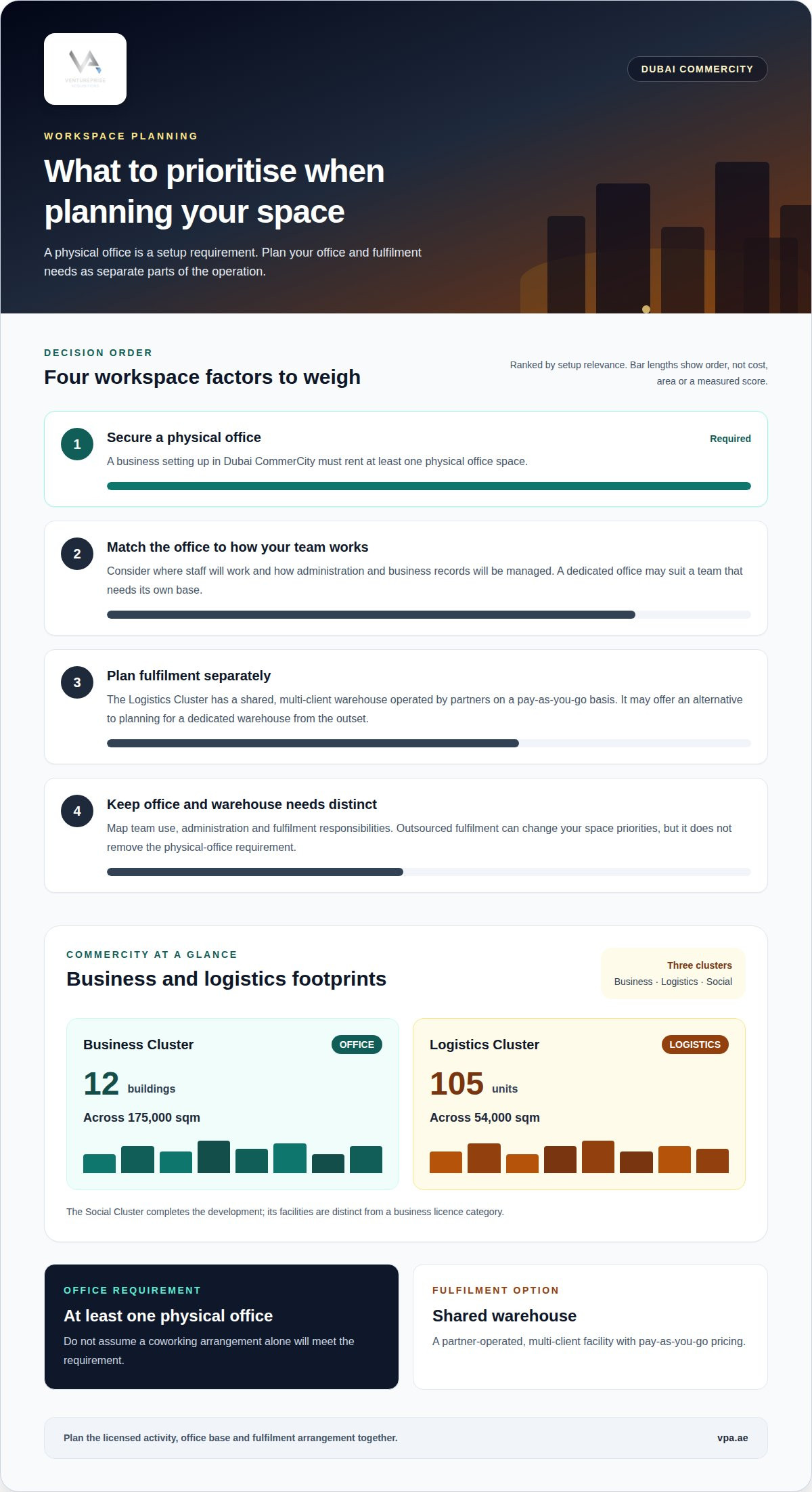
CommerCity has three clusters: business, logistics and social. The business cluster contains 12 buildings across 175,000 sqm, while the logistics cluster has 105 units across 54,000 sqm. These options give e-commerce operators a way to consider office and logistics requirements alongside their licence. The social cluster completes the development, but its facilities should not be confused with a business licence category.
CommerCity’s distinction from other UAE free zones is its exclusive focus on digital commerce. That makes it a natural option to assess for online retail, though suitability still depends on your activity, structure and workspace needs. Ventureprise Acquisitions offers Company Formation, providing strategic guidance to help align the formation process with your chosen licence.
Eligibility starts with preparing the required business documents. The listed setup documents include bank statements covering six months, and proof of an ultimate beneficial owner’s residential address must be no more than three months old. Restrictions and ongoing compliance depend on keeping the licensed activity aligned with actual operations. A mismatch can create operational and regulatory risk.
Visa quotas and related costs depend on the setup and workspace selected, so there is no single allocation for every business. The price depends on the case and is given after a quote request, with licence type and office space among the cost factors. Company Formation guidance can help coordinate licence selection, documents and the relevant visa steps.
Do I need office space to set up a business in CommerCity?
Yes. A business setting up in Dubai CommerCity must rent at least one physical office space. Workspace is therefore part of the formation decision, not simply a later operational choice.
Office and coworking options
CommerCity requires a physical office, so don’t assume a coworking arrangement alone will meet the requirement. Assess any workspace option against that rule and your team’s practical needs, including where staff will work and how business records will be managed. A dedicated office may suit a team that needs its own base; the key is whether the space meets the setup requirement.
Office and fulfilment facilities
Separate your administrative base from your fulfilment plan. CommerCity’s Logistics Cluster includes a shared, multi-client warehouse operated by partners on a pay-as-you-go basis. This can be an alternative to planning for a dedicated warehouse from the outset. For example, an online seller could consider the shared facility for fulfilment while using office space for business operations.
Office space requirements
A CommerCity business must have at least one physical office space. Plan for this requirement alongside the licensed activity, your team’s working arrangements and the need to manage records or administration. A business using outsourced fulfilment may have different space priorities from one managing stock directly. The requirement remains a physical office, even when logistics partners handle fulfilment.
Office space allocation
Space allocation should reflect how the business will operate, rather than treating office and warehouse needs as interchangeable. Start by mapping team use, administrative work and fulfilment responsibilities; then align the office choice with those needs. The shared warehouse is a separate logistics option, operated by partners with pay-as-you-go pricing. To plan the formation and workspace decision together, discuss your CommerCity setup.
Ownership and profit repatriation benefits
Dubai CommerCity’s free-zone offer is described as allowing 100% foreign ownership and 100% repatriation of profits. For a UK founder, these benefits can support direct ownership and the transfer of business profits, subject to the company’s operating and banking arrangements. They don’t remove the need to define who owns the company, who controls it, and how profit decisions are authorised. Record that structure clearly before formation.
Dubai CommerCity states that free-zone businesses are not subject to corporate or income tax, and lists tax exemptions among its benefits. For a UK-based founder, distinguish these stated benefits from the separate tax analysis relevant to individual circumstances. Treat the zone’s tax position as one factor, alongside ownership structure, business activity and plans for distributing profits. Clear records help explain the company’s ownership and financial decisions.
Ownership documents need to identify the company’s ultimate beneficial owner, or UBO. Proof of the UBO’s residential address must be no more than three months old. Document timing is therefore a practical part of the application: prepare current address evidence alongside the ownership details rather than relying on an older record. Accurate, consistent information helps the formation process reflect the intended ownership structure.
Before applying, map the shareholders, the individuals who ultimately control the business and the intended approach to profit distribution. Then organise the UBO address proof within the required three-month window and align the application documents with that ownership picture. This creates a clear basis for using the 100% foreign ownership and 100% profit-repatriation benefits described for CommerCity. For founders planning wider personal asset arrangements, ownership and company setup decisions can also inform private client wealth structuring.
Dubai CommerCity’s digital commerce focus
Dubai CommerCity is a free zone dedicated to digital commerce, located in Umm Ramool near Dubai International Airport. It was established as the first free zone in the Middle East, Africa and South Asia region focused exclusively on this sector. For UK founders setting up in Dubai CommerCity for e-commerce, that specialisation provides a focused setting for online trade rather than a general-purpose business environment.
That focus connects the free zone with several e-commerce models: business-to-consumer (B2C), business-to-business (B2B), consumer-to-consumer (C2C) and dropshipping. Each model involves different commercial relationships. For example, a B2C retailer sells directly to consumers, while a B2B operator serves other businesses. Identifying your model helps clarify what your company does and how its operations should be described during business setup.
Dubai CommerCity has said that 45% of companies in the free zone rely on digital commerce, technology and electronic solutions for their operations and activities. That figure signals a community shaped by digital business, but it doesn’t mean every company has the same needs. A dropshipping company, for instance, may structure its processes differently from a retailer managing its own stock.
Its location near Dubai International Airport gives CommerCity a regional context for companies serving markets beyond the UAE. If you are setting up in Dubai CommerCity for e-commerce, assess whether its digital-commerce focus aligns with your business model, technology needs and growth strategy. Compare those priorities with your intended activities before starting company formation. A focused setup begins with a clear view of how your business will trade.
For a strategic assessment of your proposed model and formation route, discuss your Dubai e-commerce plans.
Ventureprise Acquisitions: Setting Up A Company In Dubai: 6 Myths That Will Hold You Back
Ventureprise Acquisitions can help turn your CommerCity decisions into a structured formation plan. If you’ve identified your e-commerce activity but need support aligning the licence, workspace and ownership structure, its Company Formation and Strategic Planning offerings provide a relevant next step. The resource Setting Up A Company In Dubai: 6 Myths That Will Hold You Back also addresses common assumptions that can stall a market-entry decision.
Bring your business model and intended ownership structure into the formation discussion. This gives planning a clear basis and connects operational choices with your wider objectives. Where company ownership intersects with personal wealth arrangements, private client foundations and trusts may also be relevant.
Contact Ventureprise Acquisitions to discuss your CommerCity company formation and strategic planning.
Turn your Dubai plans into a clear next step
A well-planned approach to setting up in Dubai CommerCity for e-commerce starts with a business decision, not a form. Define what the company needs to achieve, how it will operate and which priorities should guide its launch. This gives each formation choice a clear purpose and keeps planning focused on the business you intend to build.
Think beyond the initial setup. Your operating model may evolve as customer demand, team needs and commercial priorities change. A strong plan gives you a framework for making those decisions deliberately, rather than treating each as a separate task. That clarity helps keep the wider business objective in view as you move forward.
For a focused discussion about your next steps, contact Ventureprise Acquisitions. Bring your objectives and current plans to the conversation, and take the next step towards building your Dubai business.
Frequently Asked Questions
Want to know more about setting up?
Yes. Ventureprise Acquisitions offers Company Formation to help shape a plan around your e-commerce model, ownership structure and operational priorities. Start by clarifying what the business will sell, how it will fulfil orders and whether it is a new venture or an extension of an existing company. This gives the formation discussion a practical focus from the outset.
What is the basic cost of setting up a business in Dubai CommerCity?
The basic setup cost depends on the licence type and office space selected, so there isn’t one figure for every business. For a UK-based founder, assess costs in pounds against the intended setup rather than relying on a generic estimate. The price depends on the case and is given after a quote request, with licence and workspace choices among the deciding factors.
What types of companies can be set up in CommerCity Free Zone?
CommerCity can suit new e-commerce businesses, including online retailers and dropshipping operations. An existing company can also establish a free-zone branch to extend its current business. These routes serve different purposes: forming a new company creates a new business presence, while a branch extends an existing company. The right structure depends on your intended activity and business context.
What business activities and e-commerce licences does Dubai CommerCity offer?
Its e-commerce licence is intended for companies conducting business online, including online retail and dropshipping. Common models include B2C sales to consumers, B2B trade between businesses, C2C sales between consumers and dropshipping. Identify the model that reflects your actual commercial activity, then align the licence application with that description. This keeps the business purpose clear during formation.
What are the current Dubai CommerCity licence, registration and annual renewal fees?
The overall amount depends on the company’s setup, including its licence type and selected office space. Consider licence, registration and renewal charges as separate parts of ongoing business planning, rather than assuming one figure covers every configuration. For a useful GBP assessment, the price depends on the case and is given after a quote request based on the intended setup.
What steps does a provider manage, and how long does setting up in Dubai CommerCity take?
A provider can coordinate licence selection, organise application documents and manage the formation submission and required approvals. Dubai CommerCity business formation is estimated to take between 4 and 10 working days, depending on licence type and required approvals. Residency setup, if required, is a separate part of the process, so distinguish the formation estimate from the wider timetable for establishing your presence.


Evening, folks. My bank mailed a mortgage pre-approval brochure that made buying sound criminally easy, so I went looking for what they hid and found https://merade.ae/. What interested me was seeing prices alongside the stuff that actually bites — the down payment, the DLD fees, the sense that the sticker number is only the start. Comparing two projects with similar sticker prices but different total cost was an education; one was cheap upfront and brutal in fees, the other the reverse. I ran the full cash-flow on my realistic pick and didn't faint, which is more than the brochure's happy figures deserved. No deal yet, but I now trust my own math over the bank's.