

Managing remote teams from a Dubai HQ with clear practices
Control is not the same as management. Managing remote teams from a Dubai HQ means setting clear goals, giving people the tools and autonomy to deliver, and making work visible across locations and time zones. Effective practices focus on outcomes, not constant monitoring.
It’s easy to assume remote work requires more meetings and closer supervision. In practice, teams work more effectively when they know what matters, where to find guidance and how to raise questions without interrupting focused work.
This article covers the essentials of remote team management and how to put them into practice: choosing communication and project tools, building team connection, setting expectations and documenting processes. These elements work together to create clarity, support collaboration and keep a distributed team aligned with the business.
Table of Contents
1. Communication and project-management tools
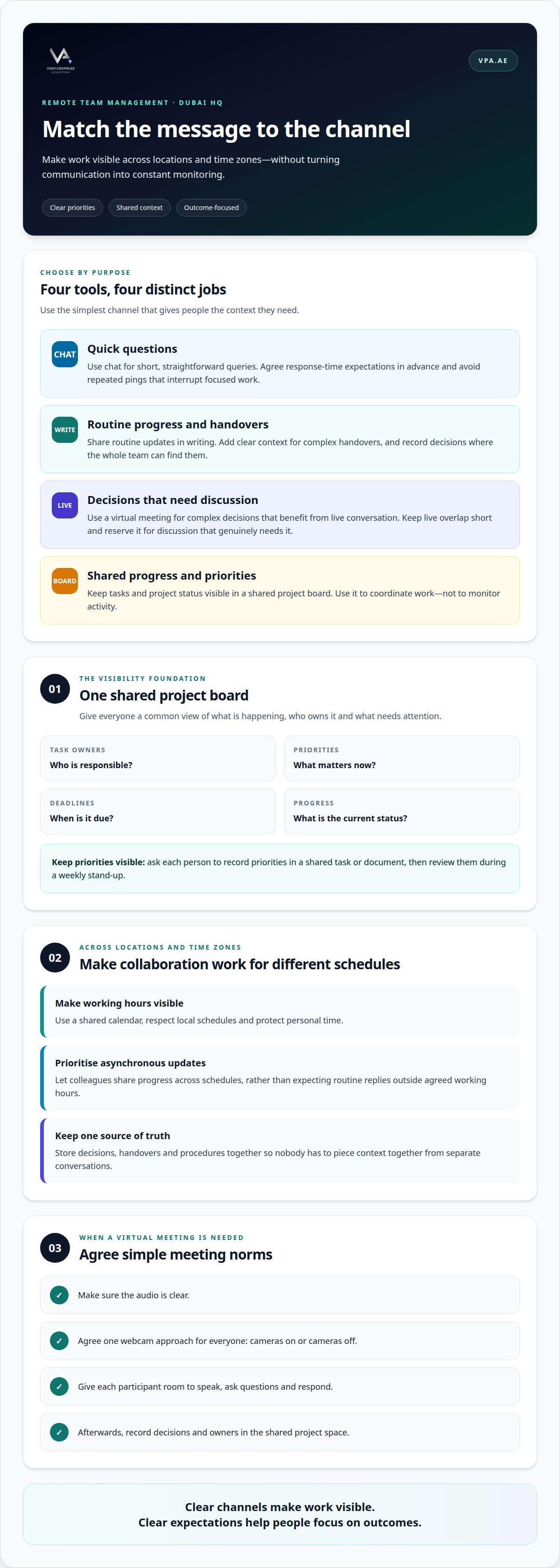
Mainland and free-zone companies can use the same management practices for day-to-day communication. The right approach depends on the work, team locations and operating arrangements, not the company classification. A hybrid team with field staff and office colleagues should set shared communication rules, then adapt them to each role. For example, a field update may need a concise message, while a complex office handover benefits from written context and a recorded decision.
Start with a shared project board showing task owners, priorities, deadlines and progress. Ask each person to record priorities in a shared task or document, then review them during a weekly stand-up. Match the channel to the message: chat for quick questions, written updates for routine progress, and virtual meetings when a decision needs discussion. Agree response-time expectations in advance, and avoid repeated pings that disrupt focused work. This makes work visible without turning the board into an activity-monitoring tool.
Field and office teams often face different communication challenges. A colleague away from a desk may need mobile-friendly instructions and a clear route for urgent updates, while an office-based team may rely more on shared files and project discussions. Keep decisions, handovers and procedures in one source of truth, so nobody has to piece together context from separate conversations. Across locations and time zones, make working hours visible on a shared calendar, respect local schedules and prioritise asynchronous updates. Reserve short periods of overlap for decisions that genuinely need live discussion.
Set simple norms for virtual meetings. Make sure audio is clear and choose one webcam approach for everyone: cameras on or cameras off. Give each participant room to speak, ask questions and respond before moving on. Afterwards, record decisions and owners in the shared project space. A suitable channel, documented guidance and regular feedback help confirm that a distributed team understands priorities and can act on them.
2. What Is Remote Team Management?
Remote team management means coordinating people, priorities and performance when colleagues work in different places. A fully remote team works away from a shared office; a hybrid team combines remote and office-based work. Synchronous collaboration happens through live calls, while asynchronous work uses shared documents and updates across schedules. Match the approach to the task: discuss a complex decision live, but share routine progress in writing.
Protect personal time with visible working hours, agreed response expectations and a clear definition of urgent work. A team member outside Dubai shouldn’t be expected to answer routine messages during personal hours. Assess performance through completed work, quality standards and measurable goals, not time spent online. Regular priority reviews help managers identify blocked tasks without constant monitoring.
UAE labour rules for remote work, working hours and monitoring depend on the employment arrangement and where the employee works. Put expectations in writing, and treat team policies as operational guidance, not a substitute for applicable employment requirements.
A Dubai HQ alone doesn’t determine an employee’s visa, residency or work-permit requirements. These depend on the person’s location and employment arrangement, so address immigration requirements before agreeing on a start date.
Remote-work security risks include unauthorised access, unsafe file sharing and lost devices. Set system-access rules, use approved collaboration tools and document whom employees should contact if a device or account is compromised. Clear procedures help the team respond consistently.
Technology investment should support specific needs, such as secure file sharing, project tracking or reliable calls. Assess its value against outcomes: smoother handovers, fewer delays and better visibility of work. For support shaping a distributed operating model, discuss your strategic priorities.
3. Informal social connection and team bonding
A global team needs more than task coordination to build a shared culture. Remote workers may miss informal conversations that help colleagues understand one another beyond their roles. Build connection into existing routines: open a team meeting with a brief personal check-in, or create an optional chat space for non-work conversations. Keep participation welcoming, not compulsory, so colleagues in different locations can join comfortably.
Choose simple activities with a clear purpose. A virtual coffee chat gives colleagues time to talk without an agenda, while a lightweight online game can help new starters learn names and roles. Praise contributions in the team channel when someone completes a difficult handover or supports a colleague. Specific recognition reinforces valued behaviours and makes contributions visible across locations.
Connection also depends on practical norms. Agree how colleagues welcome new team members, celebrate milestones and handle cultural differences. For example, ask each person which occasions they’re comfortable recognising, then use a shared calendar for relevant dates. Managers should model respectful participation and make space for quieter voices, rather than treating social activities as a substitute for one-to-one support or useful feedback.
In-person gatherings can strengthen relationships built through remote collaboration. Plan a team retreat around a clear purpose, such as setting shared priorities, resolving cross-team friction or welcoming new colleagues. Include both structured work and informal time together. For a global team, rotate locations or choose a format that doesn’t repeatedly disadvantage the same group. Follow up by documenting decisions and assigning owners.
Social connection is one part of effective remote management, alongside suitable tools, organised work, measurable goals, communication and employee autonomy. Overseas payroll, tax and social-security treatment depends on where each employee works and their employment arrangement. Map those details before setting payroll, because a Dubai HQ alone doesn’t determine obligations elsewhere. Keep team norms consistent, but adapt social activities to employees’ locations, preferences and working patterns.
4. Setting expectations and documenting processes
Clear expectations give remote employees a reliable basis for action. About half of professionals don’t understand what their workplace expects, so leaders should define responsibilities, deadlines and quality standards in writing. For each assignment, state the intended result, who is accountable and how success will be assessed. This reduces guesswork without dictating every step.
Connect individual goals to business priorities, then give each employee autonomy over how to achieve them. For example, define a client deliverable and its review date while allowing the employee to organise the work. Assess progress against milestones, completed work and agreed standards, rather than online activity. If a deadline is at risk, agree how early the employee should raise it and who can resolve blockers.
Make processes usable, not merely documented. Keep current workflows, templates, decision records and quality checklists in an accessible shared location. For a recurring approval, document who submits it, who reviews it and where the final decision is recorded. Add an owner and review date to each process document so outdated instructions don’t quietly shape the work.
Set realistic workloads by agreeing priorities and discussing capacity before adding urgent tasks. A weekly planning conversation can uncover clashing deadlines, unclear ownership or dependencies across teams. Leaders build trust and engagement across countries and time zones by applying consistent standards, inviting feedback and making decisions visible. Tailor support to each employee’s needs while keeping shared expectations clear.
Review the system when work changes: update goals, clarify accountability and revise the relevant process. This keeps expectations aligned with actual responsibilities instead of letting old assumptions persist. For support aligning business priorities and operating practices, discuss your strategic planning needs.
Ventureprise Acquisitions: Setting Up A Company In Dubai: 6 Myths That Will Hold You Back
Ventureprise Acquisitions can help entrepreneurs planning a Dubai presence move from operational questions to the decisions involved in establishing their business. If your remote-team strategy forms part of a wider market entry, Company Formation and Strategic Planning can support those next steps. Its guide, Setting Up A Company In Dubai: 6 Myths That Will Hold You Back, also addresses common assumptions that may complicate planning.
Turn to these services when shaping a Dubai business presence and aligning its structure and strategic direction with your plans. They complement the management practices discussed here, but don’t replace the employment, payroll or data-protection advice relevant to your team’s circumstances.
Contact Ventureprise Acquisitions to discuss your company formation or strategic planning needs.
Build a model that can grow with your business
As your organisation expands, its operating model needs to keep pace. New markets, changing roles and additional locations can affect how decisions are made and how teams work together. Treat the way you lead distributed employees as part of your wider business design, not a fixed arrangement that never needs revisiting.
For leaders managing remote teams from a Dubai HQ, the next step is to connect people practices with the company’s direction. Consider how responsibilities, decision-making and team structure can support your plans as the business develops. Ventureprise Acquisitions’ Strategic Planning supports business growth, while Company Formation helps establish a commercial presence in Dubai.
Bring your priorities into focus and identify the decisions that matter now. Contact Ventureprise Acquisitions to discuss your plans. With a clear direction, you can move forward confidently and build a business ready for its next stage.
Frequently Asked Questions
What Is Remote Team Management?
Remote team management means coordinating people and responsibilities when colleagues work from different locations. It also involves defining who can make decisions, how work moves between roles and where employees can raise blockers. For example, a client project might assign one person to approve deliverables and another to escalate a missed dependency, avoiding confusion when the manager is offline.
What are the best practices for managing remote teams from a Dubai headquarters?
The strongest practices pair clear ownership with flexibility in how employees deliver results. When managing remote teams from a Dubai HQ, map each role to its key outputs, decision authority and handover points. Then review whether the arrangement works for colleagues in other locations. If a task repeatedly stalls between departments, clarify who owns the handover instead of adding more status checks.
How do Dubai working hours and time zones affect remote teams in Europe, Asia and the Americas?
Time differences affect when colleagues can meet, respond and hand over work. Dubai-based leaders should compare local working hours with those of employees in Europe, Asia and the Americas, allowing for seasonal clock changes where relevant. Schedule essential live discussions during reasonable shared working hours, and handle routine updates asynchronously. When overlap is limited, rotate inconvenient meeting times so one region doesn’t carry the burden.
What communication tools and project-management software work best for distributed teams?
The best setup depends on the work, security needs and how employees collaborate. A distributed team might combine a project board for ownership and deadlines, shared documents for detailed guidance, and chat for quick coordination. Choose tools that help colleagues find the latest decision without searching through unrelated threads. Agree where final documents and approvals belong before a project begins.
How much does it cost to set up and manage a remote team from Dubai?
The cost depends on the case and is provided after a quote request. Key factors include team size, the roles involved, required equipment and software, and where employees work. Employment arrangements and necessary setup can also affect the overall budget. Separate initial setup needs from ongoing operating costs to build a useful forecast rather than relying on a generic estimate.
How should a Dubai HQ measure remote-team performance and productivity?
Measure performance against role-specific outcomes, agreed deadlines and quality criteria. For a customer-support role, a useful review might consider whether cases are resolved accurately and within the agreed service target, alongside feedback on recurring issues. Compare results across consistent review periods, then discuss obstacles and development needs with the employee. Don’t treat time online or message volume as proof of productivity.


Comments