

How to meet payroll requirements for a Dubai company
End-of-service gratuity is a statutory liability, not a discretionary bonus. Non-GCC nationals who complete at least one year of continuous service can qualify: the payroll requirements for a Dubai company include calculating gratuity at 21 days of basic salary for each year of service during the first five years, then 30 days per year thereafter, capped at two years’ salary. Employees with less than one year of service aren’t eligible.
Getting the calculation right is only one part of compliant payroll. Salary transfers, employee entitlements and accurate records all need a clear process, and the rules can depend on an employee’s status and the company’s regulatory framework.
This guide explains who qualifies for gratuity, how to transfer salaries through the UAE’s Wage Protection System (WPS) where it applies, and how to process and record payroll. You’ll also learn how to build a reliable workflow, from setting out employment terms to recording salary payments and end-of-service amounts.
Table of Contents
What is ‘End of Service Gratuity’ and who does it apply to?
Non-GCC employees who complete at least one year of continuous service can qualify for end-of-service gratuity. Federal Decree-Law No. 33 of 2021 mandates this benefit for eligible employees. UAE and GCC nationals are generally covered by pension and social security arrangements instead.
Payroll outsourcing and software costs depend on employee numbers, processing needs, support and system features. The scope of work shapes the cost, so request a quote based on the services required.
Calculate gratuity using basic salary and service. For service of at least one year but less than five years, calculate 21 days of basic salary for each year. After five years, calculate 21 days for the first five years and 30 days per year thereafter, subject to a cap of two years’ salary.
Put key employment terms in writing. Set out salary, allowances, probation, working hours, annual leave, notice, benefits and termination terms in each contract. Specify the agreed salary currency and payment frequency, then keep the signed agreement aligned with payroll records.
Register new employees and retain evidence. Register newly recruited employees with the Ministry of Labour at the time of employment. Keep each employee’s contract, employment permit, identity details and salary records together, and retain statutory payroll records for the period required by local legislation.
Align salary payments with the contract. Use the agreed currency and payment schedule consistently, and reconcile each transfer against the employee’s salary record. An employment permit can provide a route to live and work in the UAE.
Classify each working arrangement correctly. An Employer of Record can legally employ workers on a company’s behalf and handle payroll administration, contracts and statutory compliance. For contractors, document the agreed scope and payment terms separately, rather than processing invoices as employee salary.
Salary transfers through approved banks and financial institutions
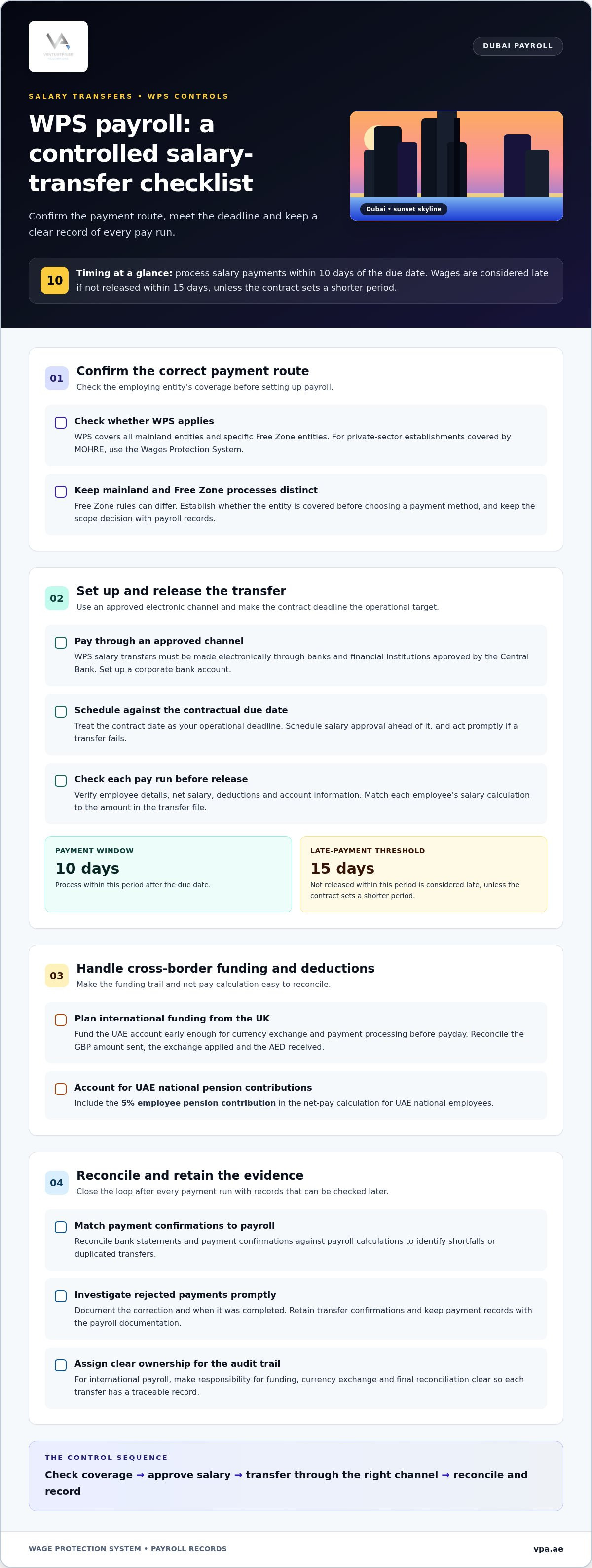
For private-sector establishments covered by MOHRE, use the UAE Wages Protection System (WPS). Process salary payments within 10 days of the due date; wages are considered late if not released within 15 days, unless the employment contract sets a shorter period. Treat the contract date as your operational deadline, and act promptly on failed transfers.
Confirm whether WPS applies. The UAE Ministry of Human Resources and Emiratisation introduced WPS to support accurate, timely wage payments. It covers all mainland entities and specific Free Zone entities. Establish whether your company falls within scope before configuring payroll software or issuing salary instructions.
Use an approved payment channel. WPS salary transfers must go electronically through banks and financial institutions approved by the Central Bank. Set up a corporate bank account, then match each employee’s salary calculation to the amount provided in the transfer file.
Plan international funding from the UK. Fund the UAE account early enough to complete currency exchange and payment processing before payday. Reconcile the GBP amount sent, the exchange applied and the AED received; review bank statements against payroll calculations to identify shortfalls or duplicated transfers.
Separate mainland and Free Zone processes. Mainland private-sector establishments covered by MOHRE must pay through WPS. Free Zone rules can differ, so determine whether the entity is covered before selecting its payment method. Keep the scope decision and payment records with payroll documentation.
Build controls around each pay run. Schedule salary approval ahead of the contractual due date. Check employee details, net salary, deductions and account information before release. For UAE national employees, account for the 5% employee pension contribution in the net-pay calculation, then reconcile the payment confirmation.
WPS does not remove the need for sound records. Retain transfer confirmations and investigate rejected payments promptly, documenting the correction and when it was completed. For international payroll, assign responsibility for funding, currency exchange and final reconciliation so every transfer has a clear audit trail.
How can businesses ensure compliant payroll processing in Dubai?
Build payroll around the rules that apply to each employing entity and employee. Record working time, leave and statutory benefits before calculating each pay run.
Check free-zone and emirate payroll requirementsMap each employee to the employing entity, work location and applicable regulator. The UAE has seven emirates and 45 Free Zones, each with its own administrative procedures. Free-zone frameworks can differ for registration, licensing and employment administration, so don’t assume a Dubai mainland process automatically fits a Free Zone.For a branch or Free Zone workforce, record the hiring entity and applicable payroll route. Check WPS scope separately, as it covers mainland entities and specific Free Zone entities. Prepare the relevant registration and payment process before the first payroll run, and document the decision for each entity.
Process overtime, leave and public holidaysCapture attendance and approved leave before closing payroll. The standard UAE workweek is 8 hours per day or 48 hours per week. Normal-day overtime is 1.25 times the regular hourly rate; work on a rest day or public holiday is paid at 150% of the normal hourly rate.Record annual leave, sick leave and holiday compensation as separate payroll entries. Employees receive 30 calendar days of paid annual leave after completing one year; those with more than six months but less than one year receive at least two days monthly. Sick leave totals 90 days per year: the first 15 days are full pay, the next 30 half pay, and the remaining 45 unpaid.For public-holiday work, record whether a substitute holiday is granted. With a substitute holiday, pay 1.5 times the ordinary wage; without one, add 150% of basic salary for the days worked. During Ramadan, Muslim employees’ working hours are reduced by 2 hours per day.
Payroll reporting and accounting journal entries
Turn every completed payroll run into an accurate record of employee pay, employer costs and payments. Meeting payroll requirements for a Dubai company also means keeping reports consistent with contracts, bank transactions and accounting entries.
Prepare payroll reportsGenerate a report for each pay run showing gross salary, allowances, deductions, net pay and payment status. Reconcile totals against bank statements and WPS records for employees paid through approved channels. Record corrections separately, preserving both the original calculation and the amended amount for review.Use consistent processing dates and reporting periods across payroll software and the general ledger. For a global workforce, distinguish foreign employee records and keep pay data separate for each employing entity.
Handle tax and statutory reportingSeparate employee payroll records from corporate tax calculations. The UAE personal income tax rate on employment income is 0%, but pension and social security contributions may still apply to eligible employees. Record these contributions separately from salary and retain the supporting documents.Where WPS applies, reconcile reported wages with the electronic transfer file and payment confirmation. This helps identify and resolve differences between approved salary calculations and completed payments.
Compile tax returns and annual wage reportsMaintain an annual payroll summary for accounting review, including salaries, allowances, deductions, contributions and gratuity provisions. Tie each total to monthly reports and ledger entries, then document any adjustments made during the year.Keep employee wage information distinct from company tax calculations. Before preparing tax documentation, compare the payroll summary with the company’s financial records. This supports payroll requirements for a Dubai company without treating employee pay as a corporate tax figure.
Produce payslipsGive each employee a detailed salary slip that clearly shows the pay components. UAE private-sector employers commonly issue payslips monthly, although there is no single statutory format. Include the pay period, salary components, deductions and net amount, then match the figures to the employee’s payroll record.Store payslips securely alongside payroll reports. Consistent filing gives accounting staff a clear audit trail when reviewing journal entries or resolving an employee’s payment query.
For structured financial reporting, discuss accounting and bookkeeping support for your Dubai company.
Ventureprise Acquisitions: Setting Up A Company In Dubai: 6 Myths That Will Hold You Back
Ventureprise Acquisitions supports entrepreneurs entering the Dubai market through Company Formation and Strategic Planning. Once you understand the payroll rules, align your business structure, hiring plans and operational requirements from the outset.
Turn to the firm when you’re assessing how to establish a commercial presence in Dubai or shaping a plan for growth. Its guide, Setting Up A Company In Dubai: 6 Myths That Will Hold You Back, addresses common assumptions that can complicate early decisions. Strategic Planning can help connect the company’s direction with its operating model, while Company Formation supports the establishment process.
Payroll compliance remains the company’s responsibility. Use these steps to organise salary transfers, employee records and reporting alongside your wider setup plans. To discuss your Dubai business objectives, contact Ventureprise Acquisitions.
Build your Dubai business on a stronger operating plan
Payroll is one part of a wider decision: how your Dubai business will be structured, staffed and positioned to grow. Treat the payroll requirements for a Dubai company as an input to your operating plan, not a process to design in isolation. Linking workforce plans with business priorities can support more deliberate decisions as your organisation develops.
Ventureprise Acquisitions supports this next stage through Company Formation and Strategic Planning. Its guide, Setting Up A Company In Dubai: 6 Myths That Will Hold You Back, can help you challenge assumptions as you shape your market-entry approach. Bring your priorities together, consider how the business should evolve, and set a direction that supports sustainable progress.
Contact Ventureprise Acquisitions to discuss your Dubai business plans. Take the next step with clarity and move forward with confidence.
Frequently Asked Questions
Can I pay my employees without a UAE bank account?
For employees paid through WPS, salaries must pass through approved banking channels or financial institutions. A UK account alone cannot send salary payments directly through those UAE channels. Set up a corporate bank account to fund the company’s payroll, then reconcile the amount sent from the UK with salary payments completed in the UAE.
Do employees in Dubai pay income tax?
Employment income is subject to a 0% UAE personal income tax rate. That doesn’t remove every payroll obligation: employers may still need to account for pension and social security contributions for eligible UAE and GCC nationals. For example, keep an employee’s nationality and applicable contribution records separate from any personal income tax calculation.
How can businesses manage payroll for UAE nationals, GCC nationals, and expatriates simultaneously?
Set up separate payroll categories based on employee status. UAE and GCC nationals are covered by pension and social security arrangements rather than end-of-service gratuity, while non-GCC nationals generally qualify for gratuity after completing at least one year of continuous service. Register UAE and GCC national employees with the General Pension and Social Security Authority within a month of joining, and keep supporting records in each employee file.
How does Dubai Labour Law affect payroll for multinational companies?
Apply the UAE employment rules relevant to your Dubai-based workforce rather than copying payroll settings from another country. Payroll rules differ across Middle Eastern jurisdictions, so a process used for a UK or Saudi Arabian workforce may not meet UAE requirements. Keep separate records for each employing entity and jurisdiction, including local salary terms, statutory benefits and payment reporting.
Is there a minimum wage in Dubai?
Set out each employee’s salary in their employment contract and process pay according to the agreed terms and applicable employment requirements. Don’t assume one threshold applies to every worker: payroll treatment can depend on the employee’s category and the rules governing the employing entity. Keep the contract and salary records aligned whenever pay terms change.
What are the paid leave entitlements under UAE Labour Law?
Annual leave includes 30 calendar days of paid leave after one year of service. Eligible employees receive 45 days of paid maternity leave after one year of continuous service, with a possible further 15 days at half pay; before completing one year, maternity leave is paid at 50% of normal pay. New fathers receive five days of paid paternity leave. Sick leave pay varies by duration.



Comments