

UAE corporate tax for free zone companies: how qualifying income works
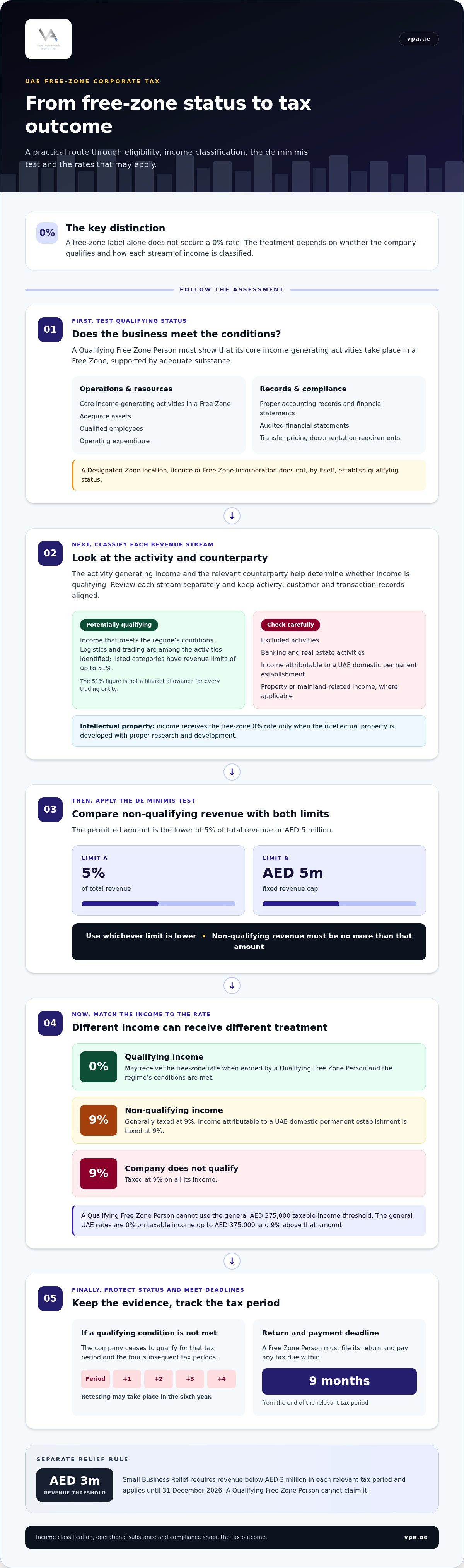
The free-zone label does not, by itself, secure a 0% tax rate. UAE corporate tax for free zone companies applies a 0% rate to qualifying income earned by a Qualifying Free Zone Person, while its non-qualifying income is taxed at 9%. A company that does not qualify is taxed at 9% on all its income.
That distinction matters: the regime rewards qualifying activity and compliance, not simply incorporation in a free zone. Understanding how income is classified helps you assess the rules’ potential effect on your business and tax exposure.
This guide explains who can qualify, which activities and income may be eligible, what is excluded, and how corporate tax can still apply. It also clarifies why the 0% rate is not a blanket exemption, and how factors such as the company’s activities, resources and income classification shape the outcome. You’ll see how qualifying income fits within the wider UAE tax framework, including the conditions that can bring a free-zone company’s income into the taxable scope.
Table of Contents
What is Qualifying Income?
For a Qualifying Free Zone Person, qualifying income may be taxed at 0%, while non-qualifying income is generally taxed at 9%. The distinction depends on the income’s classification, not simply the company’s designated location.
Qualifying and non-qualifying income
Qualifying income is income that meets the UAE Free Zone Corporate Tax Regime’s conditions; non-qualifying income falls outside that category. This matters because it can determine whether income receives the 0% rate or is taxable at 9%. The general UAE rates are 0% on taxable income up to AED 375,000 and 9% above that amount, but a Qualifying Free Zone Person cannot use the AED 375,000 threshold.
The de minimis test permits non-qualifying revenue up to 5% of total revenue or AED 5 million, whichever is lower. Small Business Relief requires revenue below AED 3 million in each relevant tax period and applies until 31 December 2026; a Qualifying Free Zone Person cannot claim it.
Income-generating activities
Income classification depends on the activity generating it and whether that activity meets the regime’s qualifying conditions. Ministerial Decision No. 229 of 2025 covers qualifying and excluded activities. Intellectual property income qualifies for the free-zone 0% rate only when the intellectual property is developed with proper research and development.
Banking and real estate activities, including management, construction, development, agency and brokerage, fall within the scope of corporate tax. Review each revenue stream separately: a company’s general business description may not reveal whether specific income qualifies. Keep activity, customer and transaction records aligned for accounting and filing.
Mainland activity and tax status
Mainland activity can affect both the treatment of particular income and the company’s qualifying status. Income attributable to a UAE domestic permanent establishment of a Qualifying Free Zone Person is taxed at 9%. Existing free-zone tax incentives continue where regulatory requirements are met and the business is not set up in the UAE mainland.
Failure to meet a qualifying condition means the company ceases to qualify for that tax period and the four subsequent tax periods; it may retest in the sixth year. This makes activity and income classification a central part of assessing UAE corporate tax for free zone companies. A Free Zone Person must file its return and pay any tax due within 9 months from the end of the relevant tax period.
Who Can Be a Qualifying Free Zone Person?
A UAE free zone company can qualify for the 0% rate only if it meets Qualifying Free Zone Person conditions. It must conduct core income-generating activities in a Free Zone and maintain adequate assets, qualified employees and operating expenditure. It must also keep proper accounting records and financial statements.
Substance, audit and transfer pricing requirements apply alongside those conditions. A Qualifying Free Zone Person must maintain audited financial statements, even when revenue is below AED 50 million during the relevant Tax Period, and meet transfer pricing documentation requirements.
Eligibility for qualifying status
Qualifying Free Zone Person status depends on a company’s activities and operations, not simply its licence or address. A company in a Designated Zone does not automatically qualify. Its core income-generating activities must take place in a Free Zone, supported by adequate assets, qualified employees and operating expenditure.
These conditions make operational substance central to the tax outcome. A Free Zone Person should be able to link its resources and expenditure to the activities generating its income. Proper accounting records and financial statements help show how the business operates and earns profit. Incorporation or ownership in a Free Zone alone does not establish qualifying status.
For transactions between Free Zone Persons, record the other party and the activity behind each transaction. The counterparty’s free-zone status does not remove the need to classify the income and assess the activity under the applicable regulations.
Substance, audit and transfer pricing rules
Substance requirements link the company’s people, assets and operating expenditure to its core income-generating activities. A company must maintain audited financial statements even if revenue is below AED 50 million during the relevant Tax Period. This audit requirement applies to a Qualifying Free Zone Person, not only a business exceeding that revenue figure.
Transfer pricing documentation is also part of the compliance framework. Article 34 of Federal Decree-Law No. 47 and Ministerial Decision No. 97 of 2023 cover transfer pricing requirements. These rules matter when reviewing transactions between related persons, including transactions involving Free Zone Persons. Keep accounting records, financial statements and transaction documentation consistent, so reported income and business activity can be traced.
Qualifying and excluded activities
The activity generating income helps determine whether it qualifies for the Free Zone Corporate Tax Regime. A free-zone licence or Designated Zone location does not make every revenue stream exempt.
Qualifying activities
Qualifying activities are those recognised under the regime as capable of generating qualifying income. Classification matters because an entity’s tax status depends on its activities and income, not just its registration.
Logistics and trading are among the activities identified, with revenue limits of up to 51% applying to listed categories. That figure is not a blanket allowance for every trading entity. Identify the activity behind each revenue stream and assess it against the applicable category and conditions. Financing services also need careful classification: banking operations are within the scope of corporate tax, so the label alone cannot establish qualifying treatment.
Excluded activities
Excluded activities are activities whose income does not receive qualifying treatment under the regime. They can therefore affect the 0% rate and the company’s continuing status.
Banking operations and real estate management, construction, development, agency and brokerage activities fall within the scope of corporate tax. For example, an entity should distinguish income from trading goods from income earned through property brokerage. An address in a Designated Zone does not turn an excluded activity into a qualifying one. Review the activity and income classification together before applying the preferential rate.
Non-qualifying revenue threshold
The de minimis test allows non-qualifying revenue only up to 5% of total revenue or AED 5 million, whichever is lower. This threshold matters because exceeding it can put Qualifying Free Zone Person status at risk.
Compare the non-qualifying amount with both limits, then apply the lower one. For example, where 5% of total revenue is below AED 5 million, that smaller amount sets the ceiling. Keep revenue classifications clear across the tax period; registration in a Free Zone does not itself resolve the test.
Group transfers are a separate relief. UAE taxable persons may qualify for intra-group transfer relief when at least 75% commonly owned and other conditions are met. A two-year clawback period applies from the initial transfer, so ownership changes during that period can affect the relief.
Free zone companies within UAE corporate tax scope
Incorporation in a free zone does not remove a company from the federal corporate tax regime. The key distinction is which income receives qualifying treatment and which remains taxable.
Corporate tax scope for free zone companies
Free-zone companies are within UAE corporate tax scope, even where qualifying income may receive a 0% tax rate. A Qualifying Free Zone Person pays 9% on non-qualifying income, while a company that does not qualify is taxed at 9% on all income.
Income attributable to a UAE domestic permanent establishment of a Qualifying Free Zone Person is subject to 9% corporate tax. A branch does not create an automatic exemption: the activity, income attribution and qualifying status matter. Foreign entities and individuals are subject to UAE corporate tax when they conduct business in the UAE on an ongoing or regular basis. Distributions do not change the need to classify the company’s underlying income.
Rules across UAE free zones
The federal corporate tax framework applies across UAE free zones, including ADGM and DIFC. A zone’s name alone does not establish a different rate or exemption. The company must assess its qualifying status and income under the same federal regime.
For example, a company in a designated zone cannot rely only on its location to claim 0%. It must meet the qualifying conditions and classify its transactions. This distinction keeps the focus on the activity and income, rather than the free zone’s separate business environment.
Registration and filing deadlines
Free-zone companies must register for corporate tax with the Federal Tax Authority within the applicable registration timeline, including when they expect to pay 0%. A UAE resident juridical person incorporated, established or recognised on or after 1 March 2024 must register within three months of that event.
Filing follows the financial year and tax period, not a universal calendar deadline. A Free Zone Person must file its return and pay any corporate tax due within 9 months from the end of its relevant tax period. For example, a company with a different tax-period end date will have a different filing deadline. Track the period end, registration obligation and income classification together.
Ventureprise Acquisitions: Setting Up A Company In Dubai: 6 Myths That Will Hold You Back
Ventureprise Acquisitions can help if you are planning a business and need to connect company formation with clear strategic planning. Tax considerations can shape decisions about activities, income and operating structure from the outset. Defining each entity’s role and how your strategy may adapt as the venture develops supports more informed planning.
Ventureprise Acquisitions offers Company Formation and Strategic Planning, helping business owners bring their establishment plans into focus. Its guide, Setting Up A Company In Dubai: 6 Myths That Will Hold You Back, challenges common assumptions about business set-up. Use these resources to sharpen your direction and make considered decisions. Contact Ventureprise Acquisitions to discuss your business plans.
Make your next move with a clear business strategy
Build tax considerations into your business design rather than leaving them until after launch. When assessing UAE corporate tax for free zone companies, connect the proposed structure with commercial priorities and long-term plans. Define the business activities, each entity’s role and how the strategy may need to adapt as the venture develops. This creates a stronger foundation for decisions about establishing a business in the UAE.
Ventureprise Acquisitions supports business owners through Company Formation and Strategic Planning. Its guide, Setting Up A Company In Dubai: 6 Myths That Will Hold You Back, offers another perspective for challenging assumptions before settling on a market-entry approach. Use that thinking to clarify your direction and turn plans into considered decisions. Discuss your business plans with Ventureprise Acquisitions and take your next step with purpose.
Frequently Asked Questions
What is the Free Zone Corporate Tax Regime in UAE?
The Free Zone Corporate Tax Regime sets the conditions under which a free-zone business may receive preferential tax treatment on qualifying income. The rules for UAE corporate tax for free zone companies distinguish between qualifying persons and other taxable businesses. For example, two companies in the same zone may have different outcomes because of differences in activities, income classification or compliance. The regime forms part of the UAE’s federal corporate tax system.
What is corporate tax (CT)?
Corporate tax is a tax charged on the taxable profits of businesses and other taxable persons. In the UAE, it is governed by Federal Decree-Law No. 47 of 2022 on the Taxation of Corporations and Businesses. The regime applies to financial years beginning on or after 1 June 2023. For a business, accounting profit is the starting point, then adjustments under UAE tax rules determine taxable income.
What are Free Zones in the UAE?
UAE Free Zones are designated business areas where companies can establish operations under the relevant zone’s licensing and administrative framework. The UAE has more than 50 Free Zones, supporting different commercial and industrial activities. A company’s chosen zone affects its registration and permitted business activities, but the zone itself does not automatically decide its corporate tax treatment. The company’s income and compliance position also matter.
What are the Special Tax Rules for FreeZone Companies?
Free-zone companies must apply the corporate tax rules that match their status and transactions, rather than assuming all income receives identical treatment. A practical compliance point is record retention: a Free Zone Person must keep relevant records and documents for 7 years following the end of the Tax Period to which they relate. This supports the company’s tax calculations and its ability to substantiate reported income.
What is Tax Applicability for Various Types of Entities?
UAE corporate tax can apply to businesses and individuals conducting business under a commercial licence. A natural person conducting business may enter the regime when turnover exceeds AED 1 million in a Gregorian calendar year. Foreign entities and individuals are subject when they conduct a trade or business in the UAE on an ongoing or regular basis. The entity type and nature of activity shape the tax analysis.
What is a Designated Zone?
A Designated Zone is a specific area recognised for UAE tax purposes under the applicable rules. The Corporate Tax definition refers to Federal Decree-Law No. 8 of 2017 on Value Added Tax. That status should not be confused with automatic entitlement to the free-zone 0% corporate tax rate. A company still needs to assess its own eligibility and the treatment of each relevant income stream.



Comments