

Risks of Starting a Business in Dubai and How to Prepare
Living in the UK doesn’t make the biggest risk of starting a business in Dubai the distance. It’s choosing a company structure that doesn’t match where you’ll trade: mainland businesses can operate across the UAE, while free-zone companies may face restrictions on trading outside their zone or through local agents. Free-zone companies allow 100% foreign ownership, but ownership rules and operating permissions are not the same thing.
It’s understandable to focus first on whether you can establish a business without living in Dubai. The more important question is how your chosen structure affects market access, compliance and the way you run the company from the UK. This guide covers the practical risks of starting a business in Dubai, including licensing, tax, staffing and market pressures, and explains how company formation and strategic planning can help you prepare. You’ll get a clearer view of the trade-offs to consider before committing to a launch.
Table of Contents
What to keep on your mind before opening up a business in Dubai?
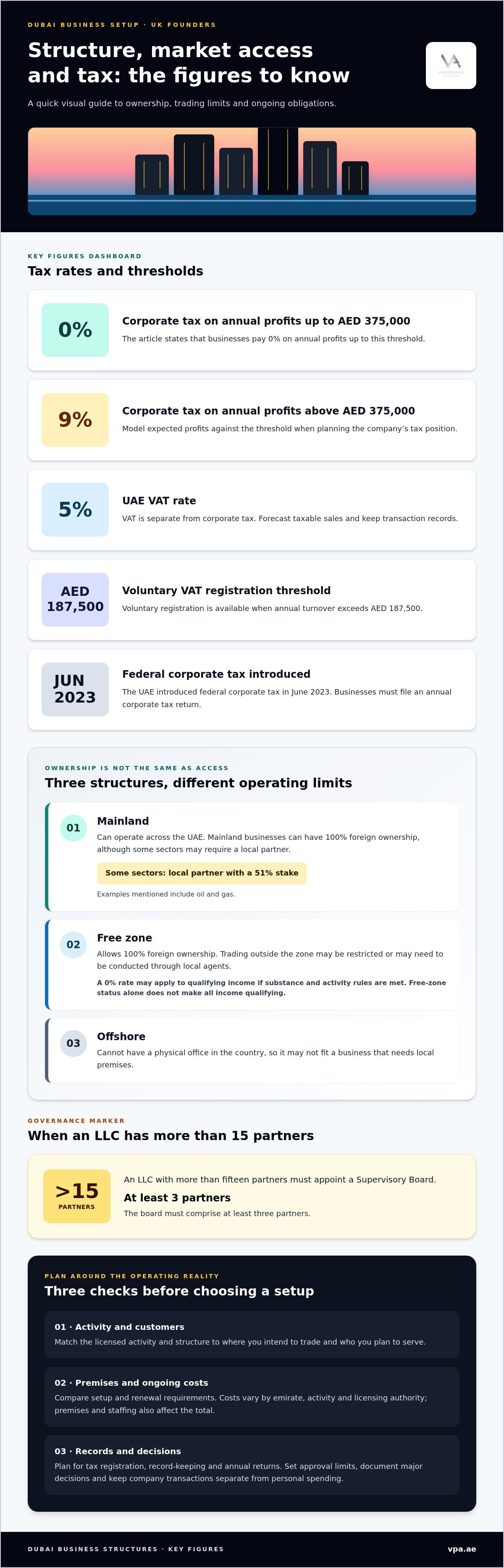
Dubai’s business setup decision starts with activity and customer access, not the licence label alone. UAE free zones allow 100% foreign ownership, while some mainland sectors, including oil and gas, may require a local partner with a 51% stake. Dubai setup and ongoing costs vary against Abu Dhabi and other emirates by activity and licensing authority. Premises, staffing and renewal obligations also shape the comparison.
Choosing a Business Setup
A business setup is the legal structure and jurisdiction that determine where and how your company can operate. Choose by mapping your activity, customers and need for a physical UAE presence. A mainland company can operate across the UAE, while free-zone trading may be limited to its zone or conducted through local agents. An offshore company cannot have a physical office in the country, so it may not suit an operation needing local premises. These distinctions affect your route from opening to ongoing trade.
Free Zone and Mainland Structures
Free-zone and mainland structures are distinct company frameworks with different ownership and market-access conditions. A free zone may suit a business focused on international or zone-based activity, but its trading limits matter if UAE-wide customers are central. Mainland access can support operations across the UAE. The foreign ownership position also depends on the activity: some mainland sectors may require a local partner with a 51% stake. Before you submit documents, align the proposed activity, customer base and operating location with the structure.
Comparing Setup and Ongoing Costs
Compare the full setup and renewal requirements, not just a single licence charge. Costs vary between Dubai, Abu Dhabi and other emirates according to activity and licensing authority. Premises, staffing and renewal obligations also affect the total. For example, a company that needs physical space must include it in the budget; a business with different operational needs will have a different cost profile. Compare each emirate against the same activity, structure and operating plan, then include recurring obligations in your financial forecast.
Can I open a business in Dubai if I don’t live there?
Yes, you can establish a Dubai company without relocating from the UK. International founders still need to choose a suitable structure, meet its operating conditions and plan tax administration. Company formation and personal residency are separate decisions, so assess each in light of your business activity and management arrangements.
The UAE introduced federal corporate tax in June 2023. Businesses pay 0% on annual profits up to AED 375,000 and 9% on annual profits above that threshold. Free-zone companies may qualify for a 0% rate on qualifying income if they meet substance and activity rules. Free-zone status alone does not make every type of income qualifying, so model expected income against the relevant activity criteria before formation.
Tax obligations also affect how you operate from abroad. Dubai-based businesses must file an annual corporate tax return. Mainland companies file with the FTA, while free-zone companies file through their Free Zone authority. Include registration, record-keeping and return preparation in your operating plan rather than leaving tax until after trading begins.
VAT is separate from corporate tax. The UAE’s VAT rate is 5%, according to the Federal Tax Authority. Voluntary VAT registration is available when annual turnover exceeds AED 1,87,500. Forecast taxable sales and keep transaction records so you can assess registration and reporting needs as demand develops.
Remote ownership makes good governance essential. Set clear approval limits, document major decisions and keep company transactions separate from personal spending. If a director or shareholder has an interest in a proposed deal, record it and agree who can approve the transaction. These controls help international owners manage conflicts and avoid mistakes when making decisions across borders. Treat foreign ownership, tax administration and day-to-day authority as connected parts of the business plan.
Company formation and legal structures
Choose a structure that fits your ownership plan, licensed activity and operating model. For UK founders, formation documents and approvals can shape registration and future flexibility.
Foreign Ownership and Restricted Activities
Foreign ownership rules determine who can hold shares, while activity restrictions shape what the company may do. Mainland businesses can have 100% foreign ownership, although some industries may require a local partner. Some mainland sectors, including oil and gas, may require a local partner with a 51% stake. Federal Decree-Law No. 19 of 2018 allowed foreign investors to own more than 49% of onshore companies in selected sectors.
Check that the proposed activity matches the licence before preparing documents. A mismatch can delay registration or prevent the company from doing its intended work. UAE registration documents may need notarising, translation or attestation; errors can cause delays or rejection. Careful preparation supports a smoother formation and helps avoid basing your business plan on permissions the licence does not cover.
Legal structure also affects governance as the company grows. UAE LLCs are regulated under Federal Decree-Law No. 32 of 2021 on Commercial Companies and Cabinet Decision No. 77 of 2022. An LLC with more than fifteen partners must appoint a Supervisory Board comprising at least three partners. Consider ownership, decision-making and future profits together before selecting the structure.
Licence Setup and Renewal Costs
Licence costs are the charges for establishing and maintaining permission to conduct an approved activity. The total depends on the licensing authority, business activity, structure and operating requirements, so compare like-for-like plans rather than headline charges alone. Include renewal obligations in your financial forecast from the outset.
Dubai company registration and licensing can take 2-6 weeks when all documents are ready. Delays can affect opening plans, premises arrangements and expected income. Build time for document preparation into the schedule, and organise company records around the licence conditions. This careful approach helps founders manage formation without treating registration as a single submission.
How much does it cost to set up and renew a Dubai business licence?
There isn’t one fixed Dubai licence cost. The amount depends on the activity, licensing authority and company structure. Budget separately for formation and renewal, then include premises and staffing needs in your forecast. A licence figure alone won’t show the full cost of operating the business.
For a realistic comparison, identify the activities your company will carry out and the authority responsible for licensing them. Then account for the requirements attached to that setup, including workspace and any staffing or residency arrangements. A business that needs physical premises will have a different cost profile from one operating without them. The price depends on the case and is provided after a quote request; key cost factors include activity, authority, structure and operating requirements.
Renewal is a recurring commitment, not an optional extension to the formation budget. Add the renewal date and expected funding to your cash-flow plan, alongside ongoing costs such as premises, employee arrangements and accounting. If your activity changes, reassess the licence requirements before relying on the original budget. This helps keep planned operations aligned with the permissions attached to the licence.
Also allow for the cost of delay. Dubai company registration and licensing can take 2-6 weeks when all documents are ready. Incomplete paperwork can disrupt opening plans, so prepare the required documents before submission and build the expected registration period into your launch schedule. Keep a record of licence conditions and renewal dates to support orderly administration.
For UK-based founders, prepare your forecast in pounds and separate one-off formation costs from recurring commitments. Compare Dubai options using the same activity, premises assumptions and staffing plan; otherwise, the figures won’t provide a useful comparison. A structured company formation cost discussion can help you assess the setup against your operating plan.
Ventureprise Acquisitions: Setting Up A Company In Dubai: 6 Myths That Will Hold You Back
Ventureprise Acquisitions supports Dubai business planning through Company Formation and Strategic Planning. Turn to the team when weighing mainland and free-zone options, assessing how your activity fits your chosen structure, or aligning company decisions with wider commercial goals.
Its guide, Setting Up A Company In Dubai: 6 Myths That Will Hold You Back, addresses assumptions that can cloud planning. For founders also considering long-term asset arrangements, Private Clients Foundations amd Trustss and private client wealth structuring are relevant areas of support. The right next step is to connect your market-entry decision with a clear formation and planning strategy.
To discuss your Dubai business plans, contact Ventureprise Acquisitions or visit vpa.ae.
Turn your Dubai plans into a resilient launch
The risks of starting a business in Dubai are easier to manage when preparation continues beyond registration. Treat your launch plan as a working framework and revisit your assumptions as your customers, operating model and priorities develop. This helps you respond deliberately rather than letting early decisions constrain future growth.
Ventureprise Acquisitions can support this next stage through Company Formation and Strategic Planning. Its guide, Setting Up A Company In Dubai: 6 Myths That Will Hold You Back, can also help you question assumptions before they shape your decisions. The priority is to build a clear path from your commercial goals to the structure and operating approach that serves them.
When you’re ready to discuss your plans, contact Ventureprise Acquisitions to discuss your options. Take the next step with a strategy designed around your ambitions, and move forward with purpose.
Frequently Asked Questions
Do you require a visa to set up a business in Dubai?
No, you don’t have to live in Dubai to establish a business. A company’s registration and an owner’s residency status are separate considerations. If you obtain a UAE residency visa, the business information says you must enter the UAE at least once every 180 days to maintain its validity. British passport holders can enter Dubai visa-free for 30 days, but that visit permission is not a residency visa.
What is a free zone?
A free zone is a designated business jurisdiction with its own licensing authority and rules for company operations. It can suit a company focused on international trade, but your planned customer base matters. Free-zone companies may face limits on trading outside their zone, so check the applicable trading arrangements before choosing one. Before choosing a zone, map your proposed activities and sales routes against its licence conditions and mainland access arrangements.
What are the main risks of starting a business in Dubai?
Key risks include misjudging customer demand, strong competition, economic fluctuations and changing regulations. Cultural differences can affect negotiations and customer relationships, while hot, arid conditions may complicate some logistics. Technology-dependent businesses also face cybersecurity and electronic fraud risks. Reduce exposure by researching customer preferences, testing your commercial assumptions and planning for supply, staffing and digital security before committing significant resources.
What are the differences in costs and rules between Dubai free zones and the mainland?
Costs and operating rules depend on the chosen authority, activity, premises and business model, so compare equivalent requirements rather than headline licence charges. Mainland companies can operate across the UAE, whereas free-zone companies may face limits on trading outside their zone or use local agents. Free zones also differ from one another. Map your customers, sales channels and space needs before comparing setup and renewal commitments.
What legal structures can foreign entrepreneurs use to start a business in Dubai?
Foreign entrepreneurs can consider mainland and free-zone companies, offshore companies, and incorporated forms such as a limited liability company or public joint stock company. The right structure depends on the activity, ownership plan, market access and whether the business needs a physical UAE office. For example, an offshore company cannot have a physical office in the country. Check how governance and ownership rules fit your intended operations.
What visas, sponsorship and Emiratisation rules apply to Dubai businesses?
Employers are responsible for securing residence visas and work permits for foreign workers, and salaries must be processed through the Wage Protection System. Health insurance coverage is required for every employee. Dubai employers are expected to employ UAE nationals as at least 2% of their workforce. These obligations affect staffing budgets and recruitment plans, so include visa administration, payroll processes and workforce composition in your operating model.



Comments