

Middle East Business Expansion Strategy: A Practical 2026 Guide
The Middle East is not one launch market. Treating it as one can turn a strong growth ambition into a costly mismatch. A practical Middle East business expansion strategy starts by identifying which market best fits your business, then testing whether the opportunity matches your commercial goals and operating capacity. If you’re unsure where to begin or concerned that a regional plan will miss important differences, don’t move faster on assumptions. Make each decision deliberately.
This guide gives you a framework to prioritise and validate target markets, assess commercial potential alongside operational readiness, and understand the governance requirements that shape execution. You’ll see how to compare opportunities, identify gaps in your ability to deliver, and set decision points before committing further resources. The result is a sequenced, market-by-market plan that connects ambition with practical readiness, so you can pursue growth with clarity and control.
Table of Contents
Middle East business expansion strategy: Why one regional playbook falls short
The opportunity may be compelling, but a regional ambition is not yet a market-entry decision. A strong Middle East business expansion strategy recognises that countries differ in economic structure, customer demand and operating conditions. The Middle East economic diversity is a useful reminder: regional context can frame the opportunity, but it cannot validate a specific market for your business.
Separate the expansion thesis from the execution plan. The thesis explains why a market could support your goals and what evidence would make it worth pursuing. The execution plan sets out how you would test that case, including the people, partners, processes and governance required. The first supports a decision to investigate; the second supports a decision to commit resources and proceed.
What should a Middle East expansion strategy answer first?
Start with the objective: are you seeking new customers, a distribution route, partnerships or greater operational reach? Each objective calls for different evidence. To assess customer growth, test whether target buyers recognise the need and engage with your offer. For distribution, identify a credible route to customers. Record the evidence, its source and any remaining assumptions before deciding whether to test the market.
Why regional averages can hide decisive differences
Customer preferences, purchasing processes, routes to market and operating requirements can vary between countries and sectors. A direct-sales model might suit one opportunity; another may depend on a local partner or a different service model. Treat these as questions to investigate, not regional facts. Verify market-specific customer and regulatory claims against relevant evidence before building them into your assumptions.
Takeaway: Prioritise markets by strategic fit and operating readiness, not headline appeal. Choose the first market where evidence and your capacity to execute align.
Build a Middle East expansion strategy around market fit and business readiness
Turn your shortlist into a like-for-like assessment. A useful Middle East business expansion strategy applies the same business-specific criteria to each candidate market, without assuming there’s a universal winner. Use a simple comparison matrix:
Strategic fit: Does the opportunity support your growth objective and complement your existing offer?
Customer evidence: What have target customers said or done that demonstrates a need?
Route to market: Can you reach buyers directly, through partners or by another viable channel?
Execution capacity: Can your team support the work, systems and oversight needed to deliver?
For each criterion, note the strongest evidence, working assumptions and unanswered questions. Keep those categories distinct. Customer conversations can reveal needs and buying considerations; partner discussions can test whether a proposed route to market is realistic. A small-scale commercial experiment, such as testing a focused offer with a defined audience, can provide further evidence before you expand your commitment.
How to prioritise a first target market
Score each market against the same criteria and explain the reasoning behind every rating. A high score based on verified customer interest is stronger than one resting on an untested assumption. Identify which assumption could most change your decision, then make resolving it the next test. This keeps the comparison specific to your business rather than turning it into a generic country ranking.
Check operating readiness before committing
Assess leadership time, HR requirements, technology needs, and who will own governance and performance reviews. Map gaps against the work required to serve customers reliably, then decide whether to address them before a market test or as part of it. Market readiness is the alignment of strategic fit, credible evidence and capacity to execute. Ventureprise Acquisitions’ Strategic Planning service crafts strategies that align with your business goals. Its Management Consulting service is focused on streamlining operations and increasing productivity.
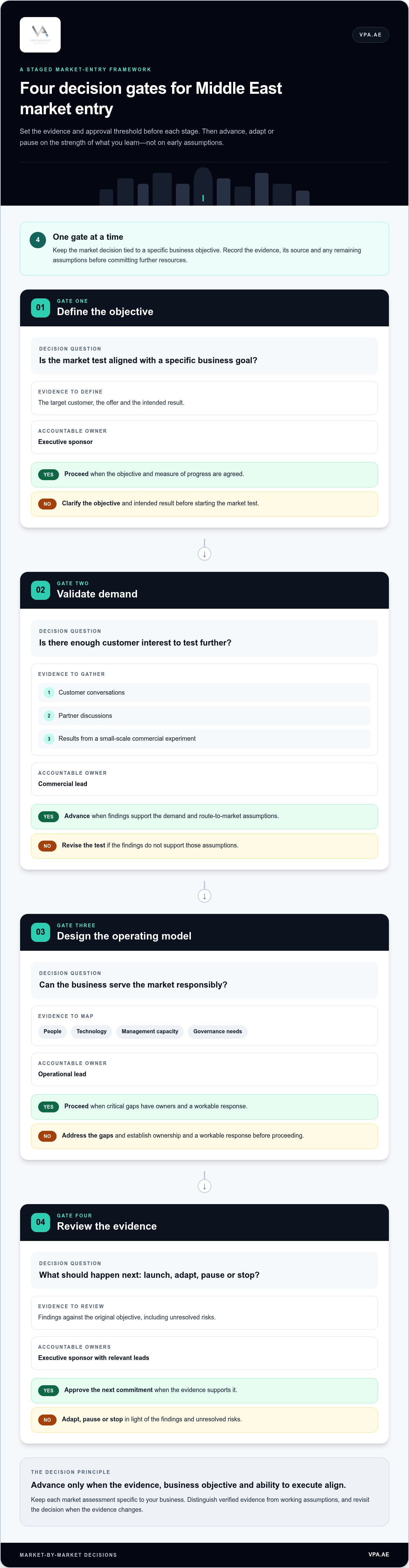
Turn the strategy into staged market-entry decisions
A disciplined Middle East business expansion strategy uses decision gates to control what happens next. Define the evidence and approval threshold before each stage begins. This gives the team a clear basis to advance, adapt or pause instead of letting early assumptions drive a larger commitment.
Define the objective. Decision: is the market test aligned with a specific business goal? Evidence: the target customer, offer and intended result. Owner: the executive sponsor. Threshold: proceed only when the objective and measure of progress are agreed.
Validate demand. Decision: is there enough customer interest to test further? Evidence: customer conversations, partner discussions and results from a small-scale commercial experiment. Owner: the commercial lead. Threshold: advance when findings support the demand and route-to-market assumptions, or revise the test if they don’t.
Design the operating model. Decision: can the business serve the market responsibly? Evidence: a practical view of people, technology, management capacity and governance needs. Owner: the operational lead. Threshold: proceed when critical gaps have owners and a workable response.
Review the evidence. Decision: launch, adapt, pause or stop? Evidence: findings against the original objective, including unresolved risks. Owner: the executive sponsor with relevant leads. Threshold: approve the next commitment only when evidence supports it.
What to validate before committing to a launch
Test customer demand, the proposed route to market and the resources needed to deliver the offer. List regulatory and tax questions as separate workstreams, with clear owners and review points before a commitment. If the evidence weakens, change the proposition or pause. A stage gate is useful only if it can change the plan.
How to organise the first execution phase
Once the decision is to proceed, assign workstreams for management, people, technology and governance. Give each a named internal owner, a defined output and a review point, then bring dependencies to one decision forum. Strategic management insights can help frame the link between plans and execution. To shape your next decision, discuss your expansion strategy.
Make Middle East expansion a managed growth plan, not a leap
Market entry isn’t the finish line. Once activity begins, review performance against the original growth objective and the assumptions that justified the decision. Set regular review points to compare customer response, commercial progress and operating capacity. If the evidence shifts, decide whether to adapt the offer, adjust the operating model, pause further investment or continue. This keeps expansion responsive without losing sight of why the business entered the market.
Where advisory support fits into the expansion journey
Ventureprise Acquisitions’ Strategic Planning service crafts strategies that align with your business goals. Its Management Consulting service focuses on streamlining operations and increasing productivity. The firm’s stated value propositions are Tailored Solutions, Proven Results, Client-Centric, Expert Team and Innovative Approaches.
Create a focused next-step brief
Turn the review into a concise brief that records the objective, candidate markets, strongest evidence, unresolved questions, readiness needs and immediate decisions. Name an owner for each open issue and state what evidence would change the next decision. This gives leadership a practical reference for tracking progress and keeps new commitments tied to the expansion case. Explore strategic planning solutions to connect market priorities with business goals and execution.
A clear Middle East business expansion strategy is built through evidence-led decisions, disciplined reviews and an operating plan that can adapt as the business learns. Talk through your expansion priorities and define the next decision your business needs to make.
Make your next expansion decision count
The next move isn’t to commit to an entire regional roll-out. Decide what your business needs to learn next, who will own that decision and what evidence would justify moving forward. That discipline keeps ambition active while giving leadership room to respond as market conditions and internal capacity evolve.
A Middle East business expansion strategy should create momentum without forcing certainty where it doesn’t yet exist. Ventureprise Acquisitions brings together Angel Investors and Business Strategists to support entrepreneurs and businesses as they shape their direction. Client Stephen W. puts it simply: “Love the simplicity of this company. No Jargon, no excuses. They delivered.”
Bring your current priorities, open questions and growth objective into a focused conversation. Discuss your expansion strategy and identify a practical next step for your business. A clear decision today can put your next stage of growth on firmer ground.
Frequently Asked Questions
Is a Middle East expansion strategy suitable for a small business?
It can be, if the opportunity fits your objectives and you can test it within your capacity and risk tolerance. Company size alone doesn’t determine suitability. For example, a small firm might assess whether one service meets a specific buyer need before building a wider operation. Make the Middle East business expansion strategy proportionate: define a limited validation stage, the resources it can use and the evidence needed before committing further.
Can a business test demand before making a full market-entry commitment?
Yes. Customer interviews can explore the problem buyers want solved; partner conversations can probe how a proposed route to market might work. A limited commercial experiment, such as presenting a focused offer to a defined audience, can test response without assuming a full launch. Set the research question and decision threshold first. Choose methods suited to your business and target market, then assess the quality of the evidence before acting on it.
How should a company assess expansion risks across different Middle Eastern markets?
Assess each market separately across commercial, operational, regulatory, people and governance considerations. For instance, map dependencies on local partners or specialist staff alongside customer demand and the resources required to deliver. Label each finding as verified information or an assumption, and record its source and date so the team can revisit it. Treat jurisdiction-specific legal and tax requirements as distinct items to review before making a commitment; don’t assume one market’s risk profile applies across the region.
Does a business need to establish a local company before testing a new market?
There’s no universal answer: the appropriate route depends on the activity, market and intended operating model. Exploratory research, such as interviewing prospective customers, differs from conducting business locally, which may bring separate requirements. Before choosing a structure or beginning commercial activity, define what the test involves and identify the requirements that need to be assessed. This keeps the research approach distinct from any subsequent commitment.
How often should a Middle East expansion strategy be reviewed?
Set review points around meaningful evidence, business milestones and changes in your assumptions, rather than relying on a fixed schedule that may not suit your situation. Revisit whether demand remains credible, delivery capacity is adequate, costs match the plan and the opportunity still fits your strategic goals. A business running a limited test may need different review points from one managing ongoing operations. Match the cadence to your pace and exposure.



Comments