
_svg.png)
Trust Structures for UK Nationals in Dubai: 2026 Guide
The most familiar structure may not be the right one for your plans. If you’re weighing trust structures for UK nationals in Dubai, the decision is not about choosing the more appealing label. It depends on what you want the arrangement to do, who should make decisions and how your UK connections may affect the outcome.
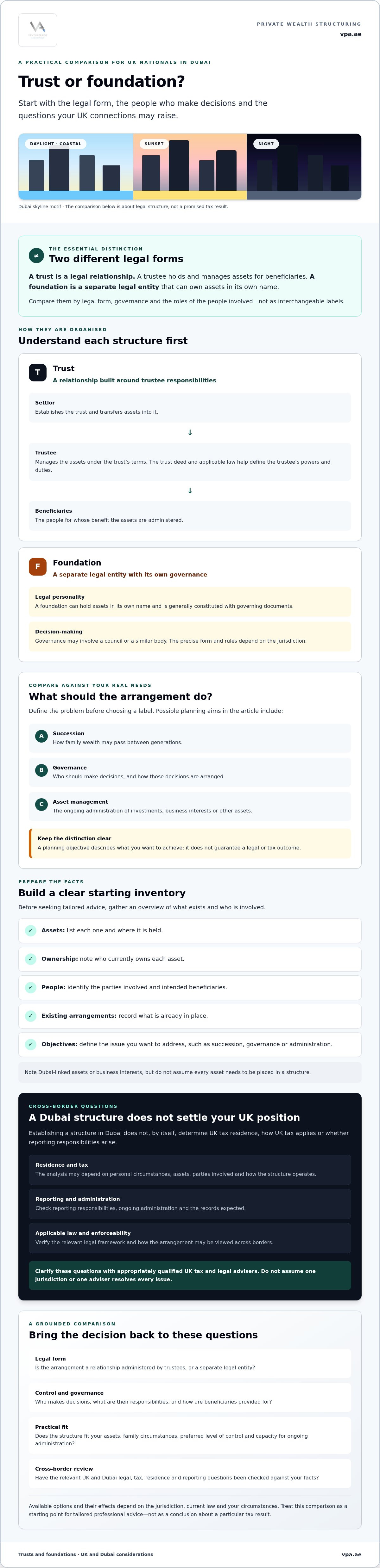
A useful starting point is to distinguish the two forms. A foundation is a separate legal entity that can own assets in its own name; a trust is a legal relationship in which a trustee holds and manages assets for beneficiaries. These differences can shape governance and how an arrangement is viewed across borders. Establishing a structure in Dubai does not, by itself, settle your UK tax position or remove reporting and administration questions. Your residence, assets, beneficiaries and objectives all matter.
This guide compares what trusts and foundations are designed to do, then sets out the UK and Dubai questions to clarify before seeking tailored advice. You’ll have a practical starting point for a discussion with appropriately qualified advisers, without assuming a particular tax result.
Table of Contents
Why UK nationals in Dubai consider trust structures, and what they need to clarify first
Trusts and foundations in Dubai: understand the differences before comparing them
How to compare trust structures for your UK and Dubai circumstances
Plan your next step with a cross-border wealth-structuring discussion
Why UK nationals in Dubai consider trust structures, and what they need to clarify first
A trust is a planning tool, not a guaranteed tax result or a promise that assets will be protected. Broadly, a settlor places assets under the care of trustees, who manage them according to the trust’s terms for beneficiaries. The roles and legal effects depend on the arrangement and applicable law. For background on the legal concept of a trust, it helps to understand these distinct responsibilities before considering a structure.
For UK nationals with Dubai-linked interests, possible objectives include planning how family wealth passes between generations, setting governance arrangements and managing assets for intended beneficiaries. These are aims to assess, not outcomes a structure automatically delivers. Keep the distinction clear: a planning objective describes what you want to achieve; it does not guarantee a legal or tax outcome.
What might prompt a UK national to explore a structure?
A change in family circumstances, uncertainty about who should make decisions, or questions about the long-term administration of investments or business interests may prompt a review. Start with a simple inventory: list each asset, where it is located, who currently owns it and whether it is already part of another arrangement. Note any Dubai-linked assets or business interests, but don’t assume every asset needs to be placed in a structure. First define the problem you want to address, such as succession, governance or ongoing asset management. That makes it easier to compare legal forms against a real need rather than a label.
What a trust structure cannot establish by itself
Setting up a structure in Dubai does not, by itself, determine your UK tax residence or how UK tax applies. The analysis may depend on your personal circumstances, the assets, the parties involved and how the structure operates. Reporting responsibilities and enforceability also need to be checked against the relevant facts and current law. Treat these as separate questions for suitably qualified advisers, rather than assuming that one adviser or one jurisdiction resolves every issue.
Before proceeding, identify which questions need specialist review. A private-client wealth-structuring consultancy such as Ventureprise Acquisitions can help clarify your objectives and discuss the structuring process. It does not provide legal representation or replace advice from an appropriately qualified UK tax adviser and legal adviser.
Trusts and foundations in Dubai: understand the differences before comparing them
Trusts and foundations are distinct legal forms, not interchangeable labels. A trust is generally a legal relationship in which a trustee holds and administers assets for beneficiaries; a foundation is generally a separate legal entity that can hold assets in its own name. A trust centres on the trustee’s responsibilities; a foundation centres on its own legal personality. This is only a starting point: available options and their effects depend on the jurisdiction, current law and your circumstances.
How a trust arrangement is commonly organised
A settlor establishes a trust and transfers assets into it. A trustee then manages those assets under the trust’s terms for the benefit of one or more beneficiaries. Roles and terminology can vary between arrangements. The trust deed and applicable law help determine the trustee’s powers and duties, how beneficiaries are provided for, and what ongoing administration involves. When reviewing a proposed arrangement, ask who would make decisions, what the trustee is required to do and what records or administration are expected. A qualified legal adviser can explain how those terms apply.
How a foundation may differ from a trust
A foundation is generally constituted as a separate legal entity, with its own governing documents and decision-making arrangements. Its governance may involve a council or similar body, while a trust relies on trustees administering the arrangement. Beneficiary provisions, control and administrative responsibilities can therefore be structured differently. Don’t assume that every Dubai jurisdiction offers identical forms or rules. Verify the current legal framework for the jurisdiction being considered.
For trust structures for UK nationals in Dubai, the practical comparison is not simply which form sounds more familiar. Compare how each option addresses ownership, decision-making, beneficiary arrangements and ongoing administration. Then ask how the proposed structure may be viewed across the relevant borders. A legal adviser can verify the applicable UAE framework, while a qualified UK tax adviser should review UK implications.
To organise those questions, you could discuss your structuring objectives with Ventureprise Acquisitions as a private-client wealth-structuring consultancy. Its role is consultancy, not legal representation or specialist UK tax advice.
How to compare trust structures for your UK and Dubai circumstances
Use a clear sequence before comparing options. Focus on questions tied to your circumstances, not just the name of a structure. For a broader overview, see this private-client wealth structuring guide.
Define your objectives: Write down whether you’re considering succession, governance, asset management or another goal. Be specific about the decision or situation you want the arrangement to address.
Map the assets: Record what you own, where each asset is located and how it is currently owned. Note any Dubai-linked business interests and any existing arrangements affecting those assets.
Set out family circumstances: Identify relevant family members, potential beneficiaries and existing arrangements that may affect planning. Note any changes you expect advisers to consider.
Consider control: Decide who you expect to make decisions and how much involvement you want to retain. Ask advisers to explain how control works under each option.
Assess administration: Consider who can manage governance, records, updates and coordination with professional advisers. Include the practical work involved in keeping the arrangement up to date.
This checklist gives advisers a clearer basis for assessing trust structures for UK nationals in Dubai. It also helps avoid assuming that every asset or family situation calls for the same approach.
Questions to take to qualified advisers
Ask a UAE-qualified legal adviser which law and jurisdiction would govern the proposed structure, how it would be established and what its administration would involve. Ask an appropriately qualified UK tax adviser to assess relevant UK tax, reporting, residence and succession questions separately. Clarify who is responsible for governance, records, future changes and coordination between advisers. If an answer depends on information you have not yet gathered, ask what details are needed before a recommendation can be made.
Red flags in a structure recommendation
Be cautious of promises of guaranteed tax savings, universal asset protection or claims that one structure suits everyone. Ask for a plain-English explanation of each party’s responsibilities, the structure’s limitations, the documentation required and ongoing obligations. Check that the proposed approach relates to your stated objectives and the specific assets involved. If you cannot tell who will make decisions or what work will be required to maintain the arrangement, pause and ask for clarification before proceeding.
Ventureprise Acquisitions provides private-client wealth-structuring consultancy, not legal representation or specialist UK tax advice. To discuss your objectives and the questions to take to qualified advisers, speak with Ventureprise Acquisitions about wealth structuring.
Plan your next step with a cross-border wealth-structuring discussion
A focused conversation can turn a broad question about trust structures for UK nationals in Dubai into a practical sequence: define your objectives, compare possible structures, verify the UAE and UK implications, then agree who is responsible for each part. The aim is to identify what needs review and by whom, not to assume a particular tax or legal result.
What to prepare before an initial conversation
Bring a high-level overview of your assets and how they’re owned, your family and succession objectives, and any existing planning documents that may be relevant. A simple list showing each asset’s location and current ownership can help keep the discussion focused. You don’t need to share more sensitive detail than is necessary at the outset. Prepare separate questions for a UAE-qualified legal adviser and an appropriately qualified UK tax adviser, particularly where you need current advice on local law, UK tax treatment or reporting.
Agree the right professional roles
Ventureprise Acquisitions provides private-client wealth-structuring consultancy and can be a starting point for discussing objectives and the structuring process. Its role is not legal representation or specialist UK tax advice. Before proceeding, confirm what consultancy work is in scope, what requires a legal adviser and what needs a UK tax adviser. Be clear about who will handle governance, records, future changes and coordination, and whether ongoing administration is part of the agreed arrangement.
You can review Ventureprise’s private-client solutions to understand its consultancy context. Use that information alongside your own questions, then discuss your wealth-structuring requirements as a next step. A well-prepared conversation helps you move from comparing labels to assessing responsibilities, professional input and fit for your circumstances.
Make your next decision with clarity
The right structure starts with your objectives, not a preferred label. Trusts and foundations differ in legal form, governance and administration, so compare them against the assets, family circumstances and control preferences that matter to you. Just as importantly, verify UK tax and reporting implications with a suitably qualified UK tax adviser, and the relevant UAE legal position with a qualified legal adviser.
For trust structures for UK nationals in Dubai, a thoughtful discussion can help organise the questions and identify which professional input you need. Ventureprise Acquisitions provides private-client wealth-structuring consultancy, including trusts and foundations. With UK roots and an on-the-ground presence in Dubai, the firm offers clear, plain-English support for complex planning questions. Its role is consultancy, not legal representation or specialist UK tax advice.
Start with your aims and the questions you need answered. Discuss your cross-border wealth-structuring requirements and take a considered next step, without assuming a particular tax or legal outcome.
Frequently Asked Questions
Do UK nationals need a trust to own assets in Dubai?
No. Being a UK national or owning assets in Dubai does not automatically mean you need a trust. Whether a structure is relevant depends on your aims, the assets and their ownership, your family circumstances and the applicable rules. Start by identifying what you want to achieve, then ask a UAE-qualified legal adviser whether a structure is appropriate for those specific assets.
What is the difference between a trust and a foundation in Dubai?
A trust is generally an arrangement in which a trustee holds and manages assets for beneficiaries under its terms. A foundation is generally a separate legal entity that can hold assets in its own name. They differ in legal form, governance and administration, and aren’t interchangeable. The precise options and effects depend on the relevant UAE jurisdiction and current law, so seek qualified legal advice.
Can a Dubai trust reduce UK tax for a UK national?
Not automatically, and no tax saving should be assumed. A Dubai trust does not by itself determine your UK tax residence or treatment. UK tax analysis may depend on your circumstances, the assets, the people involved and how the arrangement operates. Ask an appropriately qualified UK tax adviser to review tax and reporting implications before acting. A UAE structure alone does not settle your UK position.
How do I choose between a trust and a foundation?
Compare each option against your objectives, assets, family arrangements, preferred control and capacity for ongoing administration. Consider who would make decisions, how beneficiaries are provided for, where assets are located and who would manage records and governance. Then ask a UAE-qualified legal adviser to verify the available structure and governing law, and a UK tax adviser to assess the separate UK implications.
Can Ventureprise Acquisitions provide legal or UK tax advice on a trust?
No. Ventureprise Acquisitions provides private-client wealth-structuring consultancy, including trusts and foundations, but it does not provide legal representation or specialist UK tax advice. The consultancy can help clarify objectives and discuss the structuring process. For advice on applicable UAE law, consult a qualified legal adviser; for UK tax and reporting questions, consult an appropriately qualified UK tax adviser.


Comments