
_svg.png)
Accounting and Bookkeeping Services Cost: How to Assess Your Budget
Could the lowest quote for accounting and bookkeeping services cost leave your business paying more in time, risk or unexpected extras? A headline fee tells only part of the story. The actual scope depends on your business activity, the condition of your records and how often you need support.
It is understandable to focus on the monthly cost, especially when proposals use different labels for bookkeeping, accounting and tax-related work. A fair comparison starts with a consistent scope, not a single figure. Match the proposed support to your transaction activity, reporting needs and business structure, and make sure exclusions and additional charges are clear.
This guide explains what can shape fees, how to compare proposals on a like-for-like basis and what to clarify before agreeing ongoing support. With responsibilities and deliverables set out in plain English, Ventureprise Acquisitions helps you make a more informed budget decision and keep financial processes aligned with your business.
Key Takeaways
Assess accounting and bookkeeping fees by looking beyond the headline figure to the agreed scope and your business’s complexity.
Use transaction volume, number of accounts, currencies and record quality to identify factors that may affect the workload.
Compare proposals consistently by mapping deliverables, exclusions, reporting frequency and review responsibilities.
Match the support you need to your business activity, internal capabilities and financial decision-making requirements.
Table of Contents
What determines accounting and bookkeeping services cost?
Fees reflect the work agreed, the complexity of the business and how often support is required. There’s no single figure that suits every organisation. A business with a small number of straightforward transactions has different record-keeping demands from one with several entities, frequent transactions or records that need sorting out.
Scope matters as much as workload. Routine transaction processing, regular reporting and more involved financial analysis each require different work. Before comparing fees, establish which tasks are included, how often they’ll be completed and who is responsible for providing information, reviewing records and following up on queries.
Which services sit under bookkeeping and accounting?
Bookkeeping generally means organising and recording financial transactions, such as sales, purchases and payments, so records are kept in order. Accounting uses that information to interpret and present a clearer picture of financial activity at an agreed level. For a foundational overview, see What is Accounting?
Tax-related work is a separate scope to define. Registration, return preparation and submission, and tax advice are distinct responsibilities, not automatic extensions of routine bookkeeping. Applicable requirements depend on the business and can change, so verify current obligations against authoritative guidance before setting the scope. Ventureprise Acquisitions also offers company corporation tax registration as an additional service.
Record quality affects the effort involved. Clear, organised source documents can make routine processing more straightforward; missing receipts, duplicate entries or unclear payments may take extra time to resolve. The number of entities matters too, as each can require its own records and reporting.
Look beyond the label on a proposal. A clear description of bookkeeping, accounting analysis and any tax-related responsibilities helps you identify what the fee covers, spot gaps and compare like-for-like support. Ask how the process handles common exceptions, such as a payment with no supporting document or a transaction whose purpose is unclear.
Which business factors can raise or reduce accounting fees?
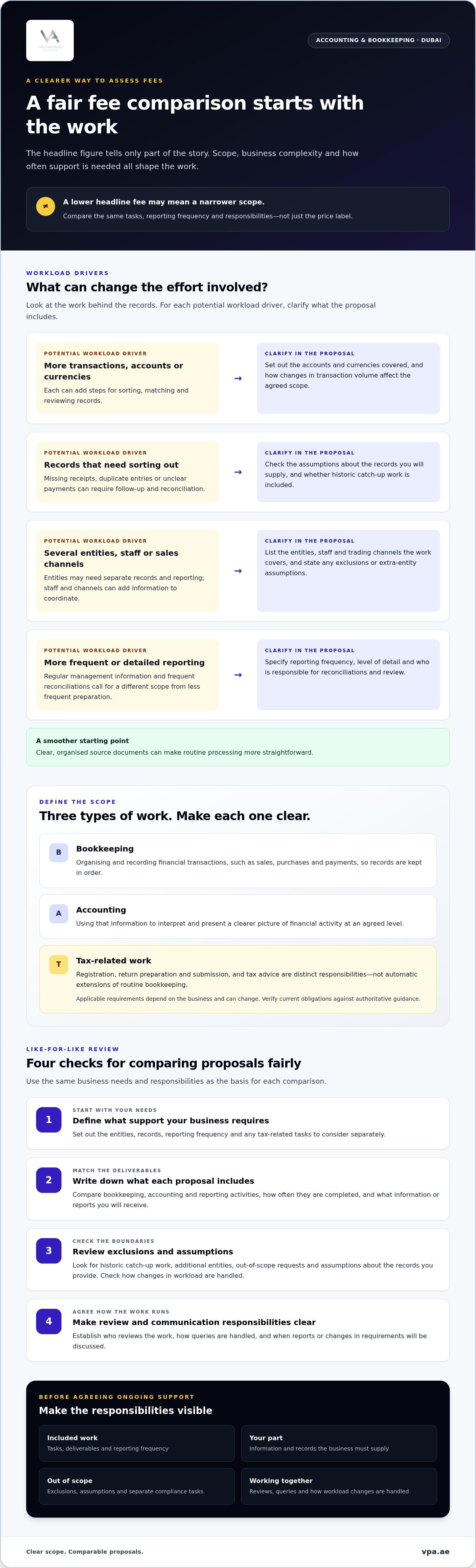
The workload behind accounting and bookkeeping services cost in Dubai depends on more than the number of transactions. Each account, currency and trading channel can add steps for sorting, matching and reviewing records. A business that receives or makes payments in several currencies, for example, may need more detailed checks than one with straightforward transactions in a single currency.
Record quality has a direct impact, too. Consistent, well-organised documents make processing easier; missing receipts or unclear entries can mean extra follow-up and reconciliation. Multiple entities may require separate records and reporting, while employees and different sales channels can introduce further information to coordinate. These factors don’t automatically determine a particular fee, but they help define the work involved.
Reporting expectations matter. A business that needs regular management information or frequent reconciliations has a different scope from one that needs records prepared less often. Specify the reporting frequency, level of detail and reconciliation responsibilities so the work supports the way you monitor the business and make decisions.
How do reporting needs and compliance change the scope?
Separate routine record-keeping from periodic reporting and compliance tasks. VAT and UAE Corporate Tax registration, returns or related support are distinct scope questions, not automatic inclusions in bookkeeping. Applicable obligations depend on the entity and current rules. Use the UAE Federal Tax Authority’s official guidance to verify requirements rather than assuming the same treatment applies to every business.
Before agreeing the scope, map your accounts, currencies, entities, staff, trading channels and reporting needs. This gives you a clearer picture of recurring work and any separate compliance requirements, without relying on a generic package label. For a plain-English discussion of your accounting and bookkeeping requirements, share your business needs.
How can you compare accounting and bookkeeping proposals fairly?
A useful comparison starts with equivalent work, not the headline fee. Use this checklist to assess whether each proposal reflects your business’s needs and makes responsibilities clear:
1. Define your needs. Set out the entities, records and support you require, including reporting frequency and any tax-related tasks to be considered separately.
2. Map the deliverables. Note precisely which bookkeeping, accounting and reporting activities are included, how often they’re completed and what information or reports you’ll receive.
3. Check exclusions and assumptions. Look for historic catch-up work, additional entities, out-of-scope requests and assumptions about the records you’ll provide. Understand how a change in transaction volume or workload affects the agreed scope.
4. Compare review and communication points. Establish who reviews the work, how queries are handled and when you’ll discuss the reports or changes in requirements.
This approach makes accounting and bookkeeping services cost in Dubai easier to assess fairly. Compare the same tasks, reporting frequency and responsibilities across proposals. Otherwise, a lower headline fee may simply reflect a narrower scope.
What should a clear proposal spell out?
A clear proposal identifies who does each task, which records the business must supply, how often reports are prepared and how communication is arranged. It should also state assumptions, exclusions and how changes in workload are handled. Record the agreed scope in plain English before work begins, so both sides share expectations and potential extras are not a surprise.
Business structure can shape the planning required. If you’re considering an entity setup, explore company formation information alongside your accounting requirements. To discuss a scope aligned with your business, share your accounting and bookkeeping requirements.
How does accounting and bookkeeping support fit your business plan?
The right level of support should keep pace with your business, not lock you into a scope that no longer fits. Consider how many transactions you handle, what your team can manage internally and what financial information you need to make decisions. A business with changing activity may need a different approach over time from one with stable, predictable records.
Think about the purpose of your financial information, too. Is your priority to keep records organised, understand performance or support decisions as the business develops? Clear priorities help shape a relevant scope and make the accounting and bookkeeping services cost in Dubai easier to assess in context. Ventureprise Acquisitions provides accounting and bookkeeping as part of its broader business support, with direct, plain-English communication to make complex processes easier to discuss.
What should you prepare before discussing your requirements?
A concise overview gives the discussion a practical starting point. Summarise your entity structure, typical transaction activity, current record-keeping approach and reporting expectations. Note what your internal team already manages and where you need additional support.
Then identify immediate priorities and likely changes. For example, are you preparing for a new trading channel, more transactions or a change in how you review financial information? Flagging these plans helps shape a scope around both current needs and the direction of the business, without assuming a fixed package.
Where accounting needs connect with wider operational planning, explore business solutions from Ventureprise Acquisitions. Bring your requirements together in plain language, then discuss a scope aligned with your activity, capabilities and decision-making needs.
Set your financial support scope with confidence
The right fee is shaped by the work your business needs, its transaction activity and the level of reporting that supports your decisions. To assess accounting and bookkeeping services cost in Dubai, compare proposals against the same scope, responsibilities and reporting frequency, rather than relying on the headline figure. Clear records and well-defined expectations can help you understand what support fits your business today and how it may need to adapt as activity changes.
Ventureprise Acquisitions offers accounting and bookkeeping as part of its broader business support. The firm takes a direct, plain-English approach to discussing requirements and helping entrepreneurs navigate company formation and residency processes. Start with an outline of your business structure, current record-keeping and priorities, then discuss your accounting and bookkeeping requirements.
Set out what your business needs and take the next step towards a clear, practical scope.
Frequently Asked Questions
How much do accounting and bookkeeping services cost?
There’s no single fee that suits every business. The accounting and bookkeeping services cost in Dubai depends on the agreed scope, transaction activity, record quality, number of entities and support frequency. A quote is most useful when it specifies exactly what work is covered and what sits outside the scope. Compare proposals on those details rather than relying on a headline figure or assuming every package includes the same tasks.
What is usually included in bookkeeping support?
Bookkeeping support generally centres on organising and recording a business’s financial transactions. Depending on the agreed scope, this may include keeping sales, purchases and payments organised, with related records available for review. Don’t assume that reporting, accounting analysis or tax registration and filings are automatically included. These can be distinct tasks. A clear agreement should describe the work, the records the business needs to provide and how often the work is carried out.
What factors affect accounting fees for a business?
Fees are influenced by the volume and complexity of the work. Transaction numbers, bank accounts, multiple currencies, the condition of records and the number of entities can all affect processing and review. Reporting frequency and the level of management information required also shape the scope. Employees or several trading channels may add coordination needs. Set out these details early to help define a proposal that reflects your business rather than a generic service label.
Are bookkeeping and accounting services charged separately?
They can be scoped together or as separate tasks, depending on the business’s needs and the agreed arrangement. Bookkeeping focuses on organising and recording transactions; accounting involves interpreting or presenting financial information at an agreed level. Tax-related work, such as registration or filings, can be a separate responsibility. Review each proposal’s deliverables and exclusions carefully, as similar package names don’t necessarily mean the same work is covered.
How can I compare accounting service proposals fairly?
Compare proposals against the same checklist. Define your needs, map the tasks and reporting frequency, check exclusions and assumptions, then compare review and communication arrangements. Look for how each proposal handles historic catch-up work, extra requests or changes in workload. Confirm who provides records and who is responsible for each task. This like-for-like approach makes differences in scope visible and helps you judge whether the support fits your business priorities.


Comments