
_svg.png)
Setting Up a Start-up in Dubai 2026: Build for Investment
Incorporation gets you a company; it doesn’t make the business fundable. When setting up a startup in Dubai, founders need more than a licence: investors will want to understand the model, the evidence of demand and how the business will operate. Build those foundations from the start, rather than leaving them until the first funding conversation.
Dubai can be a compelling base for growth, but the order of decisions matters. This guide takes you from business concept to investor conversations, with practical steps for preparing an operating plan and organising the records that help others assess your potential. It also covers funding routes and setup requirements, including company formation, compliance and residency. Initial company formation and visa processing can begin remotely, helping international founders handle early administrative steps before travelling for appointments. The aim is to establish a company that is also ready to explain its opportunity and plans to investors.
Table of Contents
Dubai Start-up: What Incorporation Does and Does Not Do
Registration is a starting point, not proof of a fundable business. Setting up a startup in Dubai calls for a deliberate sequence: validate the model, choose a suitable structure, register the company, then prepare to operate. Incorporation creates the legal framework for the business. It doesn’t show that customers want the product, that the economics work or that investors will commit.
Keep formation and fundraising readiness distinct. Formation establishes the company; readiness means being able to explain its market, commercial evidence, finances and execution plan. Dubai’s focus on non-oil sectors and investment is part of the wider Economy of Dubai, but a promising market context is no substitute for validating your own opportunity.
Funding routes serve different needs. Founder funding uses the team’s own resources to develop the business. Angel investment usually involves individuals investing at an early stage, whilst venture capital typically targets companies with potential for substantial growth. Strategic investment may come from an organisation seeking commercial alignment as well as a financial return. Each route brings different expectations, so define what the capital will enable before approaching investors.
What should founders decide before registration?
Write down who the customer is, what problem you solve, how the business will earn revenue and which markets it intends to serve. These decisions help clarify the company’s intended business activity. Mainland or free-zone suitability depends on that activity and your operating plans, including how you intend to reach customers. Many activities, particularly in free zones, permit 100% foreign ownership. Free-zone companies can trade internationally and can trade with mainland UAE through a branch setup. Match the structure to the intended activity and markets, and check the current requirements. Thoughtful Dubai company formation starts with the business model, not a licence choice made in isolation.
Can a founder begin the setup remotely?
Yes. Ventureprise Acquisitions supports international founders with remote-start company formation and visa processing, so initial administrative stages can begin without travel. Later residency steps include travel to the UAE for medical and biometrics appointments. Plan those commitments alongside the remote stages so your launch schedule reflects the full process.
What investors assess before backing a Dubai startup
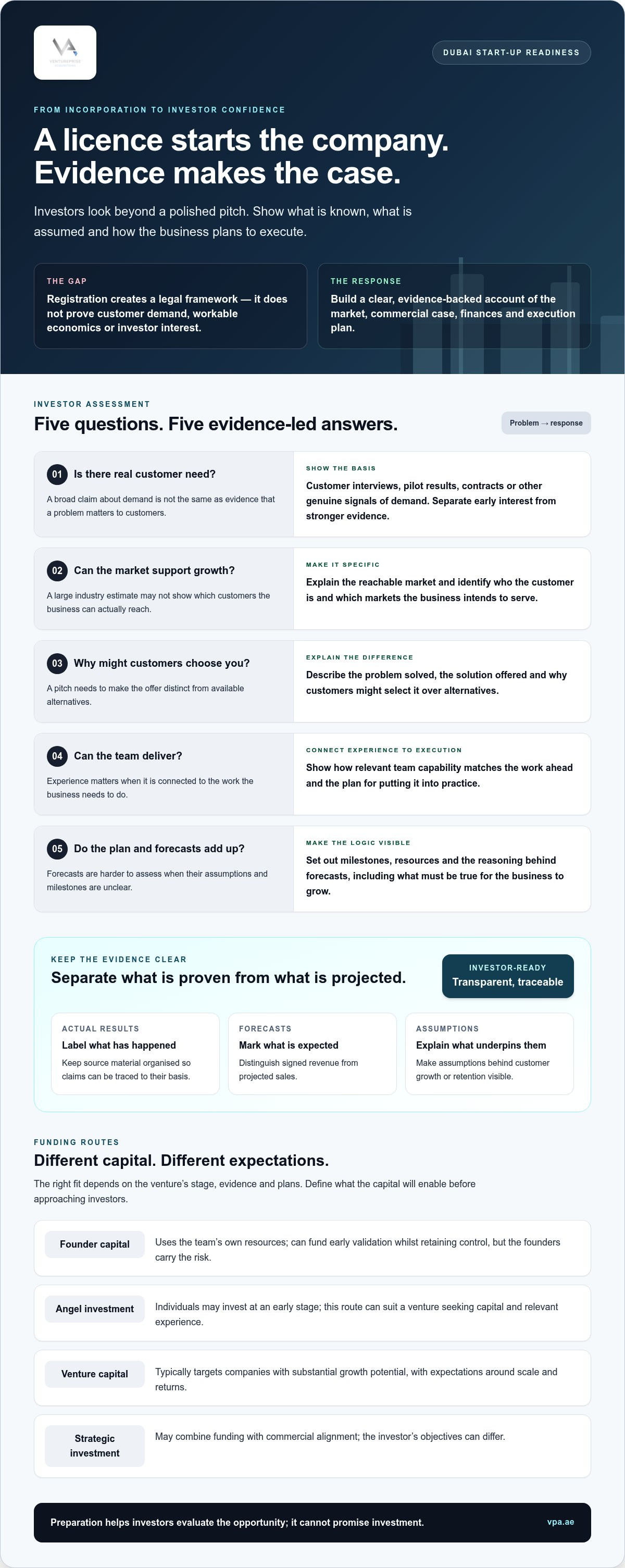
Investors look beyond a polished pitch. They want to understand whether customers need the product, whether the market can support growth, what makes the offer distinct and whether the team can execute. A clear revenue model shows how the business could generate income, whilst transparent assumptions make forecasts easier to assess. Investor readiness is the evidence-backed ability to explain a venture’s potential, its risks and the plan to address them.
Customer evidence: Show who has a problem and how you know it matters.
Market opportunity: Explain the reachable market, not just a broad industry estimate.
Differentiation: Make clear why customers might choose your solution over alternatives.
Team capability: Connect relevant experience to the work ahead.
Execution plan: Set out milestones, resources and the logic behind your forecasts.
These indicators can make a case more credible, but no checklist can promise investment. Preparation helps investors evaluate the opportunity; it doesn’t determine their decision.
What evidence belongs in an investor-ready case?
Build an evidence folder with customer interviews, pilot results, contracts or other genuine signals of demand. Keep source material organised so claims can be traced to their basis. In your pitch deck and financial model, label actual results, forecasts and assumptions clearly. For example, distinguish signed revenue from projected sales, and explain the assumptions behind customer growth or retention. This helps investors see what’s proven and what remains to be tested.
Which funding route fits the startup’s stage?
Founder capital can fund early validation whilst retaining control, but the founders carry the risk. Angel investors may suit an early venture seeking capital and relevant experience. Venture capital is generally aimed at businesses with substantial growth potential and comes with expectations around scale and returns. Strategic investors may bring commercial alignment alongside funding, though their objectives can differ. Before pursuing a route, check current eligibility, securities rules and programme requirements. The right fit depends on your stage, evidence and plans, not simply the size of the opportunity.
As you prepare for setting up a startup in Dubai, strategic planning can connect the operating model to an investor-focused case. Ventureprise’s strategic planning support helps clarify that direction.
How to prepare a Dubai startup for investment, step by step
Turn preparation into a sequence so your evidence, company records and funding story reinforce one another. For founders setting up a startup in Dubai, readiness means showing not just what the business could become, but what supports that ambition today.
Validate demand. Speak with prospective customers and record the problem, feedback and willingness to engage. Separate interest from stronger evidence such as pilot results or contracts.
Define the commercial case. Set out your customer, market, differentiation and revenue model. Explain what must be true for the business to grow.
Build a realistic financial model. Map expected income, costs, cash requirements and milestones. Label actual results, forecasts and assumptions distinctly.
Set the funding objective. Specify how much capital the plan requires in GBP and what it will fund, such as product development, hiring or market entry. Tie the request to measurable milestones.
Prepare records and materials. Create a concise pitch deck, financial model, ownership records and an organised evidence folder before approaching investors.
Start targeted conversations. Prioritise investors whose sector interests, investment stage and strategic aims fit your business. Personalise each approach and track follow-ups, questions and next steps.
Build a coherent pitch and diligence folder
Structure the deck around the problem, solution, market, business model, traction, team, risks and proposed use of funds. Keep supporting information consistent: incorporation records, ownership details, contracts and financial assumptions should tell the same story. Use clear file names and dates, and make it easy to trace each material claim to its supporting evidence. If a forecast changes, update the model and explain why.
Make investor outreach targeted and credible
A relevant introduction beats a generic message. Briefly state what the company does, the evidence of demand, the funding purpose and why that investor may be a fit. Avoid overstating traction or implying an investor has committed. Record responses and refine your approach as you learn which questions recur. Check programme eligibility and securities requirements against current rules.
Clear planning connects company setup with a credible investment case. Ventureprise’s startup setup support can help shape the foundations of your plan.
Set up the operating foundations before approaching investors
A credible investment case depends on practical foundations as well as a strong pitch. For founders setting up a startup in Dubai, coordinate company formation, residency processing and operating preparation, but keep each workstream distinct. A visa doesn’t provide investor access, guarantee a bank account or automatically create a tax advantage. Record your decisions and progress, and plan for the requirements relevant to your activity.
Keep company formation, residency and fundraising workstreams distinct
Ventureprise’s formation process runs from company formation processing in days 1-12 to visa processing in days 13-20. Both stages can begin remotely. The travel stage is days 20-27, with concierge transport to medical and biometrics appointments. The medical examination takes eight minutes and biometrics registration takes fifteen minutes. The process includes delivery of the Emirates ID and handover of the formation paperwork. Build these steps into your schedule rather than assuming every stage can be completed from abroad.
Use Dubai company formation support to establish the company framework, while keeping fundraising preparation focused on your evidence, financial model and investor materials. These are connected tasks, not interchangeable ones.
Turn setup into a clear next-step plan
Align your selected business activity with the way you’ll operate, the markets you intend to serve and the claims in your investor materials. Then organise essential operating tasks, including banking setup and company corporate tax registration where applicable. There is no requirement to show personal or business bank statements to start a business, or to buy property. There is also no minimum annual turnover threshold. Corporate tax has been introduced, although it does not apply in some specific cases, so account for the rules that apply to your company. Growth consultancy can help shape the next stage, but neither setup support nor a growth plan guarantees investment.
Ventureprise also provides business growth consultancy as your operating plan develops. Treat the work as a coordinated sequence: establish the company, prepare to operate, maintain clear records, then begin focused investor conversations. This gives prospective investors a more coherent view of the venture and its readiness to execute.
Ventureprise’s Dubai startup setup support connects formation and operating priorities.
Turn your Dubai ambition into a focused next move
The strongest next step isn’t simply to register a company. It’s to align your Dubai presence with the business you intend to build and the evidence you’ll bring to future investor conversations. For UK founders, setting up a startup in Dubai can be more manageable when practical setup and longer-term commercial direction are planned together.
Ventureprise Acquisitions combines UK roots with an on-the-ground presence in Dubai. Company formation and visa processing can begin remotely, with further support spanning residency coordination, banking setup and business growth consultancy. These services help organise the work ahead, whilst investment decisions remain with investors and depend on the venture’s own merits.
Take the next step with a plan shaped around your business, operating priorities and ambitions. Plan your Dubai startup setup with Ventureprise Acquisitions.
Frequently Asked Questions
Can I set up a startup in Dubai without moving there?
Yes. Initial company formation and visa processing can begin remotely, so setting up a startup in Dubai doesn’t require you to relocate before work starts. The process includes a later travel stage for medical and biometrics appointments. Owners don’t need to live in Dubai full-time, but must enter the UAE at least once every 180 days to keep a residency visa valid. Plan remote preparation and in-person requirements as separate parts of the setup.
Do I need a local partner to set up a Dubai startup?
No, 100% foreign ownership is available for many business activities, particularly in free zones. The applicable conditions depend on the activity and chosen setup. Match the proposed company structure to what the business will actually do, and check the current requirements for that activity.
Does registering a company in Dubai guarantee that I will raise investment?
No. Registration formalises the business, but it can’t guarantee an investor will fund it. Investors may also examine customer demand, the team’s ability to deliver, how revenue is generated, the assumptions behind forecasts and the risks that could affect execution. Clear answers can make discussions more focused, but company formation support or a readiness checklist can’t promise an investment decision.
What documents should I prepare before approaching startup investors?
Prepare a concise pitch deck, a financial model with assumptions clearly labelled, ownership records, company documents and evidence of customer demand. For instance, keep interview notes or pilot results alongside the claims they support. Investors may request different information depending on the company’s stage and sector. Distinguish completed performance from projections, and make sure every statement can be substantiated.
Can a Dubai free-zone company trade internationally and with mainland customers?
Free-zone companies can trade internationally and can trade with mainland UAE through a branch setup. The permitted route depends on the company’s structure, activity and current rules. Map where customers will be based and how you’ll serve them, then check the relevant requirements before relying on a particular trading arrangement.


Comments