
_svg.png)
Economic Substance Regulations UAE Guide: What Businesses Need to Know in 2026
ESR hasn’t vanished from the UAE compliance picture; its role has changed. Businesses no longer need to submit ESR notifications and reports for financial years ending after 31 December 2022, but unresolved obligations from 2019 to 2022 may still matter. This Economic Substance Regulations UAE guide explains what that change means and why treating ESR as entirely finished could leave historic issues overlooked.
It’s understandable to wonder whether ESR filing is still active, which past periods need attention and how the rules relate to UAE Corporate Tax. The key is to separate a review of legacy ESR matters from current tax compliance. The Federal Tax Authority can still assess historic ESR compliance, while substance requirements also matter under Corporate Tax for Free Zone businesses seeking the 0% rate on qualifying income. This guide explains how the rules changed, which records and financial years to review, and what to consider as you organise your business setup and ongoing compliance.
Table of Contents
Economic Substance Regulations UAE: What Changed by 2026?
Economic Substance Regulations (ESR) required certain UAE businesses carrying on specified activities to demonstrate that their income-generating operations had adequate substance in the country. Introduced in the context of international efforts to counter tax avoidance, including Base Erosion and Profit Shifting (BEPS), the rules required businesses to assess their activities, resources and reporting. In 2026, the key question is whether a business has historic ESR matters to review, not whether it should continue making routine ESR filings for later periods.
Does ESR still apply to UAE businesses in 2026?
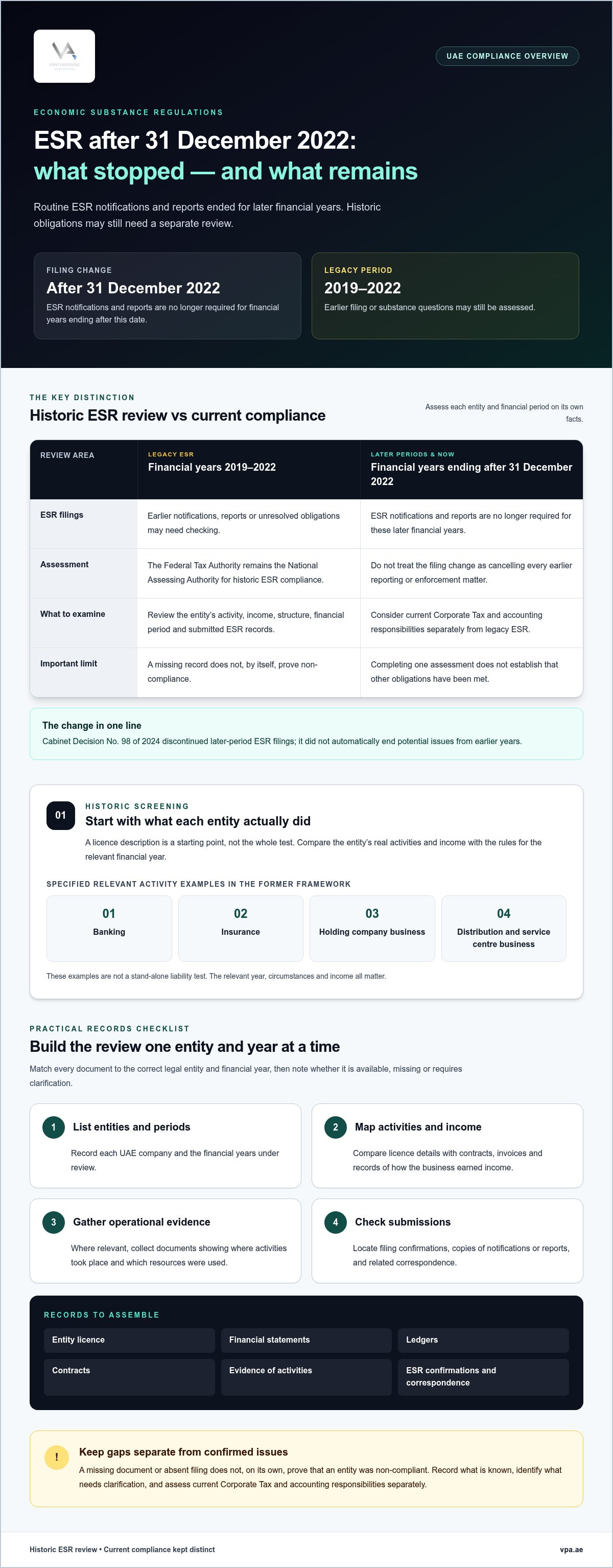
ESR notifications and reports are no longer required for financial years ending after 31 December 2022. Cabinet Decision No. 98 of 2024 amended the original ESR legislation to discontinue filings for those later periods. The date marks a change to the filing regime, not an automatic end to potential issues from earlier years.
In 2026, UAE ESR filings are discontinued for financial years ending after 31 December 2022, while historic obligations for 2019 to 2022 may still be assessed. The Federal Tax Authority remains the National Assessing Authority for historic ESR compliance, so past filing or substance questions may need a separate review. This Economic Substance Regulations UAE guide distinguishes that legacy review from ongoing business compliance.
Which rules and authorities should readers recognise?
Cabinet Decision No. 98 of 2024 is the relevant change to the filing requirement. The earlier ESR framework governs the historic period, while the Federal Tax Authority retains assessment powers over that period. The precise obligations depend on the financial year and the business’s circumstances. The change should not be read as cancelling every earlier reporting or enforcement matter.
Keep the wider business structure in view. Company activity and presence are relevant planning considerations, but an ESR review does not replace an assessment of current tax and accounting responsibilities. For broader context on establishing a UAE commercial presence, see our UAE company setup guidance.
Which Businesses and Activities Could Have Had Historic ESR Duties?
Historic ESR screening starts with what each UAE entity actually did, not simply the name on its licence. The former framework covered specified Relevant Activities, including banking, insurance, holding company business, and distribution and service centre business. These examples help focus a review, but they aren’t a stand-alone test of liability. The rules for the particular financial year, the entity’s circumstances and its income all matter.
Assess an entity’s activity and financial period together. The same business may need a different analysis for different years, especially if its operations, income sources or structure changed. ESR screening is also distinct from Corporate Tax registration, return filing and accounting obligations. Completing one assessment doesn’t establish that the others have been met.
How to screen a company’s past activities
Build a picture of every entity for each historic financial year. Bring together its licences, income sources, contracts and records of actual operations. Then compare those facts with the Relevant Activities and rules that applied in that year. A licence description is a useful starting point, but it may not capture the full range of business conducted. Record what the documents show and flag unanswered questions for further review. A missing record, on its own, does not prove non-compliance.
Free Zone, mainland and other structures
A Free Zone or mainland label alone doesn’t settle historic ESR treatment. Review the rules for the relevant period alongside the entity’s activity, income and structure. This is why the Economic Substance Regulations UAE guide approach is period by period, rather than based on a blanket assumption about where a company was registered. Licence context can also inform setup planning; explore our UAE company setup guidance for wider structural considerations.
Organised bookkeeping can make this review more efficient by bringing financial records and evidence of business activity together. Ventureprise Acquisitions supports company formation and business administration, including accounting and bookkeeping. Discuss your business-support needs.
How to Review Historic ESR Exposure: A Practical Records Checklist
A structured review turns scattered paperwork into a clearer picture of each entity’s historic ESR position. Work through the records one legal entity and financial year at a time. Don’t assume missing paperwork proves a breach, or that an absent filing means no obligation applied.
Records to gather before assessing a historic period
For an initial review, assemble the entity’s licence, financial statements, ledgers, contracts, evidence of its activities, and any ESR notification or report confirmations. Match each item to the correct legal entity and financial year. Use this sequence to organise the review:
List entities and periods: note each UAE company and the financial years under review.
Map activities and income: compare licence details with contracts, invoices and records showing what the business did and how it earned income.
Gather operational evidence: where relevant, collect documents showing where activities took place and which resources were used.
Check submissions: locate filing confirmations, copies of notifications or reports, and any related correspondence.
Mark each item as “available”, “missing” or “requires clarification”. This keeps gaps in the archive separate from confirmed compliance issues and makes follow-up more targeted.
For each historic period, verify applicable deadlines, penalties and any available amendment or correction route against current official guidance, including information from the Federal Tax Authority. These details can depend on the period and circumstances, so a general checklist is not a final determination.
Ventureprise supports business administration and record organisation, including accounting and bookkeeping. Discuss your business-support requirements.
When a specialist review is the sensible next step
Give the issue closer attention if submission evidence is unclear, records conflict or the business has received correspondence from the authority. Start by documenting the question, the relevant entity and period, and the records that support your understanding. Ventureprise supports business administration and accounting-related needs, including organising records. This Economic Substance Regulations UAE guide is a practical starting point; complex historic questions require careful assessment against the applicable rules and current official guidance.
What Comes After ESR Review? Separate Legacy Issues from Current Compliance
Completing a historic ESR review doesn’t close the wider compliance file. It answers questions about earlier periods; your business still needs a separate view of current tax administration, accounting and record-keeping. Manage these as distinct workstreams so that one review does not get mistaken for another.
ESR and Corporate Tax answer different compliance questions
ESR focused on substance in relation to specified activities and historic financial periods. Corporate Tax is a separate current regime, with its own rules and administration. An ESR review doesn’t replace an assessment of tax registration, filing, exemptions or deadlines. Verify those requirements against current Federal Tax Authority and Ministry of Finance guidance, as they depend on the business and its circumstances. For wider structural planning, see our UAE company setup guidance.
Build a clear next-step plan for the business
Keep the actions distinct: resolve gaps in historic ESR records, review current tax registrations and obligations, then address bookkeeping or record-keeping weaknesses. This Economic Substance Regulations UAE guide helps organise those questions, but it is not a substitute for a tailored tax or legal assessment. Ventureprise supports UAE company formation, Corporate Tax registration, accounting and bookkeeping as part of business administration.
Planning a new structure or reviewing your next steps? Talk through your UAE business setup.
Turn Your ESR Review into a Clear Business Plan
The practical message from this Economic Substance Regulations UAE guide is clear: treat historic ESR questions separately from current Corporate Tax and accounting responsibilities. Review relevant entities and financial periods using the records available, then identify what needs follow-up. Don’t assume a paperwork gap proves non-compliance.
Next, set out distinct actions for historic records, current registration and filing administration, and ongoing bookkeeping. Ventureprise Acquisitions brings UK roots and an on-the-ground UAE presence, supporting entrepreneurs with company formation, Corporate Tax registration, accounting and bookkeeping. This practical business support can help you organise your next move.
Discuss your UAE business requirements and build a clearer path from review to action. With organised records and a structured plan, you can move forward with confidence.
Frequently Asked Questions
Is the UAE Economic Substance Regulations filing still required in 2026?
No. ESR notifications and reports aren’t required for financial years ending after 31 December 2022, following the amendment made by Cabinet Decision No. 98 of 2024. That change doesn’t automatically remove earlier obligations. Financial years from 2019 to 2022 may still require review, and the Federal Tax Authority can assess historic compliance. Check current official UAE guidance for the change’s precise scope and any surviving obligations.
What happens if a UAE company missed an ESR notification or report?
The outcome depends on the entity, its activities, the financial year and the rules that applied at the time. Start by gathering any notification or report copies, submission confirmations, accounts and correspondence with the authority. Then assess what was required and whether anything remains unresolved. Don’t assume a missing record proves a filing was missed, or that the regime’s later change removes the need to address historic enquiries.
Which UAE businesses were subject to Economic Substance Regulations?
Historic coverage depended on the relevant activity categories and each entity’s circumstances in the financial period concerned. The former framework included categories such as banking, insurance, holding company business, and distribution and service centre business. These examples aren’t a complete eligibility test. Review actual activities, income and entity structure against the rules and any exclusions applicable to each year. A licence description alone may not show the full picture.
Are Economic Substance Regulations the same as UAE corporate tax?
No. ESR addressed substance requirements for specified activities during historic periods, whilst Corporate Tax is a separate regime with its own registration, filing and record-keeping requirements. The distinction in this Economic Substance Regulations UAE guide matters: reviewing historic ESR compliance doesn’t establish whether a business has met its current tax obligations. Check applicable requirements and deadlines using current Federal Tax Authority guidance, taking the company’s circumstances into account.
What records should I gather for a historic ESR review?
Gather company licences, financial statements, ledgers, contracts, records of activities and income, and copies of ESR notifications or reports, including submission confirmations. Organise them by legal entity and financial year so each document can be matched to the period it concerns. Depending on the historic rules and circumstances, evidence of where activities took place may also help. Track missing documents separately from confirmed compliance issues.


Comments