
_svg.png)
UAE Tax Residency Certificate: 2026 Benefits & Limits
A UAE Tax Residency Certificate can support a cross-border tax claim, but it can’t decide the outcome for you. When weighing the tax residency certificate UAE benefits, the key question isn’t simply whether you can obtain one. It’s what the certificate proves, for which period, and how the relevant foreign tax authority will treat it.
That distinction matters because a UAE residence visa, tax residence and a certificate are related, but they aren’t interchangeable. A certificate doesn’t automatically secure treaty relief or reduce tax due in another country. For UK-based individuals and businesses with UAE links, understanding what each document does can help you plan your next steps.
This guide explains when a certificate may help with a double taxation treaty claim or another cross-border tax matter, where its limits arise, and why home-country rules still matter. It also sets out practical questions to consider before applying or relying on the document, including how company and residency setup fits into a wider cross-border strategy. You’ll have a clearer basis for assessing your position and discussing it with a qualified tax adviser.
Table of Contents
What a UAE Tax Residency Certificate proves, and what it does not
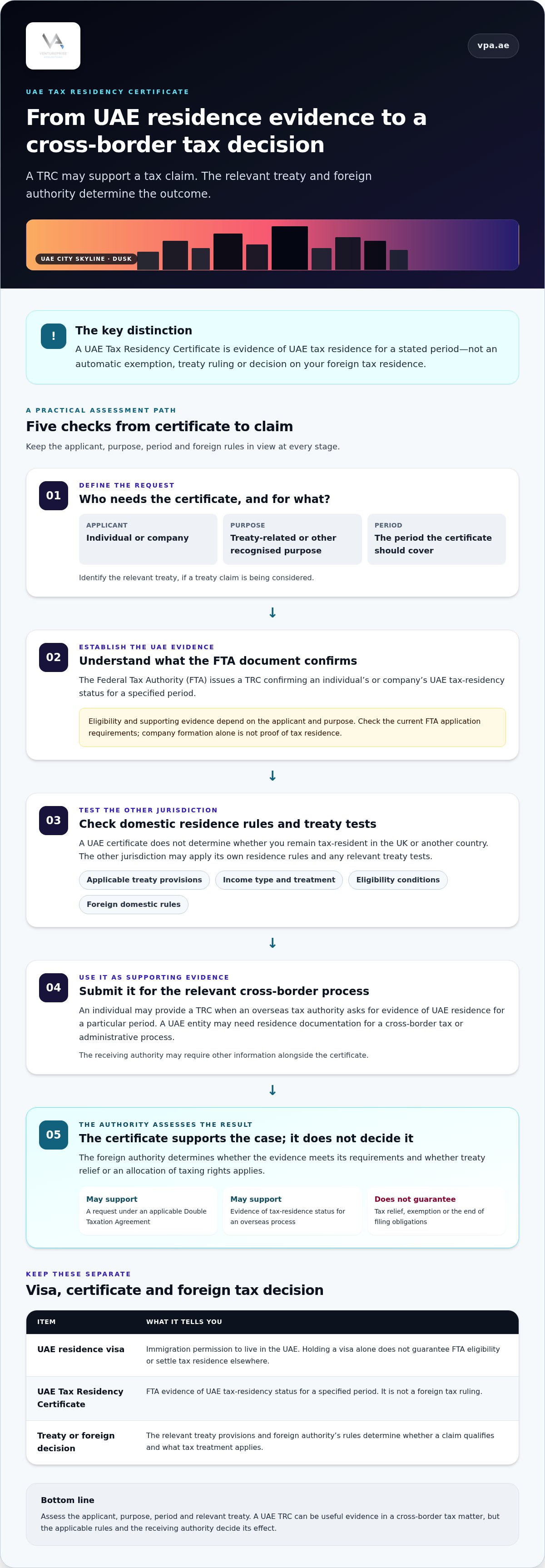
A UAE Tax Residency Certificate (TRC) is a Federal Tax Authority (FTA) document confirming an individual’s or company’s tax-residency status for a specified period. The FTA issues certificates for purposes connected with applicable tax treaties and other recognised purposes. The concept of tax residence varies between jurisdictions, so a certificate records a position under UAE rules. It doesn’t settle how another country views you.
A certificate is evidence of tax residence, not an automatic tax exemption. Its value depends on why it’s requested and the rules applied by the relevant foreign authority. That distinction is central to understanding the tax residency certificate UAE benefits: the document may support a claim, but it doesn’t guarantee a tax outcome.
Is a UAE residence visa the same as a tax residency certificate?
No. A residence visa grants immigration permission to live in the UAE. A TRC is documentary evidence of tax-residency status for a stated period. Holding a visa alone doesn’t guarantee that you meet the FTA’s eligibility requirements or qualify for a certificate. Neither a visa nor a TRC by itself determines whether you remain tax-resident in the UK or another country.
Who issues a UAE Tax Residency Certificate?
The FTA is the issuing authority. Its service information distinguishes applications by individuals, also known as natural persons, and companies or other juridical persons. Eligibility and supporting evidence depend on the applicant and the certificate’s purpose. Business formation alone should not be treated as proof of tax residence.
If establishing a UAE business forms part of your wider plans, Ventureprise Acquisitions provides UAE company formation support. Keep the objectives distinct: company formation shapes your business structure, while tax-residency status must be assessed separately under the relevant rules.
UAE tax residency certificate benefits: where the document may help
The practical value of a Tax Residency Certificate is that it can provide formal evidence for a cross-border tax process. The Federal Tax Authority identifies treaty-related and other recognised purposes for its certificates. Potential tax residency certificate UAE benefits include supporting a request under an applicable Double Taxation Agreement (DTA), or responding when an overseas authority or institution asks for proof of tax-residence status.
The relevant treaty and foreign rules determine the result, not the certificate alone. A DTA may set out how taxing rights are allocated or when relief may be available. The provisions, income type, eligibility conditions and the other jurisdiction’s domestic rules all matter. A certificate doesn’t automatically remove tax, withholding or filing obligations. Review the official requirements for a Tax Residency Certificate alongside the rules relevant to your particular claim.
Can a UAE certificate help with double taxation?
Potentially. If a DTA applies, a certificate may support a request to access its provisions, such as relief from double taxation or an allocation of taxing rights. It isn’t a ruling on that request. The foreign authority may assess whether you qualify under the agreement and its own rules, including how the relevant income is treated.
When might an individual or business find it useful?
For example, an internationally mobile individual may be asked by an overseas tax authority to document UAE tax residence for a particular period. A certificate may form part of the evidence submitted, alongside any other information the authority requires. A UAE entity might likewise need residence documentation for a cross-border tax or administrative process. In either case, the receiving authority decides whether the evidence meets its requirements.
For individuals whose business, assets and family arrangements cross borders, private client wealth structuring can form part of wider planning. If you’re mapping your UAE setup objectives against your cross-border position, discuss your planning objectives with the team.
The limits: a UAE certificate does not decide your foreign tax position
A UAE Tax Residency Certificate doesn’t automatically make you non-resident in the UK or any other country. Each jurisdiction can apply its own domestic residence rules, and a relevant tax treaty may have separate tests for deciding which country’s rules apply. A certificate can support your position, but it can’t override those tests or settle a foreign authority’s assessment.
This distinction matters when weighing the tax residency certificate UAE benefits. Evidence of UAE status is not personal tax advice, a definitive interpretation of a treaty, or confirmation that you have met every filing and compliance duty. Criteria and supporting evidence can also differ according to the applicant, period covered and purpose of the application.
Does a UAE Tax Residency Certificate automatically prevent double taxation?
No. A certificate may support a claim, but it doesn’t itself determine whether another country will grant relief. The outcome depends on your circumstances, the wording of any applicable treaty and the procedures of the relevant authority. For example, a treaty may treat different types of income differently, so evidence of residence alone may not resolve how a particular payment is taxed.
Review current guidance from the UAE Federal Tax Authority and the authority in the other jurisdiction. For a cross-border position, qualified tax advice can help you assess treaty eligibility, reporting duties and the evidence needed.
How do immigration residency and tax residency differ?
Immigration residency concerns permission to reside in the UAE. Tax residence concerns how tax rules apply to a person or entity, based on the relevant jurisdiction’s criteria and circumstances. A visa, company formation or certificate should not be treated as a standalone answer to another country’s tax position.
Business setup can be planned separately from tax-residence analysis. If you’re considering a UAE venture while based in the UK, discuss your UAE setup objectives as part of your wider cross-border planning.
How to assess your UAE certificate options and plan the next step
Start with the purpose, not the paperwork. Working through these questions in order helps you assess whether an application fits your cross-border position and how the potential tax residency certificate UAE benefits relate to your wider plans.
Identify the applicant: are you applying as an individual or on behalf of a company?
Define the intended use: what tax, treaty-related or administrative matter requires evidence?
Set the relevant period: establish which tax period the certificate needs to cover.
Map the jurisdiction: identify the overseas country involved and whether an applicable treaty is relevant.
Then review the latest Federal Tax Authority (FTA) guidance for eligibility, application timing, evidence and submission requirements. These can vary by applicant, period and purpose. Don’t rely on an old checklist, fee or processing estimate as a current requirement.
What should you prepare before considering an application?
Bring together the applicant category, intended use, relevant period and cross-border jurisdiction. With these details clear, you can check the FTA’s current evidence requirements and identify any questions about treaty terms or overseas procedures for a qualified tax adviser.
Where does UAE company and residency planning fit?
Company formation, immigration residency, corporate-tax registration and a Tax Residency Certificate are distinct workstreams. A company or visa setup does not, by itself, establish eligibility for a certificate or determine tax treatment abroad. Ventureprise Acquisitions provides UAE company formation and residency setup as part of broader business planning, without presenting setup as a guaranteed tax outcome.
Explore UAE business setup solutions as you shape your next steps. To discuss how your UAE setup plans fit your wider objectives, start a conversation with the team.
Plan your UAE position with clarity
A UAE Tax Residency Certificate can support a cross-border tax claim, but it doesn’t guarantee treaty relief or determine whether you remain tax-resident elsewhere. The potential tax residency certificate UAE benefits depend on the certificate’s purpose, the applicable treaty and the other country’s rules. Keep tax-residence evidence distinct from an immigration visa, and assess certificate requirements against your circumstances before relying on it.
Your next step is to align any certificate application with your wider UAE plans. Company formation, immigration residency and tax-residency assessment are separate considerations, even when they form part of one strategic move. Ventureprise Acquisitions supports company formation, residency setup and business consultancy. Initial company formation and visa processing stages can begin remotely.
Build your plan on clear objectives, not assumptions about tax outcomes. Discuss your UAE company and residency plans with Ventureprise Acquisitions and map a practical route forward.
Frequently Asked Questions
What are the main benefits of a UAE Tax Residency Certificate?
A UAE Tax Residency Certificate provides official evidence of tax-residency status for a specified period. Potential tax residency certificate UAE benefits include supporting a cross-border tax claim under an applicable treaty or responding to an overseas authority’s request for documentation. Its usefulness depends on the applicant, purpose and foreign procedures. It doesn’t guarantee relief, establish your residence status in another country or remove reporting obligations.
Can a UAE Tax Residency Certificate help avoid double taxation?
It may support a claim under an applicable Double Taxation Agreement, but it doesn’t automatically eliminate tax in either country. The treaty’s terms, the type of income, your circumstances and the foreign authority’s procedures all affect the outcome. Check that the agreement applies to your situation and seek qualified cross-border tax advice before changing how you report income or relying on the certificate.
Is a UAE residence visa enough to get a Tax Residency Certificate?
No. A residence visa relates to immigration permission, while a Tax Residency Certificate is issued by the Federal Tax Authority (FTA) to confirm tax-residency status for a particular purpose and period. Having a visa doesn’t prove that you meet every certificate criterion. Review the FTA’s current eligibility and evidence requirements for your applicant type and circumstances before preparing an application.
Does a UAE Tax Residency Certificate make me non-resident in the UK?
Not automatically. The certificate documents a UAE tax-residency position, but your UK residence status is assessed under UK rules and your individual circumstances. It doesn’t settle that assessment or remove UK tax obligations by itself. If you have UK connections, consider the full facts and current official guidance, and obtain advice suited to your circumstances before making decisions about your tax position.
How do I apply for a UAE Tax Residency Certificate?
The Federal Tax Authority provides the application service and sets the current requirements. First identify whether the applicant is an individual or an entity, the period the certificate should cover and its intended purpose. Then review the latest FTA eligibility, evidence and submission guidance before applying. Requirements can vary, so avoid relying on an old document checklist or assumed processing time.


Comments