

Expanding your UK business to the Middle East: costs and cash flow
Market opportunity is only half the expansion decision. Expanding your UK business to the Middle East can put your offer in reach of a region with more than 500 million people, but success depends on choosing the right country, sector and operating structure. Dubai may provide a practical base, yet mainland and Free Zone routes have different commercial implications.
You’re right to focus on costs and cash flow as well as demand. Establishment, staffing and launch spending can strain working capital if they arise before local revenue, so your financial plan should match the pace and scale of your market entry. Digital services, financial expertise and consumer products all offer potential, but each calls for an approach suited to its customers and operations.
This guide explains why the region may suit a UK business, where sector opportunities are emerging and how mainland and Free Zone structures differ. It also outlines the main setup costs to plan for and the cash-flow decisions that can help you judge whether expansion is commercially sustainable.
Table of Contents
Why the Middle East?
Expanding your UK business to the Middle East calls for a market choice grounded in customer demand and commercial fit. According to HM Revenue & Customs, the UK corporation tax rate is 25%; key risks include policy or licensing changes, contract rules, currency movements and payment delays, which require country-by-country planning.
Saudi Arabia as a Regional Gateway
Saudi Arabia can provide a base for reaching customers across Middle Eastern, Asian and African markets. Its scale matters if your strategy targets regional trade rather than one national market. Saudi Arabia announced Vision 2030 in 2016 to reduce dependence on oil, and more than 180 international firms had relocated regional offices there. Consider how local infrastructure and a suitable partner support your intended route to customers.
Testing the Market Before Establishing an Entity
Market testing means assessing customer response before committing to a local company and its ongoing obligations. Define a customer segment, test a focused offer through direct sales or a local partner, then review enquiries, conversions and payment behaviour. These signals can help refine your pricing and cash-flow assumptions. For example, a UK consultancy could gauge demand among prospective clients before establishing a permanent presence.
Cultural Differences in Market Entry
Cultural adaptation means adjusting business communication and relationship-building to local expectations. In the UAE, personal relationships and trust matter, so allow time to build credibility with prospective partners. Tailor marketing, meetings and commercial discussions to each audience instead of using UK materials unchanged. This practical step can make your entry strategy more relevant and help you avoid treating the region as one uniform market.
Regional Expansion and Market Opportunities
Regional expansion means choosing markets individually, rather than assuming one launch covers the region. The GCC and Egypt offer distinct opportunities, so weigh customer demand, local rules, payment practices and partner fit in each market. Dubai, Riyadh and Doha are financial hubs generating demand for consulting, accountancy and financial advisory expertise. A staged strategy helps you decide where to deepen your presence next. Expanding your UK business to the Middle East is a sequence of deliberate market decisions.
Sector opportunities for UK businesses and franchises
The strongest opportunities align a UK business’s expertise with investment and demand in its chosen market. The UAE and Saudi Arabia are investing heavily in digital transformation, creating openings for technology firms and businesses that support digital services. The UK Industrial Strategy identifies Financial Services, Creative Services and Professional & Business Services among its eight growth-driving sectors. Those capabilities can translate into regional demand, but success depends on matching a specific offer to local customers.
Consumer businesses have routes to market too. UK SMEs can sell fashion, beauty and speciality food through regional marketplaces and direct-to-consumer digital channels. E-commerce can help test interest without immediately building a large physical retail footprint. Before launch, define your target customer, select products suited to regional preferences, and plan fulfilment and customer support. For a franchise, assess whether the operating model, brand presentation and partner relationship can work in the target market.
Financial and professional expertise also has a clear regional context. Dubai, Riyadh and Doha are financial hubs generating demand for consulting, accountancy and financial advisory expertise. A UK firm can shape its offer around a defined client need, such as business planning or financial support, rather than exporting a broad service catalogue. In Saudi Arabia, economic diversification creates potential for suppliers serving new business activity. Focus on opportunities that match your capabilities and delivery model.
Turn sector interest into a practical growth decision by mapping customer demand, local partners and the route to revenue in each country. For retail, compare marketplace sales with direct online sales; for professional services, identify the target client and how relationships will be built. Treat the UAE and Saudi Arabia as distinct markets, not interchangeable launch locations. If expansion also raises questions about ownership and personally held assets, discuss your expansion priorities in the context of private client wealth structuring.
Mainland versus Free Zone company structures
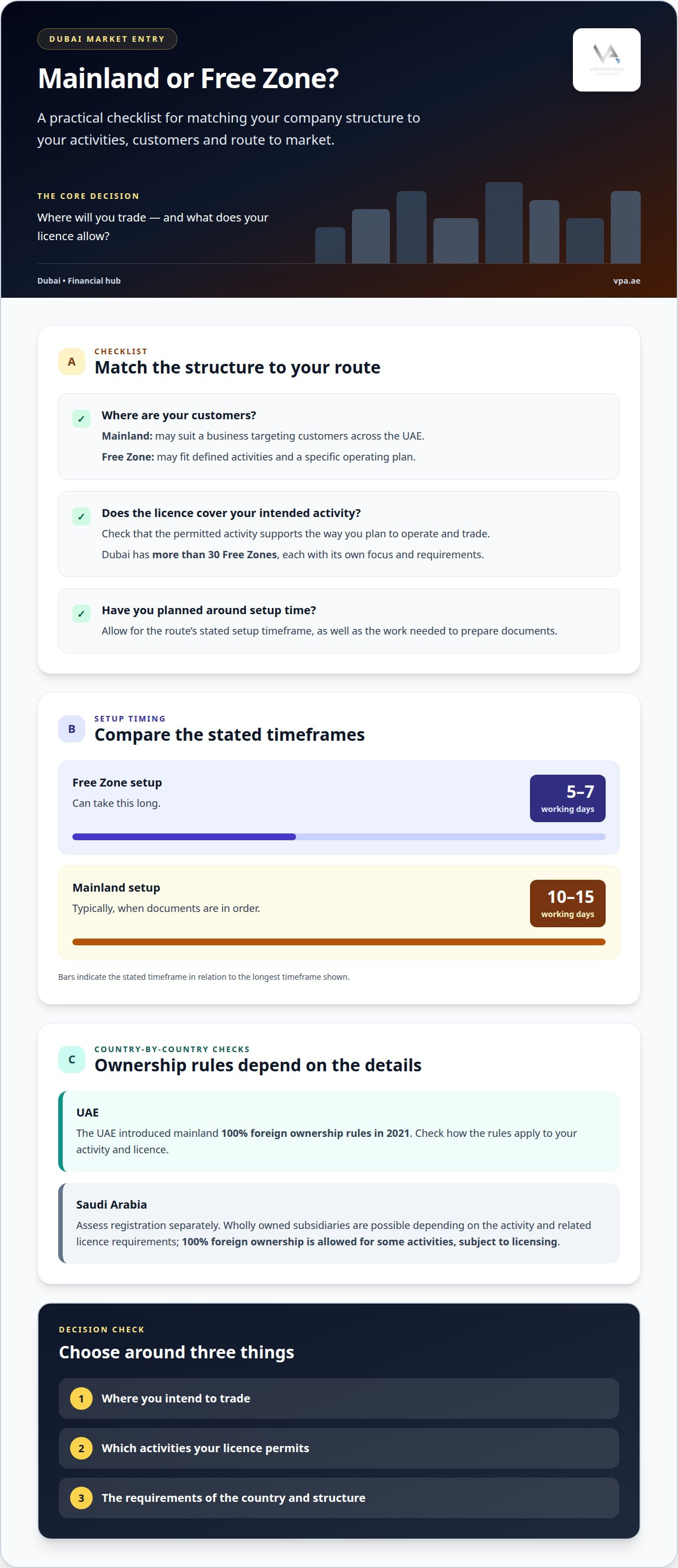
Foreign ownership rules depend on the country, activity and licence. The UAE introduced mainland 100% foreign ownership rules in 2021; in Saudi Arabia, foreign entities can establish wholly owned subsidiaries, depending on the activity and related licence requirements.
In Dubai, a mainland company and a Free Zone company offer different routes to market. Mainland registration may suit a business targeting customers across the UAE, while a Free Zone structure may fit defined activities and operating plans. Dubai has more than 30 Free Zones, each with its own focus and requirements. Free Zone setup can take 5-7 working days; mainland setup typically takes 10 to 15 working days when documents are in order. The right choice turns on where the business will trade and what its licence permits.
Saudi registration needs separate assessment. A UK company considering an LLC should first establish whether its activity is commercial, service-based or professional, and whether a Saudi partner is part of the ownership structure. The permitted ownership and capital requirements vary with those factors. Saudi rules also allow 100% foreign ownership for some activities, subject to licensing. Treat registration as a country-specific decision, not an extension of a Dubai setup.
Parent-company documents support the application and show the foreign company’s ownership and authority. Prepare the incorporation record, constitutional documents and details of the proposed subsidiary, then organise translations or legalisation where the relevant authority requires them. Missing or inconsistent details can slow an application, so align company names, ownership information and activity descriptions before submission. A focused Dubai company setup assessment can help clarify which structure matches the intended market.
For UK reporting, distinguish a separately incorporated overseas subsidiary from a branch, which extends its foreign parent rather than operating as a separate company. The choice affects governance, accounts and how the parent manages its overseas presence. Coordinate the selected Middle Eastern entity with the UK company’s records, ownership structure and ongoing reporting responsibilities.
Expansion setup costs and cash flow planning
Company formation in the UAE, Saudi Arabia and Qatar depends on the chosen activity, ownership structure and local licence. There is no single regional route or cost. Model establishment costs separately from operating expenses, then forecast when each outlay falls due and when customer receipts may arrive.
Formation Costs and Cash Flow Planning
Saudi capital requirements vary: stated minimums include SAR 7 million for a commercial LLC with a Saudi partner holding at least 25%, and SAR 50,000 for a wholly foreign-owned service or professional company. Qatar requires its own activity and ownership assessment.
Cash-flow planning means timing setup spending against expected income, not simply estimating a launch total. Map formation, licensing, visas, staffing, premises, compliance and market development as separate cash demands. Then forecast conservative sales timing, payment delays and currency movements. This shows how much working capital must remain available after incorporation. Treat incentives as a possible influence on the economics, not as guaranteed cash at launch.
Taxes, VAT and Customs Duties
Tax planning identifies the taxes that may affect profits, sales and cross-border goods. In the UAE, corporate tax is 9% on profits exceeding AED 375,000 annually; UAE VAT is 5% and applies to most goods and services. For UK exporters, customs duties and import taxes depend on the destination country and goods, so include them in landed-cost and pricing calculations rather than treating them as one regional rate.
Build a global expansion forecast with separate UAE, Saudi and Qatar scenarios. Include regulatory and compliance spending, local operating costs, tax timing and expected customer payment dates. Stress-test slower sales and delayed receipts before committing to fixed costs. To shape a Dubai setup and a practical cash-flow plan, discuss your company formation requirements.
Ventureprise Acquisitions
Ventureprise Acquisitions helps business owners connect market-entry decisions with company formation and strategic planning. Turn to the firm when you have identified a target market but need to align your proposed activity, operating structure and launch priorities before committing resources. Its Company Formation service supports a Dubai setup, while Strategic Planning helps connect your wider business strategy with regional growth.
Its company formation support is relevant when you are ready to establish a presence, while strategic planning can help shape the commercial direction behind that move. For business owners also considering personal wealth arrangements, Private Clients Foundations amd Trustss may be relevant to broader asset planning. The firm’s resource, Setting Up A Company In Dubai: 6 Myths That Will Hold You Back, can also help frame questions about a Dubai launch.
To discuss your expansion plans, contact Ventureprise Acquisitions.
Turn your expansion plan into a clear next move
Expanding your UK business to the Middle East becomes actionable when your commercial ambition, ownership choices and available resources align. Before committing, define what a successful first stage would achieve, which decisions must come first and what would prompt you to scale or adapt. That clarity gives your expansion a practical direction, rather than making the launch itself the goal.
Ventureprise Acquisitions supports business owners through company formation and strategic planning. Its resource, Setting Up A Company In Dubai: 6 Myths That Will Hold You Back, can help you examine assumptions behind a Dubai launch and prepare sharper questions for your planning. These are useful starting points when you’re shaping a market-entry decision into a workable business plan.
Contact Ventureprise Acquisitions to discuss your plans and identify the next step for your expansion. Move forward with a strategy built around your business priorities.
Frequently Asked Questions
Can a UK citizen start a business in Saudi Arabia?
Yes, a UK entrepreneur can establish a business in Saudi Arabia, usually through a company structure suited to the proposed activity. Foreign entities can establish wholly owned subsidiaries for some activities, subject to licensing requirements. The route differs for commercial, service and professional businesses. For example, a UK company planning consultancy services should assess the relevant activity and licence before choosing its ownership structure.
Subsidiary vs Branch: Which Is Right for You?
A subsidiary may suit a business that wants a distinct local company for its Middle East operations; a branch may suit one extending the UK parent’s activities abroad. Consider where contracts will be signed, which entity will employ staff, and how each operation will be funded and managed. A UK firm piloting a new market should choose a structure that matches its planned scale and risk exposure.
What is the Easiest Way to Expand from the UK to Dubai in 2026?
For a business ready to establish a Dubai presence, choose a company route suited to its activity and intended customers, then organise formation and residency requirements together. Initial company formation and visa processing can begin remotely, so travel need not start the process. Prepare clear ownership details and a precise description of business activities to help align the application with the intended licence.
Which Middle Eastern countries are most attractive for UK businesses expanding abroad?
There is no single best country for every UK business. The UAE may suit firms seeking a Dubai base, while Saudi Arabia may fit companies targeting its commercial or professional markets. Qatar and Egypt may also merit consideration where customer demand and partner access align with your offer. Compare each market against your sector, target buyers, operating model and capacity to support local customers.
What are the market entry options for UK companies in the Middle East?
UK companies can test demand through direct exports, online sales or a local commercial partner before establishing a permanent presence. Other routes include a franchise arrangement, a branch or a locally incorporated company. The best fit depends on how much control you need, how you will deliver products or services, and whether customers require local operations. Define the sales route first, then align the company structure with it.
What licences, certifications and product standards are required to sell in the Middle East?
Requirements depend on the destination country, business activity and product category; there is no single licence or certification covering the whole region. A food product, for example, may face different approvals from a software consultancy. Map the relevant product specifications, labelling rules and activity licences for each target market before setting launch dates. Build these requirements into supplier, packaging and distribution plans from the outset.


Comments