

How to Run a Dubai Company from the UK and Manage Tax and Setup
The answer to “Can I run a Dubai company from the UK?” is yes: you can register a Dubai company while living in the UK. But incorporation alone does not determine where the company is taxed. If its central management and control takes place in the UK, it may be treated as UK tax resident.
A free zone can seem like a straightforward route into Dubai, but the right setup depends on more than where the company is registered. Match its activity, management, documents and banking arrangements to how you will actually operate it.
This guide explains how to compare a free zone with other setup options, prepare documents, and plan for banking, visas and ongoing costs. It also outlines UK tax residence risks if you continue managing the business from the UK, helping you plan before committing to a structure.
Table of Contents
UK corporate tax residence and central management and control
You can run a Dubai company from the UK, but ownership and tax residence are separate questions. Map your personal tax residence, company decisions and income before choosing a structure.
Assess UK residence and company control
Start by applying the UK Statutory Residence Test to your own circumstances. It helps assess UK residence and whether split-year treatment applies when you leave or arrive; consider the relevant double tax agreement alongside it. The UK-UAE Double Taxation Convention took effect on 25 December 2016.
A UK resident can own and manage a Dubai company from the UK. However, UK management can make the company UK tax resident if central management and control is exercised here. De Beers Consolidated Mines Ltd v Howe (1906) established this principle; Bullock v Unit Construction Co Ltd (1959) found UK control sufficient for overseas subsidiaries.
Map where directors make strategic decisions, rather than relying only on the company’s place of incorporation.
Record who makes decisions and where they are made, then compare that evidence with the company’s actual operations.
Assess whether UK corporate tax may apply if the Dubai company is treated as UK tax resident. HMRC gives rates of 19% for profits up to £50,000 and 25% for profits over £250,000.
Plan compliant company operations
Managing a Dubai company from the UK does not automatically make it UK tax resident. The key question is where central management and control actually takes place. Distinguish strategic decisions from routine administration, and keep records that reflect how the company is genuinely run.
A UK resident still has UK tax obligations on salary or dividends received from a UAE company. Work performed in the UK as an employee, director or self-employed person can also be taxed here, including relevant director fees.
Apply the Statutory Residence Test and relevant double tax agreement to assess your personal residence and UK tax position.
Identify whether your income is salary, dividends or earnings for duties carried out in the UK, and account for each according to its character.
Keep clear records of company decisions, income and operations in both jurisdictions. If you were abroad for less than 5 tax years, assess temporary non-UK residence rules, as some income and gains may become taxable on return.
Business budget, activities, location, visas and banking
Choose a setup based on the work you will do, your target customers and where decisions will be made. A Dubai free zone company can trade with UK customers, but UK VAT and customs responsibilities depend on the transaction.
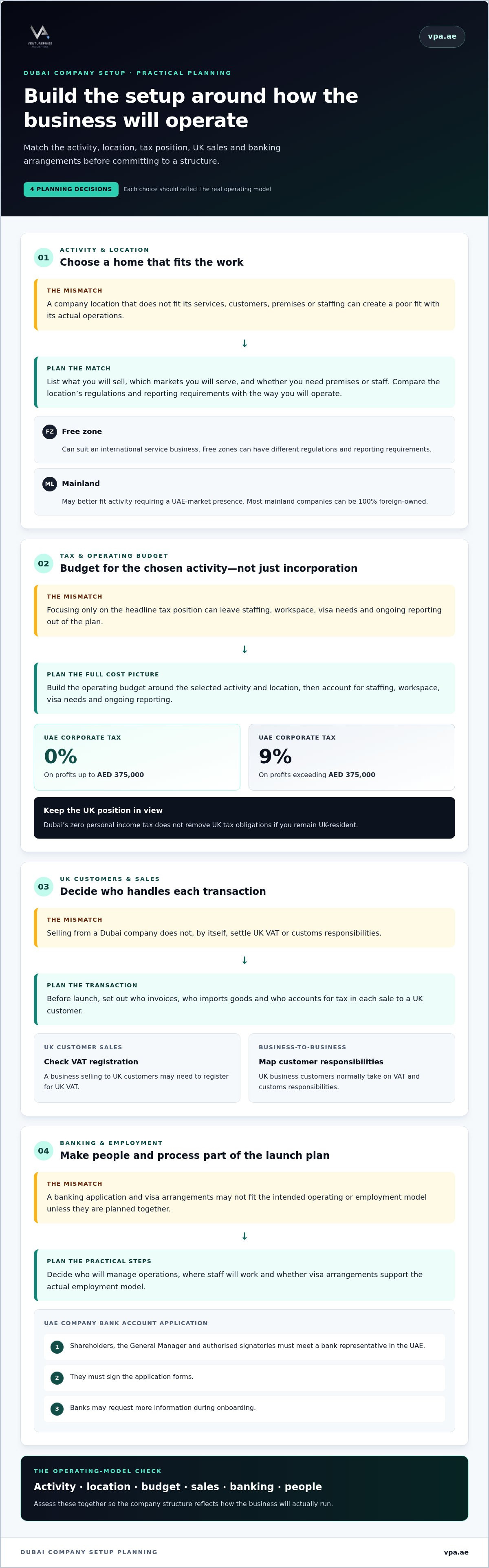
Match the business activity to the location. List the services or products you’ll sell, the markets you’ll serve and any premises or staffing needs. Free zones can have different regulations and reporting requirements. Compare those requirements with mainland options, where most companies can be 100% foreign-owned. A free zone may suit an international service business, whilst a mainland structure may better fit activity requiring a UAE-market presence.
Model the tax position and operating budget. UAE corporate tax is 0% on profits up to AED 375,000. UAE corporate tax is 9% on profits exceeding AED 375,000, according to UAE Federal Tax Authority. Build your budget around the chosen activity, location, staffing, workspace, visa needs and ongoing reporting. Dubai’s zero personal income tax is a potential advantage, but it doesn’t remove UK tax obligations if you remain UK-resident.
Plan UK sales before launch. A Dubai company can sell to UK customers, but sales may bring UK VAT obligations. A business selling to UK customers may need to register for UK VAT. For business-to-business sales, UK business customers normally take on VAT and customs responsibilities. Set out who invoices, imports goods and accounts for tax in each transaction.
Build banking and employment into the launch plan. For a UAE company bank account application, shareholders, the General Manager and authorised signatories must meet a bank representative in the UAE and sign application forms. Banks may request more information during onboarding. Decide who will manage operations, where staff will work and whether visa arrangements support the actual employment model.
Running a Dubai company while living or working in the UK
Plan operations around where you live, work and deliver services. Registering a company in Dubai does not remove UK tax obligations on UK-based work or income.
Separate your personal role from the company’s operations. Write down where you perform director, employee or self-employed duties, and what income each role generates. Work carried out in the UK can be taxable here, including employment, self-employment and directorship income. For example, a director managing customer work from a UK home should distinguish those duties from activity carried out by the Dubai company elsewhere.
Map UK activity and customers. Record whether the company has premises, staff or trading activity in the UK. A company trading from UK premises may have a UK permanent establishment and be taxed here, even if the company and its owner are abroad. Also identify UK-source income, including property income and gains relating to UK property, as the UK retains taxing rights over certain UK-source income.
Decide whether to retain a UK limited company. A UK-incorporated company remains within the UK company tax framework; moving its operations or owner to Dubai doesn’t itself change its incorporation. A UK company that leaves the UK may need to calculate and pay an exit charge. If both UK and Dubai entities operate, document their commercial roles and keep cross-border transactions at fair rates.
Build a practical routine for living in Dubai. If you move, keep the UK company’s bookkeeping organised and maintain records showing its activity, income and decisions. Separate personal and company transactions, preserve supporting documents, and review UK-source earnings alongside Dubai company income. These steps help distinguish where you live from where each business activity takes place.
Reassess the structure when circumstances change. A new UK contract, UK-based premises or a move between jurisdictions can alter the company’s operating picture. Review the structure whenever your duties, customers or location change, rather than relying on the original business setup to describe current operations.
Company formation documents and setup
Build the setup around your intended activity, ownership and operating model. A complete, consistent application file helps you establish the business efficiently and plan for international operations.
Define the business activity first. Describe what the company will sell, who its customers will be and where services or goods will be delivered. Use this scope to compare mainland and free-zone options. The selected activity influences the licence and the regulations that apply, so avoid choosing a structure before defining the work.
Map ownership and management. Prepare a clear record of shareholders, ownership interests, directors and authorised signatories. Set out who will make strategic decisions and where they will be made. This gives the formation process a coherent picture of the company, rather than treating registration as separate from how the business will operate.
Organise a working document file. Gather identity and address records for the people involved, alongside the activity description and proposed company details. Keep names and ownership information consistent across forms. Add a concise business plan explaining customers, revenue model and operational needs, so the file supports both registration and later banking discussions.
Sequence registration, licensing and banking. Submit the formation information for the chosen jurisdiction, then align licence details with the planned activity. Dubai company registration and licensing can generally take 2-6 weeks when documents are ready. Banking is a separate workstream: shareholders, the General Manager and authorised signatories must attend a UAE bank meeting and sign application forms.
Plan continuing administration before launch. UAE free zones each have their own regulations, reporting and lodgement requirements. Record the relevant filing calendar and assign responsibility for maintaining company records. If the activity, ownership or management changes, review whether the licence and company information still match the business.
For a structured route through the formation stages, explore Dubai company formation support.
Ventureprise Acquisitions: Setting Up A Company In Dubai: 6 Myths That Will Hold You Back
Ventureprise Acquisitions can help turn your Dubai business idea into a considered formation and strategic plan. If you are weighing a Dubai structure against your UK operations, its Company Formation and Strategic Planning services can help organise the setup around your activity, management and growth objectives.
Its guide, Setting Up A Company In Dubai: 6 Myths That Will Hold You Back, is a useful starting point for challenging assumptions before choosing a structure. For entrepreneurs whose plans also involve personal wealth, Private Clients Foundations amd Trustss may be relevant to broader wealth planning.
Bring your proposed activity, ownership outline and operating plans to focus the discussion on practical next steps. Contact Ventureprise Acquisitions or visit vpa.ae to explore your Dubai company plans.
Turn your Dubai plans into a clear next move
If you are asking whether you can run a Dubai company from the UK, use that question to guide your next decision: what should the business look like in practice? Define the role you want the company to play, the customers it will serve and how it fits your longer-term plans. A deliberate structure gives you a stronger basis for action than choosing a location first and resolving the operating model later.
Ventureprise Acquisitions offers Company Formation and Strategic Planning for entrepreneurs developing a Dubai business. Its guide, Setting Up A Company In Dubai: 6 Myths That Will Hold You Back, can help challenge assumptions as you refine your approach. The right starting point is a clear view of your business objectives and the decisions still to make.
Discuss your Dubai company plans with Ventureprise Acquisitions, and take the next step with purpose.
Frequently Asked Questions
What is a free zone?
A free zone is a UAE jurisdiction where businesses are established under that zone’s own licensing and administrative framework. Dubai has more than 50 free zones, and each sets its own regulations, reporting and lodgement requirements. For example, compare the permitted activities and ongoing filing responsibilities of a zone with your intended business model before selecting a location.
How does UK corporation tax apply to profits of a Dubai company managed from the UK?
UK corporation tax may apply if a Dubai-incorporated company is treated as UK tax resident because its central management and control takes place in the UK. The place of incorporation does not settle the question by itself. Map where strategic decisions are made, who makes them and how the company operates. Then assess the company’s tax position alongside your personal UK tax obligations.
Does a Dubai company need to register for UK corporation tax, VAT or Companies House?
Not simply because its owner lives in the UK. Corporation tax may apply if the company is treated as UK tax resident, while a business selling to UK customers may need to register for UK VAT. Companies House registration is separate from tax registration: a Dubai company does not become UK-incorporated merely because its owner is UK-resident.
What are the UK permanent establishment and place of effective management rules for Dubai companies?
A UK permanent establishment may arise when a company trades from premises in the UK, potentially bringing its profits into UK taxation. Separately, central management and control concerns where the company’s real strategic direction is exercised. Do not use “place of effective management” as a substitute label for either issue: assess UK premises and decision-making separately against the company’s actual operations.
What are the visa, residency and substance requirements for a Dubai free zone or mainland company?
Visa needs depend on the company’s location, licence and staffing plan. A company owner doesn’t need to live in Dubai full-time, but must enter the UAE at least once every 180 days to keep a residency visa valid. Plan genuine UAE management and business activity alongside the visa. Free zones also impose their own operational and reporting requirements.
How much does it cost to set up and maintain a Dubai company in 2026?
There isn’t one universal setup or renewal figure: the budget follows the activity, jurisdiction, licence, workspace, visa requirements and banking arrangements. Separate initial formation costs from recurring expenses such as licence renewal, reporting and bookkeeping. A practical 2026 budget should also account for staffing and the company’s actual operating footprint, rather than focusing only on the first registration payment.



Comments