

Special Purpose Vehicles in Dubai: Uses and Setup
An SPV is more than a company structure: it gives a specific project or asset its own legal entity, separate from its parent’s assets and liabilities. That separation can help ring-fence risk. For UK-based organisations, executing the right special purpose vehicle SPV setup in Dubai can also organise international investments, project finance and securitisation around a clear purpose.
Businesses often consider an SPV when they want to share risk or keep a project’s obligations distinct from wider operations. But an SPV is not a universal solution: its role depends on what it will hold, how it will be financed and whether it will remain a passive holding vehicle or carry out other activities.
At Ventureprise Acquisitions, this guide explains why companies form Dubai SPVs and how they can support risk sharing, project finance, investment holding and securitisation. It also clarifies the difference between holding assets and conducting business, helping you assess where an SPV fits into your wider strategic plans.
Table of Contents
Why Would a Company Form an SPV?
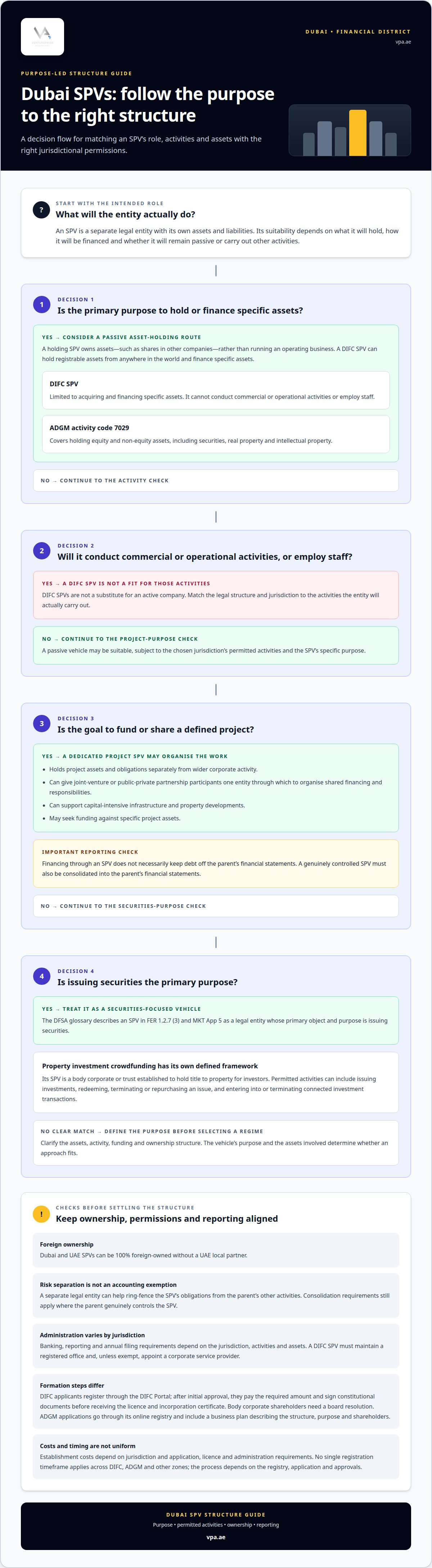
Foreign investors can own Dubai and UAE SPVs 100% without a UAE local partner. Permitted activities depend on the jurisdiction: a DIFC SPV can hold and finance specific assets, but cannot conduct commercial or operational activities or employ staff.
Ring-fencing Assets and Liabilities
An SPV is a separate legal entity with its own assets and liabilities, distinct from its parent company. That separation can ring-fence the SPV’s obligations from the parent’s other activities, helping contain exposure if a project encounters difficulty. For example, a company can place a risky project in a dedicated vehicle rather than within its wider operations. Separation does not remove consolidation requirements: a genuinely controlled SPV must be consolidated into the parent’s financial statements.
Holding and Transferring Assets
An SPV can hold assets in its own name and, where appropriate, provide a structure for transferring them. A DIFC SPV can hold registrable assets from anywhere in the world, which may suit international businesses organising assets across jurisdictions. A parent may also use an SPV to own assets that are difficult to transfer individually, then sell the SPV as a self-contained package. The vehicle’s purpose and the assets involved determine whether this approach fits.
Holding Companies and Asset Protection
A holding SPV owns assets, such as shares in other companies, rather than running an operating business. This creates a distinct ownership layer for a subsidiary, investment or joint venture, with the SPV’s liabilities separate in principle from those of its parent. The structure clarifies which entity owns an asset and carries related obligations. A parent may still need to include a controlled SPV in its financial statements.
Foreign Ownership and Permitted Activities
Dubai and UAE SPVs can be 100% foreign-owned without a UAE local partner. The permitted activity depends on the chosen jurisdiction and the vehicle’s purpose. DIFC SPVs are limited to acquiring and financing specific assets, so they are not a substitute for an active company employing staff or conducting commercial operations. ADGM activity code 7029 covers holding equity and non-equity assets, including securities, real property and intellectual property. That distinction helps align the legal structure with what the entity will actually do.
Uses for SPVs in risk sharing and project financing
A Dubai SPV is a separate legal entity created for a defined purpose, such as financing a project or holding its assets. Companies use this structure to separate a project’s funding and obligations from wider corporate activity.
In a public-private partnership, a dedicated project company can hold project assets and obligations, helping partners organise their respective exposure. The same approach can support joint ventures: participating parties use one entity to pursue a shared project and allocate its financing and responsibilities. Infrastructure and property developments are common examples of capital-intensive projects run through dedicated SPVs.
An SPV can seek funding against specific project assets, sometimes on terms its parent could not obtain directly. Financing through an SPV does not necessarily keep debt off the parent’s financial statements, so the accounting treatment should be assessed carefully. Clear purpose, ownership and reporting matter alongside the financing structure.
Banking, reporting and annual filing requirements depend on the jurisdiction, the SPV’s activities and its assets. Account arrangements and financial statements should reflect the selected regime. A DIFC SPV must maintain a registered office and, unless exempt, appoint a corporate service provider.
Establishment costs depend on the jurisdiction and its application, licence and administration requirements. DIFC charges include an application fee, an annual commercial licence fee and an additional Knowledge and Innovation Dirham fee. No single registration timeframe applies across DIFC, ADGM and other zones: the process depends on the chosen registry, application and approvals.
For DIFC, applicants register through the DIFC Portal. After initial approval, they pay the required amount and sign constitutional documents before receiving the licence and incorporation certificate. Body corporate shareholders need a board resolution. ADGM applications go through its online registry and include a business plan describing the structure, purpose and shareholders.
Key risks include choosing activities that do not fit the SPV regime, unclear project obligations, tax treatment that differs from expectations and incomplete reporting. A focused SPV structuring discussion can help connect the project’s purpose, funding and ownership with an appropriate company formation plan.
SPV uses, including investment holding and securitisation
Investment holding and securities issuance are distinct purposes, so identify the intended function before shaping the vehicle. Under the DFSA glossary, an SPV in FER 1.2.7 (3) and MKT App 5 is a legal entity whose primary object and purpose is issuing securities. That definition matters for transactions designed around securities, rather than simply holding an investment. A special purpose vehicle (SPV) setup in Dubai should reflect the transaction’s actual purpose and the assets involved.
Property investment crowdfunding has its own defined framework. According to the DFSA glossary, its SPV is a body corporate or trust established to hold title to property for investors. Permitted activities can include issuing investments and redeeming, terminating or repurchasing an issue, in whole or in part, whether for re-issue or cancellation. The SPV may also enter into or terminate investment transactions connected with those activities.
The distinction matters when a property investment crowdfunding vehicle is intended to securitise assets. Such a vehicle must have been assessed by a rating agency. For a special purpose vehicle (SPV) setup in Dubai involving this type of transaction, distinguish between holding property for investors and securitising assets. These are related investment uses, but they are not the same activity.
For investors, the practical question is whether the vehicle’s role matches the investment arrangement they are joining. A property-holding structure centres on title and investor participation; a securities-issuing structure centres on the issue and its terms. Clarifying the difference helps investors understand the entity’s purpose and which activities directly support it.
Can an SPV engage in multiple business activities?
An SPV is designed for a defined purpose, not a flexible portfolio of unrelated commercial activities. A UAE mainland company may better suit a business that needs to trade and operate, while an SPV is structured to acquire or finance specific assets. A DIFC company and an ADGM SPV also operate under distinct jurisdictional regimes, so the right choice depends on the entity’s intended activities, ownership and operating model.
For a DIFC SPV, the boundary is clear: it cannot conduct commercial or operational activities or employ staff. Its role is limited to acquiring and financing specific assets. ADGM identifies activity codes for different special purpose company or vehicle categories: 7012 covers professional investors, 7013 professional investment institutions, 7016 special purpose company activities, and 7017 special purpose vehicle activities. These codes help define the intended purpose, not authorise an SPV to operate as a general trading business.
Keep the parent’s operating functions separate. If the proposed entity needs employees, sells services or manages ongoing commercial operations, those activities do not fit the stated DIFC SPV restrictions. An SPV can hold a specific investment or asset, but adding unrelated business lines weakens the clarity of its purpose. Accounting treatment can also matter when a parent controls an SPV, as it may affect how the arrangement is reflected in financial statements.
Use the planned activity as your decision point. A vehicle holding shares in one venture has a focused ownership role; a company delivering services to customers needs an operating structure suited to that work. Compare the jurisdiction’s SPV activity categories with the actual functions, staffing needs and reporting arrangements before settling the company design. This aligns the chosen regime with the business model instead of forcing operations into a passive vehicle.
For a structure built around both ownership and active operations, discuss your company formation requirements and align the entity with its intended role.
Ventureprise Acquisitions: Setting Up A Company In Dubai: 6 Myths That Will Hold You Back
Ventureprise Acquisitions provides Company Formation and Strategic Planning to help align your SPV strategy with a considered company structure. Once you’ve identified whether the vehicle will hold assets, support investment or finance a project, the next step is to match its purpose with the right formation and ownership arrangements.
Its Company Formation offering supports businesses establishing a presence in Dubai, while Strategic Planning helps connect the structure to wider commercial goals. For entrepreneurs weighing assumptions about market entry, Setting Up A Company In Dubai: 6 Myths That Will Hold You Back provides a further perspective. These are relevant options when your plans require more than simply selecting an entity type, particularly where an SPV sits within a broader business or investment structure.
Turn the Structure Into a Clear Next Step
The value of a special purpose vehicle (SPV) setup in Dubai depends on how deliberately it supports your wider plans. Before moving ahead, define the asset or project it will serve, its relationship with the parent, and whether the business also needs an active operating company. That clarity gives the structure a practical role, rather than making incorporation the goal in itself.
Ventureprise Acquisitions can help connect those decisions through Company Formation and Strategic Planning. If you’re weighing assumptions about establishing a Dubai presence, Setting Up A Company In Dubai: 6 Myths That Will Hold You Back offers another perspective as you shape your next move.
Discuss your Dubai company structure with Ventureprise Acquisitions and take the next step with purpose.
Frequently Asked Questions
What Is a Special Purpose Vehicle (SPV)?
A special purpose vehicle (SPV) is a distinct legal entity established for a defined purpose, such as holding an investment or financing a project. It has its own assets and liabilities, separate from its parent’s. For example, a parent company could establish an SPV to hold shares in a particular venture, keeping ownership of that investment within a dedicated entity.
What are the uses of a Dubai SPV?
A Dubai SPV can support project financing, joint ventures, investment holding and securitisation. It may also be used to ring-fence a captive insurer’s self-insurance arrangement from a parent’s other operations and liabilities. The appropriate use depends on the chosen jurisdiction and the SPV’s permitted purpose. For a joint venture, partners can use a dedicated entity to hold project interests and organise their shared obligations.
Why set up an SPV in DIFC?
A DIFC Prescribed Company may suit a defined asset-holding or financing purpose, including holding registrable assets from anywhere in the world. It is treated as a private company under DIFC Companies Law and can have multiple share classes and shareholder agreements. These features can help structure ownership between investors. A DIFC SPV must maintain a registered office, and most must appoint a corporate service provider.
Can an SPV be used for international investments?
Yes. A DIFC SPV can hold registrable assets from anywhere in the world, so it may hold shares or other investments outside the UAE. For example, an investor could use a dedicated vehicle to own an interest in an overseas company. The SPV’s jurisdiction, purpose and asset-holding permissions shape the structure; international ownership does not turn a passive SPV into an operating business.
Do an SPV’s Assets and Liabilities Appear on the Parent Company’s Balance Sheet?
SPVs may appear in the parent’s consolidated financial statements if accounting standards require consolidation. Whether an SPV is included in a parent’s consolidated financial statements depends on the applicable accounting treatment and circumstances. This accounting treatment is distinct from the SPV’s status as a separate legal entity. Investors reviewing a group should examine both the SPV’s statements and those of its parent.
How are SPVs used?
Businesses use SPVs to give a particular asset, investment or transaction its own legal vehicle. For example, a company can transfer loans or receivables into an SPV, which may issue securities backed by that asset pool. Investors can then assess the assets and related payment flows as part of the transaction. Other uses include holding shares in a venture or organising a project with multiple partners.



Comments