

UK Dubai Double Tax Treaty: How It Affects Your Tax
The treaty doesn’t make cross-border tax disappear; it sets rules for which country may tax particular income and when relief can apply. This is the UK Dubai double taxation treaty explained in practical terms: the UK-UAE Double Taxation Convention allocates taxing rights, while Article 7 generally lets the country where a business is resident tax its profits unless the business operates in the other country through a permanent establishment.
If you work, invest or build a business across the UK and Dubai, you may expect the treaty to prevent the same income from being taxed twice. The outcome depends on factors such as tax residence, income type and where business activity takes place.
This guide explains how the treaty works, what happens if you’re resident in both countries, and how its rules apply to employment income and business profits. It also explains why the permanent establishment test matters for cross-border operations and how treaty relief can affect your tax position.
Table of Contents
What Is Double Taxation and Why Does It Matter?
Double taxation can arise when UK and UAE rules both apply to the same income. The treaty coordinates taxing rights and relief, but the outcome depends on residence, income type and where work is performed or assets are located.
How Double Taxation Arises
Double taxation occurs when two countries tax the same income or gains under their domestic rules. One country may tax you because you’re resident there, while the other taxes income arising within its borders.
For example, a UK resident earning consultancy income from work in the UAE may need to consider both residence-based and source-based rules. Treaty relief may allow a credit for tax paid in one country against liability in the other, subject to applicable limits. For employment income taxed in both countries, relief is restricted to the lower of the UK tax suffered and the home-country tax due on that income.
Income and Gains Examples
The income’s source and category help determine which country can tax it. UK rental income is taxed where the property is located, so a UK resident with a UAE rental property may need to consider UAE rules on that rent as well as UK rules based on residence.
Employment income is generally connected to where duties are performed. A consultant’s income also needs to be assessed in light of residence and where the business operates. UK dividends and capital gains have distinct treaty and domestic tax treatments; the outcome depends on the asset or payment and the person’s circumstances. A credit may relieve overlapping tax, but it does not automatically remove every UK liability.
Employment Income and the 183-Day Exemption
Under Article 14, employment income is usually taxed where the work is carried out, subject to a 183-day exception. Spending more than 183 days in the UK in a single tax year is an automatic UK residence test.
The day count alone doesn’t settle the position. Residence, the employer and how the remuneration is borne also matter under the relevant treaty conditions. A UK employee posted to the UAE for six months who remains UK tax resident and works abroad for less than 183 days continues to be taxable in the UK on salary.
From 6 April 2025, the UK’s Foreign Income and Gains regime gives qualifying new arrivals a four-year exemption on foreign income and gains, subject to eligibility conditions. Overseas Workday Relief is another relevant consideration for qualifying employment duties performed abroad; the treatment depends on eligibility and the work undertaken.
To claim relief, follow the relevant tax authority’s claim process and retain records of residence, income, work locations and foreign tax paid. Treaty disputes may be raised through the Mutual Agreement Procedure within three years of first receiving notification of the tax action believed to breach the treaty.
What Happens if You Are a Resident in Both the UK and the UAE?
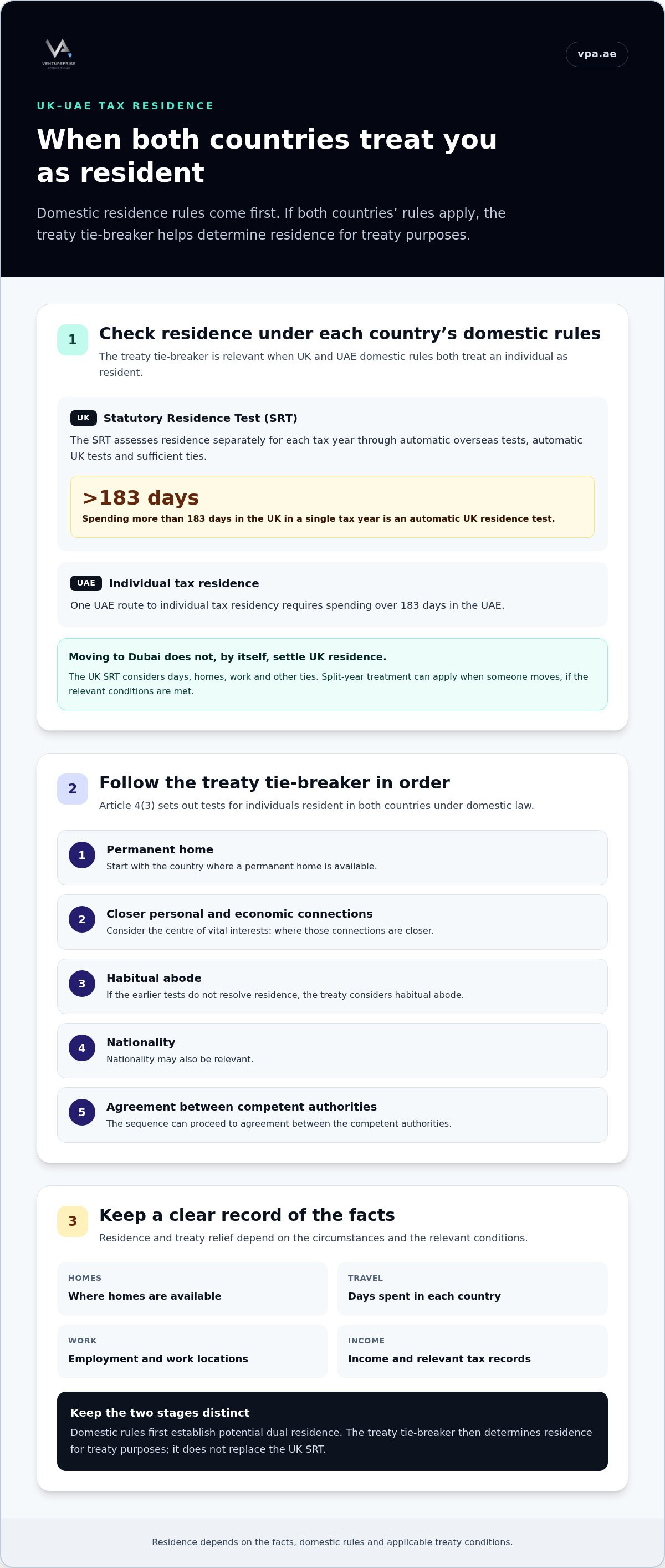
UK and UAE domestic rules may each treat an individual as resident. The treaty’s tie-breaker tests then help determine residence for treaty purposes.
UK and UAE Tax Residency
The UK Statutory Residence Test (SRT) assesses residency separately for each tax year using automatic overseas tests, automatic UK tests and sufficient ties. According to HM Revenue & Customs, spending more than 183 days in the UK in a single tax year is an automatic UK residence test.
One UAE route to individual tax residency requires spending over 183 days in the UAE. Moving to Dubai doesn’t itself settle UK status: the SRT considers days, homes, work and other ties. Split-year treatment can apply when someone moves, dividing a tax year into UK and overseas parts if the relevant conditions are met.
Treaty Residence Tie-Breaker Rules
Article 4(3) of the UK-UAE treaty provides tie-breaker rules for individuals resident in both countries under domestic law. The sequence starts with the country where a permanent home is available, then considers closer personal and economic connections, known as the centre of vital interests.
If those tests do not resolve residence, the treaty considers habitual abode. Nationality may also be relevant, followed by agreement between the competent authorities. The treaty does not replace the SRT: domestic rules first establish potential dual residence, and the tie-breaker determines treaty residence when both countries’ rules apply.
Anti-Avoidance Rules and Treaty Risks
Treaty relief depends on meeting its conditions, so residency and income arrangements should reflect the actual facts. The key risk is treating the treaty as a blanket exemption from UK tax: it allocates taxing rights and relief but does not automatically remove domestic obligations. Keep records of homes, travel, employment and income to support a clear account of your position.
Moving to the UAE also doesn’t automatically remove UK inheritance tax exposure. Since 6 April 2025, UK inheritance tax on overseas assets can depend on long-term UK residence, which may continue after departure; a long-term resident is someone who has lived in the UK for 10+ years. The possible tail period can extend up to 10 years.
What Is the UAE-UK Double Tax Treaty?
The UK-UAE Double Taxation Convention sets rules for taxing cross-border income and profits. Signed on 12 April 2016, it entered into force on 25 December 2016. If you searched for “UK Dubai double taxation treaty explained”, the key issue is how its provisions apply to particular income and business activity.
Allocating Taxing Rights
A double taxation agreement allocates taxing rights between countries and provides ways to relieve tax charged twice. Its rules distinguish between income types and link taxation to residence, source or business activity.
For example, a UK resident receiving UAE-source income must consider both countries’ rules and the treaty article relevant to that income. Relief may take the form of a credit against tax due, or an exemption where the treaty provides for one. The agreement coordinates domestic tax systems; it does not establish a shared tax rate for the UK and UAE. Identifying the relevant article is therefore central to assessing a cross-border payment.
Taxes Covered by the Treaty
The convention covers UK Income Tax, Corporation Tax and Capital Gains Tax, alongside relevant UAE taxes on income and corporate profits. The rules apply to eligible residents of the UK, the United Arab Emirates, or both, including residents of the UAE’s emirates.
It addresses income and profits, not UK Inheritance Tax. That distinction matters for a UK resident with overseas assets: treaty relief for income tax doesn’t itself remove inheritance tax exposure. Most provisions took effect from 1 January 2017, while the agreement includes rules for dividends, interest and royalties. Understanding which tax is in question helps identify whether the treaty applies.
Mutual Agreement Procedure
The Mutual Agreement Procedure (MAP) gives taxpayers a route to ask the UK and UAE competent authorities to resolve taxation they believe conflicts with the convention. A request may be made within three years of first receiving notification of the tax action believed to breach the treaty.
MAP focuses on applying the agreement to a specific case, such as a dispute over residence or which country may tax particular income. The phrase “UK Dubai double taxation treaty explained” points to these practical steps: identify the tax action, then assess whether it conflicts with the relevant treaty provision. Keep assessments, residence records and income details together for the authorities’ review.
Business profits and cross-border operations
A company operating between the UK and UAE must distinguish where it is resident from where it conducts business. Under Article 7 of the treaty, business profits are generally taxable in the country where the business is resident, unless it operates in the other country through a permanent establishment.
When does a permanent establishment matter?
Article 5 defines a permanent establishment and gives a place of management, a branch and an office as examples. If a UAE-resident company has an office in the UK, that presence may bring the permanent-establishment question into focus. The same principle applies to a UK business operating through a qualifying presence in the UAE.
A company’s registration location is only part of the picture. If a Dubai company’s management and commercial activity extend into the UK, its operating footprint matters when assessing whether the UK can tax its profits under the treaty. The treaty does not exempt every cross-border profit from tax. It sets the conditions under which the other country may tax business profits through a permanent establishment.
Build a clear picture of cross-border activity
For businesses, the practical task is to understand the company’s residence status, its activities in each country and any fixed business presence. A branch or office is specifically identified in Article 5, so records showing where management decisions and operations occur can help explain the structure. The company’s circumstances and the nature of its activities shape the analysis.
Keep operating profits distinct from dividends. The treaty has separate provisions for dividends, so a payment to an owner is not automatically treated as the company’s trading profit. Map the business structure, operating locations and payment flows between the UK and UAE before drawing conclusions about taxable profits or potential relief. This helps decision-makers assess the cross-border tax position more precisely.
Planning a UK-UAE business structure? Discuss your cross-border business plans and how company formation and strategic planning can support them.
Ventureprise Acquisitions: Setting Up A Company In Dubai: 6 Myths That Will Hold You Back
Ventureprise Acquisitions supports Dubai market entry through Company Formation and Strategic Planning. If you’re considering establishing a business in Dubai, these services can help align your commercial plans with the company structure and cross-border activity you’re assessing.
The guide Setting Up A Company In Dubai: 6 Myths That Will Hold You Back is a useful starting point for entrepreneurs examining assumptions before shaping a market-entry plan. Consider the business rationale, where operations will take place and how those facts relate to the treaty’s permanent-establishment rules. This planning complements, rather than replaces, an understanding of the applicable tax rules.
For support with Dubai Company Formation and Strategic Planning, contact Ventureprise Acquisitions or visit vpa.ae.
Turn cross-border tax insight into a stronger plan
Understanding the UK Dubai double taxation treaty matters when applying its rules to decisions ahead. Before expanding, align your commercial model, management arrangements and movement of profits with how the business will actually operate. A tax-aware plan starts with clear assumptions, then tests how those choices affect your position in both countries.
Ventureprise Acquisitions can support that planning through Company Formation and Strategic Planning. Its guide, Setting Up A Company In Dubai: 6 Myths That Will Hold You Back, can also help entrepreneurs challenge assumptions before committing to a Dubai market-entry approach. The next step is to turn your intended structure and cross-border goals into a considered business plan.
Contact Ventureprise Acquisitions to discuss your Dubai business plans and move forward with clarity.
Frequently Asked Questions
Who Is Eligible To Claim Tax Relief Under the UK-UAE Tax Treaty?
People and businesses treated as resident in the UK, the UAE or both may qualify, depending on the treaty article and income involved. For example, a UK resident receiving income taxed in the UAE would assess whether the relevant provision allows a credit or exemption. Eligibility is not automatic: the person must meet the article’s conditions, and relief applies only to the covered tax and income.
Do I still pay UK tax if I live in Dubai and claim the treaty?
Yes, UK tax may still apply after you move to Dubai. UK residence is assessed under the Statutory Residence Test, while UK-source income may remain taxable under UK rules. For example, UK rental income is generally taxed where the property is located. The treaty coordinates taxing rights and relief; living in the UAE does not make every UK income source exempt.
How are business profits taxed under the UK-UAE treaty?
Article 7 generally allows the country where a business is resident to tax its profits, unless it operates in the other country through a permanent establishment. A Dubai-resident company earning profits through a qualifying UK business presence may therefore face UK tax on profits attributable to that presence. The company’s activity and operational footprint matter; incorporation in one country alone does not settle every tax question.
What Are the Residency Rules for Legal Entities in the UK and the UAE?
Each country’s domestic rules determine whether a company is resident there; the treaty then addresses cases where both countries claim residence. For a non-individual resident in both states, the competent authorities may seek agreement on treaty residence. If they do not agree, the entity cannot claim convention benefits except those under Articles 21, 22 and 23. The company’s status can therefore affect its access to treaty relief.
What is the UK-UAE double taxation agreement and when did it take effect?
It is the convention allocating taxing rights and providing mechanisms for relief between the UK and UAE. The countries signed it on 12 April 2016, and it entered into force on 25 December 2016. Most provisions took effect from 1 January 2017. It covers specified income and corporate taxes, rather than every tax in either country, so the relevant treaty article matters for each claim.
How does the treaty determine tax residence for UK and UAE residents?
For individuals resident under both countries’ domestic rules, the treaty applies tie-breaker tests. It first considers where a permanent home is available, then the individual’s centre of vital interests. If those tests do not resolve residence, habitual abode and nationality may be considered, with agreement between competent authorities as a further route. This treaty assessment is distinct from determining UK residence under the Statutory Residence Test.



Comments